Many buyers underestimate why angle steel quality varies until inconsistent dimensions, weak mechanical performance, or poor surface finish begin affecting cost and project reliability.
For anyone comparing suppliers, standards, and manufacturing routes, understanding why angle steel quality varies helps reduce sourcing risk and avoid costly structural problems later.
What does angle steel quality really include?
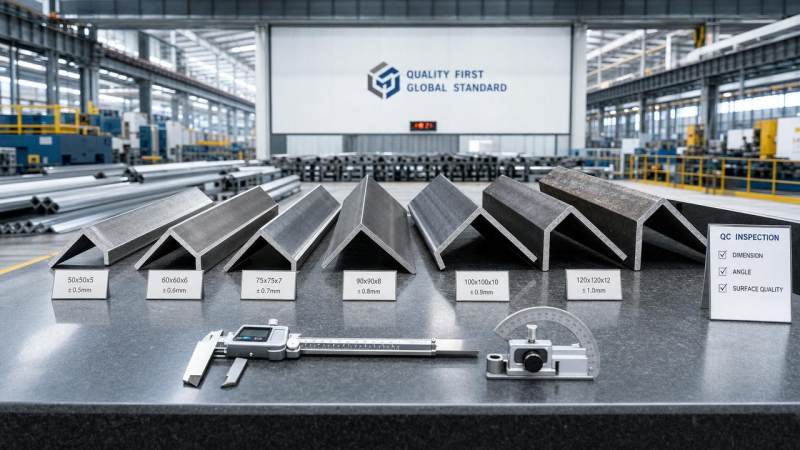
The first step in understanding why angle steel quality varies is defining quality correctly.
Quality is not only about appearance. It includes chemistry, strength, dimensional accuracy, straightness, angle consistency, edge condition, and coating performance.
Two angle bars may look similar at first glance. Yet they can perform very differently during welding, drilling, bending, galvanizing, or long-term structural service.
This explains why angle steel quality varies more than expected in real procurement.
Typical quality indicators include:
- leg width and thickness tolerance
- inside and outside angle precision
- yield strength and tensile strength
- surface scale, rust, and pits
- length accuracy and straightness
- compliance with ASTM, EN, JIS, or GB
If one of these factors is unstable, the final product may still be sold, but practical value drops.
Why angle steel quality varies between suppliers?
The biggest reason why angle steel quality varies is that production control differs widely from one mill to another.
Raw material selection matters first. Steel made from stable billets usually offers better chemistry consistency and more predictable mechanical properties.
Rolling equipment is another factor. Older mills often struggle to maintain precise leg dimensions and uniform thickness along the full length.
Temperature control during hot rolling also matters. Poor control can create internal stress, shape deviation, or variable hardness.
Cooling practices strongly affect flatness and straightness. Uneven cooling may cause twisting, bowing, or inconsistent mechanical performance.
Inspection standards differ too. Some suppliers check every batch carefully. Others only test limited items or rely on basic paperwork.
This is one practical answer to why angle steel quality varies even when quotations look similar.
Key production differences that create variation
- billet grade and traceability
- rolling line precision
- heat treatment or cooling consistency
- surface cleaning and finishing control
- final inspection depth
- packing and storage conditions
How do standards, grades, and tolerances explain quality differences?
Another reason why angle steel quality varies is that buyers often compare products under different technical assumptions.
For example, Q235, Q345, A36, and SS400 are not identical. They may overlap in use, but chemistry and property ranges are not always the same.
Dimensional tolerance also changes by standard. A bar acceptable under one standard may feel inaccurate under another project requirement.
Surface class expectations differ too. Some projects accept normal mill scale. Others require cleaner surfaces for coating or exposed structures.
When specification details are incomplete, suppliers may quote different quality levels for the same product name.
That is a common commercial reason why angle steel quality varies in the market.
How can visible and hidden defects affect structural use?
A useful way to understand why angle steel quality varies is separating visible defects from hidden risks.
Visible defects include edge cracks, uneven legs, severe rust, pits, rolling marks, and obvious twist.
Hidden defects may include unstable chemistry, weak yield strength, poor ductility, or internal stress that appears during fabrication.
In steel stairs, racks, supports, towers, and frames, these problems can increase welding difficulty and assembly time.
Poor angle consistency can cause misalignment in bolted connections. Thickness deviation may change load capacity calculations.
If corrosion protection is planned, rough surface quality may raise blasting and coating cost.
In many projects, why angle steel quality varies eventually becomes a question of total installed cost, not only material price.
In related structural systems, profile selection also matters. For purlins, wall beams, and light framing, C Channel Beam is often chosen.
It can be produced in Q195, Q235, Q345, A36, SS400, and s235jr, with galvanized, powder coated, or black varnish surfaces.
Available with 1mm-12.mm thickness and 6m, 9m, or 12m lengths, it supports steel structure buildings and mechanical light industry manufacturing.
This comparison shows a broader point. Different structural profiles require different control priorities, so quality evaluation should match the application.
What should be checked before buying angle steel?
A careful review process reduces uncertainty and answers why angle steel quality varies before shipment arrives.
Practical checkpoints
- Confirm the exact grade, standard, and tolerance requirement.
- Request mill test certificates with heat number traceability.
- Ask for real production photos, not only catalog images.
- Check dimensional reports for leg width, thickness, and length.
- Clarify surface condition, coating need, and packing method.
- Verify delivery lead time and consistency across batches.
If the material will be cut, welded, or galvanized later, request property stability rather than only minimum strength.
If the project needs repeated supply, sample approval should be linked to mass production controls.
That approach is especially useful when studying why angle steel quality varies from batch to batch.
Does lower price always mean lower quality?
Not always, but price gaps often signal differences that deserve checking.
A lower price may come from thinner actual section weight, looser tolerance, lower inspection frequency, or shorter coating life.
It may also reflect efficient production, stable raw material sourcing, or better capacity planning.
The key is identifying what is included and what is missing in the quote.
When buyers ask why angle steel quality varies, the financial answer is usually hidden in specification detail and process discipline.
Instead of comparing only ton price, compare usable value:
- rework rate during fabrication
- material loss from dimensional deviation
- coating preparation cost
- delivery reliability
- consistency across repeat orders
FAQ summary: how to judge why angle steel quality varies
Why angle steel quality varies is not a mystery once production, standards, and inspection are reviewed together.
Reliable structural steel sourcing depends on clear specifications, verified documents, and realistic quality expectations for the intended application.
Hongteng Fengda, as a structural steel manufacturer and exporter from China, supports global projects with stable production, strict quality control, and customized structural steel solutions.
For the next step, prepare a technical checklist, confirm the required standard, and compare suppliers using measurable quality data instead of price alone.
Please give us a message


Please enter what you want to find