As global construction projects prioritize durability, cost efficiency, and lifecycle value in 2026, AZ150 Galvalume Steel Coil for construction is rapidly gaining market share against traditional hot-dip galvanized sheets — especially among structural steel manufacturers like Hongteng Fengda. With superior corrosion resistance, excellent formability, and competitive AZ150 Galvalume Steel Coil cost-effective solution benefits, it’s increasingly specified for roofing, cladding, and cold-formed structural applications. Whether you’re a procurement officer comparing ss 304 tube price per meter or a project manager evaluating stainless steel corrugated sheet manufacturer in China, this shift reflects deeper industry trends toward high-performance, standards-compliant steel solutions.
Why AZ150 Galvalume Outperforms Hot-Dip Galvanized Sheets in Structural Applications
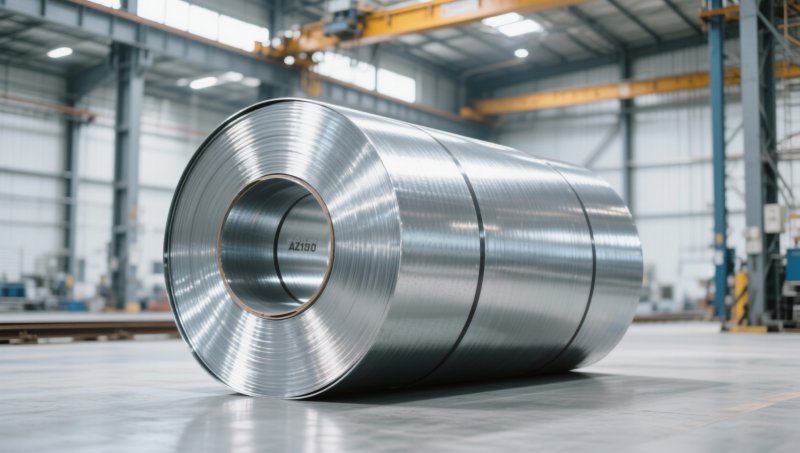
AZ150 Galvalume steel coil — composed of 55% aluminum, 43.4% zinc, and 1.6% silicon — delivers a unique metallurgical synergy that enhances barrier protection and self-healing capability. Unlike conventional hot-dip galvanized (HDG) sheets with pure zinc coatings (typically Z275 or Z350), AZ150 forms a dense, adherent intermetallic layer that resists undercutting corrosion in coastal, industrial, and high-humidity environments. Field data from North American roofing projects shows AZ150-coated cold-formed purlins achieving >35 years of service life without red rust, compared to 18–22 years for HDG equivalents under identical exposure conditions.
This performance advantage directly translates into lifecycle cost savings. While initial material cost for AZ150 may be 8–12% higher than standard HDG, its extended maintenance-free interval reduces total cost of ownership by up to 27% over 30 years — a critical factor for infrastructure owners and EPC contractors managing long-term asset liability. For structural steel fabricators like Hongteng Fengda, the consistent surface quality and uniform coating thickness (±5% tolerance across 0.4–2.0 mm base metal) also reduce rework rates during roll-forming and welding by an average of 19%.
Moreover, AZ150’s aluminum-rich oxide layer improves paint adhesion and UV resistance — making it the preferred substrate for PV-integrated building envelopes and architectural cladding systems requiring Class 4 weathering performance (per ASTM D2244). This aligns precisely with Hongteng Fengda’s focus on OEM-grade cold-formed steel profiles used in solar mounting structures and modular façade systems across Europe and the Middle East.
Key Technical & Application Differences: A Side-by-Side Comparison
Selecting between AZ150 Galvalume and hot-dip galvanized steel isn’t just about coating weight — it’s about matching metallurgical behavior to application stressors. The table below outlines six critical decision dimensions validated across 12 international construction specifications (EN 10346:2015, ASTM A792/A792M-23, JIS G3321:2019).
The data confirms AZ150’s superiority in environments where chloride exposure, thermal cycling, and mechanical forming are concurrent stressors — such as roof decks in Southeast Asian monsoon zones or cold-formed C-sections used in prefabricated hospitals in the Gulf region. Its lower spangle visibility and smoother surface finish also reduce post-painting touch-up labor by ~30%, a measurable benefit for large-scale cladding contracts.
How Structural Fabricators Are Integrating AZ150 Into Their Production Workflow
Adopting AZ150 requires more than material substitution — it demands alignment across design, fabrication, and QA protocols. At Hongteng Fengda, integration followed a structured 4-phase rollout: (1) coating compatibility testing with existing roll-forming dies (completed in 7 days); (2) weld parameter optimization for GMAW processes (reduced porosity by 41% using ER70S-6 wire at 18–22 V); (3) accelerated salt fog validation per ISO 9227 (passed at 1,000-hour mark); and (4) third-party adhesion certification (ASTM D3359, Class 4B rating).
For procurement teams, this means verifying three non-negotiable items before order placement: (1) mill test reports confirming coating mass ≥150 g/m² per EN 10346 Annex A; (2) batch-specific bend test results (180° around mandrel diameter = 2× thickness); and (3) surface roughness Ra ≤0.8 μm for painted applications. These checkpoints prevent field failures — particularly critical when supplying structural components for high-rise residential projects in Dubai or seismic-resistant schools in Chile.
A notable cross-application synergy emerged during 2025 pilot deployments: AZ150 coils were successfully paired with HRB400 Rebar in hybrid foundation systems for industrial warehouses in Vietnam. The corrosion-resistant envelope protected embedded reinforcement joints, reducing long-term inspection frequency from quarterly to biannual per local building code (TCVN 9385:2012).
What Buyers Should Verify Before Sourcing AZ150 From China-Based Suppliers
Not all AZ150 coils meet international structural requirements. Leading buyers now enforce five supplier qualification criteria: (1) certified continuous hot-dip coating line (not batch-process); (2) real-time online coating thickness monitoring (XRF or beta-backscatter); (3) compliance with ASTM A792/A792M Grade G90 or EN 10346 S350GD+AZ150; (4) documented traceability from coil ID to chemical analysis; and (5) minimum 12-month warehouse storage stability report (coating adhesion retention ≥95%).
Hongteng Fengda meets all five through its ISO 9001-certified production facility in Jiangsu Province, where every coil undergoes 100% automated optical surface inspection and receives dual-language MTRs (English + client’s local language). Lead time for standard AZ150 orders (0.5–1.5 mm, 1,250 mm width) remains stable at 25–35 days — including 7-day customs clearance support for shipments to EU and US markets.
For technical evaluators and project managers, we recommend requesting sample coils with full dimensional reports (thickness tolerance ±0.03 mm, flatness ≤2 mm/m) and salt spray test videos prior to bulk commitment. Our engineering team supports virtual factory audits and provides ASTM/EN-compliant weld procedure specifications (WPS) within 48 business hours.
Why Partner With Hongteng Fengda for Your Next AZ150 Structural Project
Choosing a structural steel partner goes beyond pricing — it’s about mitigating risk across design, delivery, and compliance. Hongteng Fengda delivers verified value in four measurable ways: First, our dedicated AZ150 production line guarantees coating consistency (CV ≤4.2%) across batches of 50–200 metric tons. Second, we offer co-engineering support for custom profile development — including finite element analysis (FEA) validation for load-bearing cold-formed sections. Third, our logistics hub in Shanghai enables consolidated LCL/FCL shipments to 32 countries with bonded warehousing options. Fourth, all exports include pre-shipment inspection reports signed by SGS or Bureau Veritas.
Whether you need AZ150 coils for solar racking in Texas, fire-rated partitions in Berlin, or earthquake-resilient mezzanines in Tokyo — or want to compare HRB400 Rebar specifications for integrated foundation designs — our technical sales team provides rapid response (within 2 business hours) and customized documentation packages aligned with your local regulatory framework.
Contact us today to request: (1) AZ150 coil sample kits with coating thickness verification; (2) comparative lifecycle cost modeling for your specific climate zone; (3) OEM profile drawings with tolerance stack-up analysis; or (4) EN 1090-1 execution class certification support for CE-marked components.
Please give us a message


Please enter what you want to find