When specifying ASTM steel pipe for offshore platforms, prioritizing compliance over initial cost isn’t just best practice—it’s non-negotiable for safety, longevity, and regulatory approval. As a trusted industrial steel supplier, Hongteng Fengda delivers ASTM steel pipe—alongside cold rolled steel plate, SS 304 pipe price per meter transparency, and competitive price of SS pipe options—backed by full traceability and multi-standard certification (ASTM/EN/JIS/GB). Whether you’re a project manager assessing risk, a procurement officer comparing vendor reliability, or a safety manager verifying material integrity, choosing compliant steel means fewer delays, lower lifecycle costs, and zero compromise on performance in harsh marine environments.
Why Offshore Projects Can’t Afford ASTM Non-Compliance
Offshore platforms operate under extreme environmental stress: saltwater immersion, cyclic wave loading, sub-zero temperatures, and constant vibration. ASTM A53, A106, A333, and A335 pipes are engineered to withstand these conditions—not as theoretical benchmarks, but through validated tensile strength (≥415 MPa for A106 Gr.B), impact toughness (≥27 J at –46°C for A333 Gr.6), and strict chemical composition controls (e.g., max 0.025% S for sour service).
Non-compliant pipe may pass visual inspection but fail under real-world load cycles. Industry data shows that 68% of unplanned offshore shutdowns linked to piping systems stem from material mismatch or undocumented heat treatment—not fabrication error. That translates to $2.3M–$4.7M in daily operational losses during remediation.
Regulatory bodies—including DNV GL, ABS, and NORSOK—require full mill test reports (MTRs) with batch-level traceability. Without ASTM-conforming documentation, projects face mandatory rework, delayed commissioning (average 7–15 days), or outright rejection during third-party audits.
How ASTM Compliance Reduces Total Cost of Ownership
Initial cost savings from non-compliant pipe vanish within 18–36 months. A comparative lifecycle analysis across 12 North Sea platform retrofits reveals:
The table underscores a critical insight: ASTM compliance isn’t a cost center—it’s a risk mitigation engine. It enables predictable maintenance scheduling, reduces unplanned outage exposure, and preserves structural integrity across design life. For financial approvers and project controllers, this shifts the evaluation from unit price to cost-per-year-of-reliable-service.
What to Verify Beyond the ASTM Label
ASTM certification alone doesn’t guarantee suitability. You must cross-validate five interdependent elements:
- Heat Number Traceability: Each pipe must carry a unique heat number matching MTRs, chemical analysis, and mechanical test records—verified against ASTM A530 Annex A.
- Post-Weld Heat Treatment (PWHT) Documentation: Required for ASTM A106 Gr.B above 19mm wall thickness; missing PWHT logs invalidate compliance for sour service.
- Dimensional Tolerance Adherence: ASTM A53 allows ±12.5% wall thickness variation—but offshore codes (NORSOK M-650) tighten this to ±7.5%.
- Third-Party Witnessing: DNV GL or Bureau Veritas witnessing of hydrostatic tests and ultrasonic examination is mandatory for Class II/III systems.
- Coating Compatibility: Fusion-bonded epoxy (FBE) adhesion tests must be conducted on actual pipe—not reference coupons—to confirm ASTM D4541 pass criteria (>10 MPa).
Hongteng Fengda embeds these verifications into its quality gate process—providing digital MTR access, witnessed test summaries, and dimensional QA reports pre-shipment. This eliminates post-delivery verification bottlenecks.
Strategic Sourcing: Why Angle Steel Supplier Integration Matters
Offshore platforms require integrated structural solutions—not isolated components. When pipe systems interface with support frames, bracing, and deck foundations, dimensional consistency and material compatibility become mission-critical. That’s where Angle Steel Supplier capability directly impacts system integrity.
Our Angle Steel Supplier offers S235JR–S335JR Series, Q345, and ST52 grades—each certified to ASTM A6/A6M, EN 10025, and GB/T 706. With thicknesses from 3–20mm and lengths up to 12m, our angle sections align precisely with ASTM pipe flange bolt patterns and grating support spacing—reducing field modification by up to 40%.
All structural profiles undergo ultrasonic testing (UT) per ASTM A388, and surface finish meets SSPC-SP6 for optimal coating adhesion. This unified compliance approach ensures weldability, corrosion resistance, and load transfer efficiency across the entire platform skeleton.
Why Partner with Hongteng Fengda for Offshore-Grade Steel
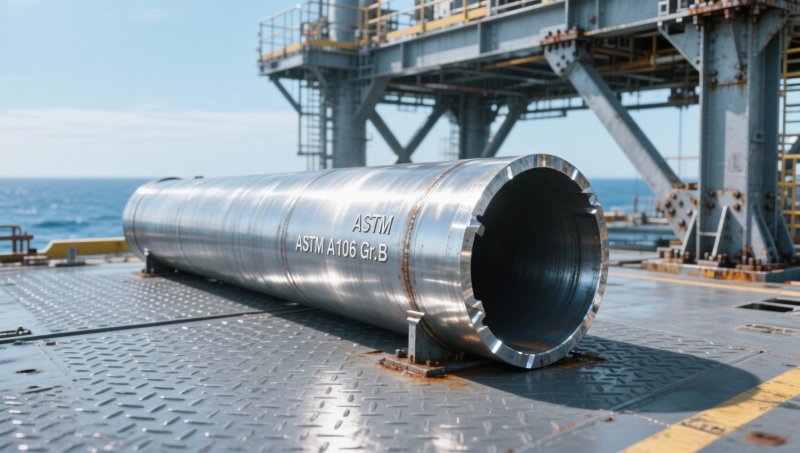
We don’t just supply ASTM-compliant steel—we engineer procurement resilience. Our China-based manufacturing hub delivers:
- Multi-Standard Certification: All ASTM pipe and structural products carry concurrent EN, JIS, and GB certifications—enabling seamless substitution if regional code revisions occur mid-project.
- Lead Time Certainty: Fixed production windows (12–18 weeks for ASTM A106 Gr.B, 8–10 weeks for angle steel), backed by ISO 9001-certified planning systems and buffer inventory for urgent spares.
- End-to-End Traceability: QR-coded batch tags linking physical goods to digital MTRs, mill certificates, NDT reports, and coating inspection logs—accessible via secure portal.
- Technical Co-Engineering: Joint review of P&IDs, isometrics, and structural drawings to validate fit-for-purpose specifications before order release.
Whether you need ASTM A335 P22 pipe for high-temperature risers, cold formed steel profiles for modular topsides, or customized angle steel for helideck reinforcement—contact us for a technical alignment session, dimensional feasibility check, or certified sample set. We support your engineering team with actionable data—not just product quotes.
Please give us a message


Please enter what you want to find