Choosing the right industrial steel plate grade can significantly affect project cost, performance, and long-term reliability. For business decisions, the gap between over-specifying and proper selection often becomes a budget issue.
In steel-related projects, grade choice shapes raw material price, fabrication complexity, inspection needs, and replacement risk. A smart industrial steel plate decision balances strength, corrosion resistance, weldability, compliance, and supply continuity.
When the grade fits the actual environment, cost control improves without sacrificing safety. When it does not, hidden expenses appear through machining delays, thicker sections, quality disputes, or premature service failure.
Why industrial steel plate grade decisions vary by project scenario
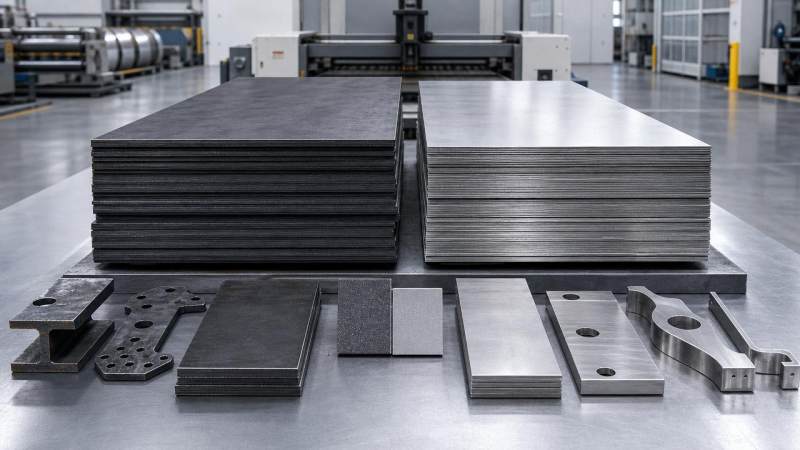
Not every industrial steel plate serves the same duty. Structural frames, pressure-related parts, transport equipment, and corrosive processing lines all ask for different performance priorities.
A lower-cost carbon plate may work well in dry indoor structures. The same plate may create severe lifecycle cost issues in humid, chemical, or hygienic operating conditions.
Grade selection also changes downstream work. Cutting speed, forming behavior, weld preparation, filler compatibility, and inspection methods can either support production efficiency or increase workshop hours.
For international sourcing, standards matter as much as chemistry. ASTM, EN, JIS, and GB equivalence must be checked carefully, because nominally similar industrial steel plate grades may differ in impact values or tolerances.
Scenario 1: Structural load applications where strength drives total cost
In buildings, platforms, support systems, and heavy equipment frames, strength is often the first filter. A higher-strength industrial steel plate can reduce section thickness and lower total steel tonnage.
That benefit is not automatic. Some high-strength grades need stricter welding control, which may increase labor cost and inspection time. The cheapest plate per ton may not be the cheapest installed solution.
Key judgment points
- Required yield strength versus actual design demand
- Thickness reduction potential and weight savings
- Welding procedure qualification requirements
- Availability in required sizes and lead times
If a stronger grade cuts weight but extends fabrication time, the cost advantage may disappear. The right industrial steel plate choice should be evaluated across material, labor, and schedule together.
Scenario 2: Corrosive or hygienic environments where grade choice prevents hidden losses
Chemical plants, food lines, marine-adjacent facilities, and washdown areas face corrosion-related pressure. In these cases, selecting an unsuitable industrial steel plate often causes the most expensive mistakes.
Surface staining, pitting, contamination risk, and unplanned replacement can quickly exceed any upfront savings. Corrosion resistance should be matched to media, temperature, cleaning chemicals, and service frequency.
For applications needing strong corrosion resistance and fabrication flexibility, 304L Stainless Steel Plate can be a practical option. It offers excellent formability, easy welding, and broad use across chemical, food, transport, and equipment applications.
Typical properties include tensile strength of at least 520, yield strength of at least 275, elongation around 55-60, and hardness up to 183HB. These values support balanced performance in many fabrication scenarios.
When this scenario changes cost most
- Frequent exposure to moisture, chemicals, or cleaning agents
- Requirements for sanitary surfaces and easier maintenance
- Need for welding without heavy post-process correction
- Long service life expectations with low replacement risk
Scenario 3: Fabrication-intensive parts where processing behavior matters more than base price
Some projects involve bending, punching, laser cutting, drilling, deep forming, or repeated welding. Here, industrial steel plate cost depends heavily on processing efficiency, not only purchase rate.
A grade with poor formability may crack during bending. A plate with unstable flatness may slow cutting and assembly. Extra scrap and rework often remain invisible during quotation comparison.
This is why buyers should ask not just for grade certificates, but also for tolerances, surface condition, and consistency between batches. Reliable processing can protect both output and margin.
Processing questions worth checking
- Will the plate be cold formed or heavily welded?
- Are there strict surface finish requirements?
- Does the workshop need stable thickness and flatness?
- Can the supplier provide standard and custom dimensions?
For projects involving custom fabrication, a supplier with modern production lines and strict quality control helps reduce uncertainty. That matters as much as nominal industrial steel plate pricing.
How different application scenarios change industrial steel plate requirements
Practical selection advice for controlling industrial steel plate cost
Cost control starts with the real service condition, not the lowest quoted grade. A disciplined review process can prevent expensive mismatch later.
- Define load, temperature, corrosion, and fabrication demands early
- Compare installed cost, not only material price per ton
- Check international standard equivalence before ordering
- Confirm available thickness, width, and length ranges
- Review weldability, formability, and surface finish together
- Ask for test reports, certifications, and quality traceability
A capable structural steel partner can support this process with customized supply. Hongteng Fengda provides angle steel, channel steel, beams, cold formed profiles, and tailored steel solutions for global industrial projects.
With compliance to ASTM, EN, JIS, and GB standards, stable production capacity, and dependable lead times, sourcing risk becomes easier to manage across varied industrial steel plate applications.
Common mistakes that raise industrial steel plate costs
Choosing by grade name alone
Similar names do not always mean identical performance. Mechanical properties, impact testing, and delivery condition can differ between standards and suppliers.
Ignoring fabrication realities
A cheaper industrial steel plate may cut poorly, bend inconsistently, or require more welding correction. Workshop losses can exceed any material savings very quickly.
Over-specifying for low-risk environments
Some indoor or lightly loaded uses do not need premium-grade material. Excess performance with no service benefit is simply locked budget.
Underestimating lifecycle exposure
Humidity, cleaning agents, and temperature cycling can gradually damage an unsuitable plate. Lifecycle cost should always be part of industrial steel plate evaluation.
A better next step for grade selection
The best industrial steel plate choice comes from matching scenario, performance, processing, and supply reliability. That approach reduces disputes, protects schedules, and improves total project value.
Start by reviewing the actual application environment, compliance target, and fabrication method. Then compare candidate grades against total installed cost and long-term service demands.
If the project includes structural sections, custom steel components, or corrosion-sensitive plate demand, it is worth discussing specifications early with an experienced export supplier. Clear technical alignment usually saves more than aggressive price comparison alone.
In many cases, the right industrial steel plate is not the highest grade. It is the grade that fits the job, supports efficient fabrication, meets standards, and arrives on time with consistent quality.
Please give us a message


Please enter what you want to find