Why structural steel bending has become a higher-stakes accuracy issue
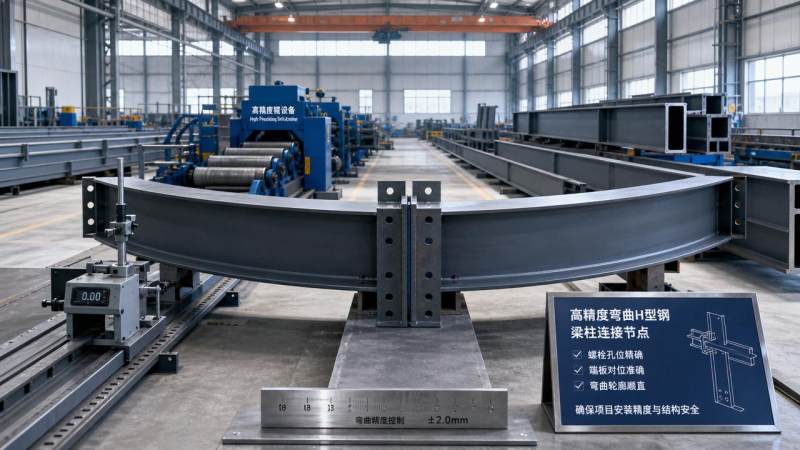
When structural steel bending is not properly controlled, small shape deviations can trigger major downstream problems.
Dimensional mismatch affects fit-up, welding alignment, bolt-hole positioning, coating quality, and final installation speed.
In steel-intensive projects, accuracy is no longer a secondary fabrication target. It is a risk control requirement.
Across construction, infrastructure, and industrial manufacturing, tighter tolerances now define supplier capability and project reliability.
This makes structural steel bending a critical topic for any project involving beams, channels, profiles, or customized steel components.
Current signals show rising sensitivity to bending tolerance
Project teams increasingly expect fabricated steel to arrive ready for direct assembly with minimal field correction.
At the same time, project schedules have less room for rework, on-site heating, or secondary straightening.
These changes amplify the impact of structural steel bending on project accuracy, especially in multi-trade environments.
Modern projects often combine steel structures, mechanical systems, cladding, cable support, and prefabricated modules.
If one bent member exceeds tolerance, the error can transfer across adjacent assemblies.
The result may include delayed erection, forced modifications, and reduced confidence in installed geometry.
Why this trend is accelerating
- More prefabrication means less tolerance for inconsistent structural steel bending.
- International projects often require compliance with ASTM, EN, JIS, or GB dimensional expectations.
- Complex steel nodes increase the sensitivity of hole alignment and end-plate positioning.
- Long-span and exposed steel elements make visual distortion more noticeable.
- Faster installation programs push error detection upstream into fabrication control.
What drives structural steel bending inaccuracy during fabrication
Structural steel bending errors rarely come from one cause. They usually develop through material, tooling, process, and handling interaction.
Among these factors, springback prediction remains one of the most underestimated causes of structural steel bending deviation.
Even when nominal dimensions are correct, elastic recovery may shift the final profile beyond acceptable tolerance.
How bending deviation spreads across the project lifecycle
The impact of structural steel bending does not stop at fabrication. It affects several linked project stages.
Design translation
Bending inaccuracy can break the connection between digital drawings and physical components.
This is especially important where BIM-based coordination depends on exact geometry.
Workshop assembly
Misaligned bent members slow tack welding, fixture setting, and dimensional inspection.
Rework increases labor time and can introduce further heat-related distortion.
Site installation
On site, structural steel bending deviations often appear as difficult bolt insertion or forced fit-up.
Crews may need shimming, slot modification, or corrective cutting, which affects schedule and traceability.
Long-term performance
Poorly controlled bending can leave residual stresses that influence fatigue behavior and load transfer.
For exposed or corrosive environments, surface damage during bending may also reduce coating integrity.
What accuracy-focused buyers should evaluate before approving supply
A supplier’s ability to manage structural steel bending should be checked through process evidence, not only price or catalog range.
- Material traceability linked to grade, batch, and mechanical properties
- Bending equipment capability for thickness, radius, and repeatability
- Inspection methods for angle, straightness, twist, and out-of-roundness
- Experience with ASTM, EN, JIS, and GB dimensional standards
- Packaging and loading methods that protect finished geometry during shipment
These points matter whether the order includes beams, channels, angle steel, cold formed sections, or customized components.
For some secondary structural applications, complementary steel products also support dimensional consistency and corrosion resistance.
One example is DC01 Galvanized Round Steel, used in towers, highway protection, building components, and precision-processed parts.
Its galvanized finish, controlled diameter range, and optional tighter tolerances show how specification discipline supports broader steel accuracy goals.
How capable suppliers reduce structural steel bending risk
Reliable suppliers reduce structural steel bending variation by combining process control with manufacturing discipline.
Manufacturers with modern lines, strict quality control, and export experience usually perform better in this area.
That is particularly relevant for projects requiring customized structural steel and dependable lead times across international markets.
Key priorities for maintaining bending accuracy in future projects
The most effective response is to treat structural steel bending as an engineering control point, not a simple forming step.
- Define acceptable bending tolerance clearly in technical documents.
- Confirm whether tolerance applies before or after coating and heat treatment.
- Request sample validation for customized or non-standard profiles.
- Check how the supplier manages residual stress and straightness correction.
- Review packing plans for long members and export transport conditions.
These measures improve consistency across fabrication, logistics, and installation.
They also reduce hidden costs that often appear only after steel arrives on site.
A practical next step for better dimensional control
Projects facing tight schedules or strict compliance requirements should review structural steel bending capability early.
This means aligning drawings, tolerance standards, inspection points, and shipping protection before mass production begins.
A trusted structural steel partner can support that process with stable production, standard compliance, and customized technical solutions.
When structural steel bending is controlled from material selection to final delivery, project accuracy becomes more predictable and far less costly.
Please give us a message


Please enter what you want to find