Choosing a custom steel tube for structural engineering makes sense when standard sections cannot fully meet load, connection, or fabrication requirements.
For technical evaluation, the real issue is balance.
Strength, tolerance, weldability, compliance, and total sourcing cost must work together.
A well-designed custom steel tube for structural engineering can reduce weight, simplify assembly, and improve long-span or connection-sensitive structures.
It can also lower rework risk when project geometry, regional standards, or fabrication sequences are not suited to off-the-shelf sections.
What a custom steel tube means in structural work
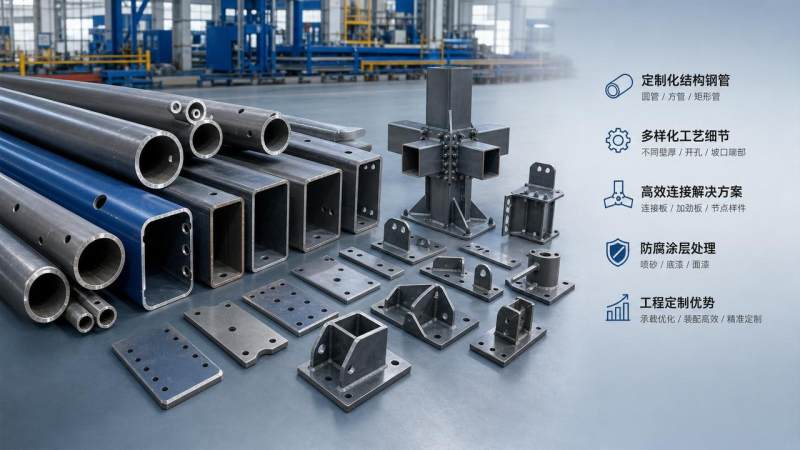
In structural steel practice, a custom tube is not only a nonstandard size.
It may include tailored wall thickness, length, end preparation, hole pattern, coating, grade, or mechanical property targets.
The purpose is practical rather than cosmetic.
A custom steel tube for structural engineering is selected when standard round, square, or rectangular hollow sections create waste or technical compromise.
Typical custom variables include:
- outside diameter or side dimension
- wall thickness matched to design load
- fixed lengths for transport and installation
- special end bevels or splice preparation
- material grade under ASTM, EN, JIS, or GB
- surface treatment for corrosion or fabrication needs
This definition matters because custom does not automatically mean expensive.
In many structural programs, it prevents overspecification and improves fit-to-purpose performance.
Current structural steel considerations shaping tube selection
Today, steel section decisions are influenced by more than nominal strength.
Projects increasingly focus on fabrication efficiency, logistics, and compliance across regions.
These factors explain why the custom steel tube for structural engineering discussion is now tied to project execution, not only section procurement.
Where customized tube solutions create measurable value
The best use case appears when a standard profile works on paper but creates hidden cost elsewhere.
That hidden cost may come from excess weight, extra welding, difficult handling, or poor connection alignment.
Load efficiency and section optimization
A custom steel tube for structural engineering can match section properties more closely to bending, compression, or torsion demands.
This often reduces unnecessary mass while maintaining safety margins.
Connection simplification
Customized dimensions can improve end plate fit, bolted connection spacing, and node geometry.
Fewer adjustment operations usually mean faster assembly and lower field error rates.
Fabrication and corrosion planning
Tube design may include beveling, drilling, passivation, oiling, galvanizing, or painted finishes before shipment.
Such planning helps avoid fragmented subcontracting later.
In related structural fabrication, complementary steel products also matter.
For machined connectors, brackets, or wear-sensitive accessories, 45# Carbon Steel Round Bar can support construction applications with excellent strength and wear resistance.
Available as hot rolled or cold rolled round bars, it can be supplied in lengths from 2m to 12m and diameters from 5mm to 2500mm.
Compliance options including AISI, ASTM, DIN, JIS, GB, and EN help align related fabricated parts with broader project documentation.
Typical structural scenarios for custom tube selection
Not every project needs a nonstandard section.
However, certain scenarios consistently justify it.
In these cases, the custom steel tube for structural engineering approach supports both performance and installation control.
How to evaluate technical and commercial feasibility
A good decision should compare total value, not just unit price.
The following checkpoints help keep evaluation practical.
- Confirm required standard, grade, and mechanical properties.
- Define dimensional tolerances important for fit-up.
- Review weld procedure compatibility and forming limits.
- Check whether custom lengths reduce scrap and cutting labor.
- Assess coating, marking, packing, and traceability needs.
- Compare shipping volume and lead time against stock alternatives.
It is also useful to request mill process details and inspection scope early.
For international projects, alignment with ASTM, EN, JIS, or GB should be explicit in the technical file.
Manufacturing reliability and project risk reduction
Customized products only create value when manufacturing control is stable.
Poor consistency can erase any design advantage through delays or rework.
Reliable structural steel production should include modern equipment, controlled tolerances, documented quality checks, and clear export coordination.
Hongteng Fengda, a structural steel manufacturer and exporter from China, focuses on these fundamentals.
Its supply range covers angle steel, channel steel, steel beams, cold formed steel profiles, and customized structural steel components.
Support for ASTM, EN, JIS, and GB helps simplify multi-market project coordination.
Stable production capacity and dependable lead times are especially important when a custom steel tube for structural engineering must arrive ready for fabrication sequencing.
Practical specification advice before placing an order
Clear specifications reduce technical ambiguity and commercial disputes.
- State application loads and structural function.
- List section dimensions, tolerances, and target lengths.
- Identify base material grade and equivalent standards if applicable.
- Define inspection items such as chemistry, tensile properties, and dimensional checks.
- Specify surface condition, coating, and packing requirements.
- Attach fabrication drawings for drilled holes, slots, or end treatment.
This level of detail makes custom sourcing faster and safer.
It also improves quotation accuracy and production planning.
Conclusion and next-step focus
A custom steel tube for structural engineering makes sense when it solves a real structural or fabrication problem better than standard stock.
The strongest justification usually comes from measurable gains in load efficiency, fit-up accuracy, installation speed, or lifecycle reliability.
Before final selection, compare total delivered value, required standards, and manufacturing consistency.
When drawings, tolerances, and inspection expectations are defined early, customized structural steel becomes a controlled engineering solution rather than a sourcing risk.
The next practical step is to review section demands, connection details, and lead-time constraints together, then match them with a qualified structural steel supply plan.
Please give us a message


Please enter what you want to find