For procurement teams and commercial evaluators, an I beam weight calculator does more than speed up quoting—it helps verify material usage, compare supplier offers, and reduce cost risks before orders are placed. In structural steel sourcing, accurate weight data supports better budgeting, logistics planning, and technical review, making it a practical tool for smarter purchasing decisions.
In the structural steel trade, small weight differences can create large commercial consequences. A deviation of just 2% to 5% in estimated beam weight may affect freight planning, warehouse handling, customs declarations, and final project cost. For buyers reviewing multiple quotations from different mills or exporters, the ability to check beam weight independently is not just convenient; it is part of responsible commercial evaluation.
This matters even more when sourcing from international suppliers. Structural steel buyers must assess not only unit price, but also section accuracy, standard compliance, production consistency, and shipment efficiency. For companies comparing ASTM, EN, JIS, or GB-based products, an I beam weight calculator helps turn dimensions into measurable purchasing insight.
Why Weight Accuracy Matters in Structural Steel Purchasing
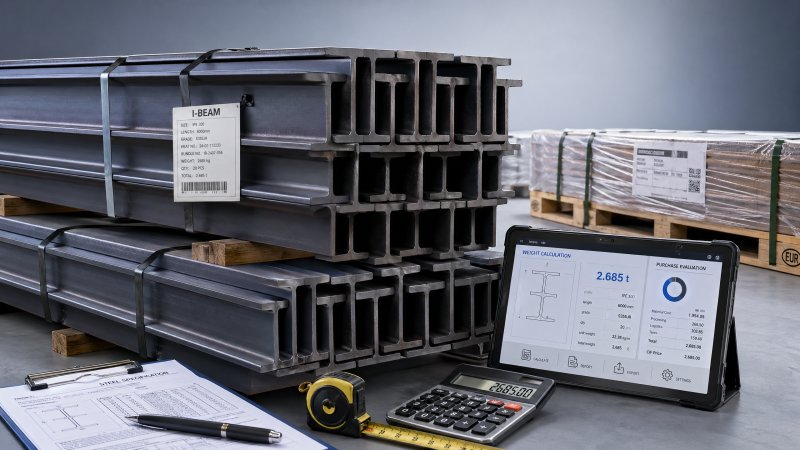
An I beam is typically purchased by theoretical weight, actual weight, or a negotiated tolerance range. In many export transactions, the quoted rate is tied to metric tons, while engineering documents specify section dimensions, grade, and length. If the weight basis is misunderstood, the buyer may approve a quotation that appears competitive but becomes less favorable after recalculation.
For commercial evaluators, the I beam weight calculator acts as a first-line verification tool. It allows a quick cross-check between section size and supplier quote, especially when reviewing 20-foot, 40-foot, or project-length beams. This is useful for standard sections as well as customized structural steel components, where unit weight directly affects total steel volume, inland delivery cost, and sea freight allocation.
In practical sourcing, weight accuracy supports at least 4 core decisions: budget estimation, supplier comparison, transport planning, and technical review. If one supplier quotes 98.5 kg/m and another quotes 101.2 kg/m for what is supposed to be the same section, the difference should be investigated before price comparison continues.
Common commercial risks caused by weight mismatch
Weight mismatch often comes from three areas: section interpretation, tolerance assumptions, and standard conversion errors. An EN section and a GB section may look similar in drawing language, yet differ in flange thickness, web thickness, or fillet radius. These differences can change weight per meter enough to affect procurement cost on orders above 50 to 200 tons.
- Quoted tonnage appears low because the section is lighter than the specified standard.
- Freight cost rises when actual loading weight exceeds the initial packing plan by 1 to 3 tons per container.
- Project installation planning is disrupted if lifting equipment was selected using inaccurate theoretical mass.
- Commercial disputes occur when invoiced tonnage differs from expected calculated quantity.
For global buyers, these issues are not rare. They are especially relevant in projects requiring repeated beam sizes across dozens or hundreds of pieces. A few kilograms per meter multiplied by 6 m, 9 m, or 12 m lengths can quickly become a major cost variable.
Key checkpoints before comparing offers
Before comparing beam quotations, evaluators should verify whether the offers are based on the same standard, grade, length range, and weight method. A supplier can be technically compliant but still commercially misaligned if the quotation assumptions are not transparent.
The table shows why weight review should be done before commercial ranking. A lower offer is not necessarily a better offer if the section reference or weight basis is inconsistent with the project requirement.
How an I Beam Weight Calculator Improves Bid Evaluation
A strong bid evaluation process looks beyond price per ton. Commercial teams often work under time pressure, reviewing 3 to 8 supplier quotations within a short tender window. In that environment, the I beam weight calculator becomes a screening tool that helps identify unrealistic figures before they reach technical approval or finance sign-off.
When beam dimensions are entered correctly, the calculator helps estimate total project tonnage, piece count, and shipment allocation. This is valuable in pre-order analysis, especially for mixed orders containing angle steel, channel steel, I beams, and customized profiles. The more varied the package, the more important it becomes to validate each section rather than rely only on the supplier’s summary sheet.
For export buyers, there is also a logistics benefit. A 40HQ container may be volume-limited or weight-limited depending on beam size and packing method. If the project involves 25 to 30 tons of beams per lot, even a moderate calculation error can lead to an extra container, split shipment, or revised port handling plan.
Commercial comparison should include more than the unit rate
A practical evaluation matrix should combine section weight, total tonnage, lead time, standard compliance, and packaging assumptions. This gives purchasing teams a more complete picture of the landed value of each offer.
The key conclusion is that accurate beam weight helps reveal the true commercial structure of a quotation. It supports a clearer comparison between a low headline price and a genuinely efficient supply proposal.
A 5-step review sequence for evaluators
- Confirm the exact section designation and applicable standard.
- Use an I beam weight calculator to check theoretical kg/m.
- Multiply by required lengths and quantities to estimate total tonnage.
- Compare supplier totals, freight assumptions, and production lead time.
- Escalate any deviation above a reasonable tolerance for technical clarification.
This sequence is simple, but it helps reduce rushed approvals. It is particularly useful when procurement teams must balance engineering expectations with budget controls.
What Buyers Should Check Beyond the Calculator
A calculator is valuable, but it is only one part of the sourcing decision. Commercial evaluators should also review mill capability, tolerance control, documentation readiness, and export execution. In steel procurement, correct numbers are important, but reliable delivery is equally critical.
This is where an experienced structural steel manufacturer can add value. Suppliers serving North America, Europe, the Middle East, and Southeast Asia usually need familiarity with multiple standards and practical export requirements. For projects involving angle steel, channel steel, steel beams, and cold formed profiles in the same order, coordination discipline can save 7 to 15 days in communication and revision time.
Hongteng Fengda focuses on structural steel manufacturing and export from China, supplying standard sections and customized OEM solutions for global construction, industrial, and manufacturing projects. With modern facilities and quality control aligned with ASTM, EN, JIS, and GB expectations, the company supports buyers seeking stable production capacity, consistent quality, and dependable lead times.
Technical documents that support a safer purchase
Even if an I beam weight calculator confirms the section mass, procurement should still ask for core technical and commercial documents. These documents help connect calculation results to real production and shipment readiness.
- Section drawings or standard references confirming profile geometry.
- Material grade description and applicable production standard.
- Length tolerance, straightness expectation, and packing method.
- Commercial quotation showing tonnage basis, Incoterms, and shipment terms.
- Inspection or quality documents if required by the project contract.
These checkpoints matter because two suppliers may provide similar weight results but differ greatly in execution reliability. A buyer evaluating a 100-ton structural package should measure both numerical accuracy and supply risk exposure.
A related example of weight-based material evaluation
Weight verification is not limited to beams. In industrial procurement, mesh, profiles, plates, and fabricated components are also evaluated through dimensional and weight-based logic. For instance, buyers sourcing corrosion-resistant support or screening materials may also review Stainless Steel Welded Mesh for filters, sieve systems, chemical industry uses, mining, architecture, and residences.
Typical options include SS 201, 304, 304L, 316, 316L, and 430, with wire diameter from 0.0008″ to 0.12″, mesh range from 2 to 635 mesh, roll width up to 240″, and roll length up to 2000′. In evaluation terms, buyers examine open area, cloth thickness, absolute micron retention, and weight in kg/m2, just as beam buyers examine kg/m, dimensions, and tolerance consistency.
The lesson is consistent across steel categories: when dimensions, weight, and application requirements are reviewed together, procurement decisions become less risky and more commercially transparent.
Practical Selection Criteria for Global Steel Buyers
Commercial evaluators need a repeatable way to judge whether a supplier can deliver as quoted. An I beam weight calculator helps validate one important variable, but supplier selection should also include service responsiveness, customization capability, and export coordination. A supplier that answers dimensional questions within 24 to 48 hours usually reduces project friction during the pre-order stage.
For international structural steel orders, a practical assessment model can be organized around 4 dimensions: technical fit, production reliability, logistics readiness, and communication clarity. This framework is especially useful for buyers balancing cost control against project deadline pressure.
The goal is not simply to find the lowest quote. It is to identify the supplier whose section data, production planning, and delivery commitment match the real needs of the project. That is where calculation tools and supplier capability review work best together.
Recommended procurement checklist
This checklist helps evaluators move from isolated price review to full-scope supply assessment. It is particularly effective when comparing multiple Chinese, regional, or local suppliers for the same project package.
Common mistakes to avoid
- Comparing price per ton without confirming identical section standards.
- Ignoring cut length and packing impact on freight efficiency.
- Assuming all suppliers use the same calculation basis for beam weight.
- Approving a quote before checking whether custom fabrication affects total mass.
Avoiding these mistakes can improve budget control and reduce post-order clarification cycles. In competitive sourcing, that can be the difference between a smooth award decision and a delayed purchasing process.
FAQ for Commercial Evaluators Using an I Beam Weight Calculator
How accurate is an I beam weight calculator for procurement use?
It is generally accurate for theoretical estimation when the correct section dimensions and standard are used. However, procurement teams should still confirm whether the contract uses theoretical weight or actual weighbridge weight. For many commercial reviews, a deviation of around 1% to 3% is enough to justify a follow-up check.
Can the calculator replace supplier technical confirmation?
No. It supports verification, but it does not replace drawings, mill capability review, or tolerance confirmation. The best practice is to use the calculator during the quotation stage, then match the result against supplier documents before issuing a purchase order.
Why do two suppliers show different weights for similar beam descriptions?
This usually happens because the sections belong to different standards or because one quotation uses a simplified designation. Similar names do not guarantee identical flange width, web thickness, or profile geometry. Commercial evaluators should request full section references and recheck the data before comparing totals.
When is the calculator most useful in the purchasing workflow?
It is most useful in three stages: initial supplier screening, tender comparison, and pre-approval verification. At these stages, the tool can reduce pricing ambiguity, improve logistics planning, and support more disciplined internal review. For orders above 30 tons, the value of early weight validation becomes even more visible.
An I beam weight calculator saves more than time because it strengthens the commercial logic behind steel purchasing decisions. It helps procurement teams verify quoted tonnage, identify standard mismatches, estimate freight impact, and compare supplier offers on a more reliable basis.
For buyers sourcing structural steel from China or other export markets, the best results come from combining calculation accuracy with supplier capability review. Hongteng Fengda supports global projects with structural steel manufacturing, customized solutions, multi-standard compliance, and dependable delivery coordination.
If you are evaluating steel beams, channels, angles, cold formed profiles, or customized structural components, contact us to discuss your specifications, request a tailored quotation, or get support for a more confident sourcing decision.
Please give us a message


Please enter what you want to find