Choosing a new ss coil manufacturer may seem like a simple way to cut purchase prices, but for finance decision-makers, the real impact often appears later in processing, quality consistency, lead times, and waste control. Hidden downstream costs can quickly erase initial savings, making supplier evaluation a critical part of cost management and operational stability.
Why finance teams should use a checklist before changing an ss coil manufacturer
For a financial approver in the steel supply chain, the purchase price per ton is only one part of the cost picture. A supplier switch can affect slitting yield, stamping efficiency, coating behavior, claims frequency, and inventory turnover within 30 to 90 days of the first shipment. That is why a checklist-based review is more reliable than a unit-price comparison alone.
In structural steel, manufacturing and downstream fabrication are tightly linked. Even a small deviation in thickness tolerance, coil flatness, surface condition, or tensile consistency can increase scrap by 1% to 3%, add rework hours, or slow a line that is expected to run at a stable processing rhythm. For finance teams, those hidden losses often remain off the quotation sheet but show up in margin erosion later.
A practical checklist also helps align procurement, production, quality, and logistics. Instead of asking whether a quote is lower, the better question is whether the new ss coil manufacturer can protect the total landed and processed cost across the next 2 to 4 quarters. This shift in evaluation is especially important for buyers serving construction, manufacturing, appliance, and industrial projects where delivery discipline matters.
The first four questions to ask before approving a supplier change
- Will the new coil reduce total cost after scrap, downtime, inspection, and claims are included?
- Can the new ss coil manufacturer hold stable mechanical and dimensional tolerances over multiple lots, not just one sample batch?
- Will lead time, port schedule, and packaging quality support your current inventory cycle, often 3 to 8 weeks depending on project demand?
- Does the supplier understand your end-use requirement, such as forming, roofing, framing, roll forming, or welded assembly?
These four questions create a financial screening layer before technical review begins. They are especially useful when two quotations appear close, such as a price difference of only 20 to 50 USD per ton, but the downstream risk profile is very different.
Core evaluation checklist: where hidden processing costs usually appear
When comparing one ss coil manufacturer with another, finance teams should ask operations and QA to convert technical concerns into cost checkpoints. This approach makes supplier selection more objective and easier to approve internally. The most common hidden costs are not random. They usually cluster around six areas.
Six cost checkpoints that deserve priority review
- Dimensional stability: thickness, width, and edge condition influence yield and fit-up accuracy in cutting or forming.
- Mechanical consistency: unstable yield strength or elongation can increase cracking, springback, or press adjustment time.
- Surface and coating quality: poor adhesion or uneven coating can create rejection in painted or exposed applications.
- Packaging and moisture protection: damaged coil edges or rust claims can generate direct write-offs.
- Lot-to-lot repeatability: one good trial lot is not enough if monthly demand requires 5, 10, or 20 repeat shipments.
- Delivery reliability: a lower price loses value quickly if project scheduling penalties or rush freight are triggered.
To make these checkpoints easier to approve, many buyers use a weighted scorecard. That scorecard should compare unit price, process risk, claim exposure, and delivery performance rather than relying on one commercial metric.
The table below provides a practical screening structure for a finance-led review of a potential ss coil manufacturer. It can be used before trial order release or before annual supplier consolidation.
This type of matrix helps finance teams justify why the lowest quote may not be the lowest total-cost option. In many steel purchasing situations, one rejected lot or one delayed container can offset the savings from several cheaper orders.
Use product-fit checks, not only supplier reputation
Another common mistake is evaluating an ss coil manufacturer only at the company level without checking whether the offered grade truly fits the intended process. A supplier may be experienced, but if the selected coil specification is misaligned with the fabrication route, processing costs still rise. This is why product-fit review belongs in the middle of the approval workflow.
For example, buyers in construction, appliances, agriculture, or light industrial manufacturing often need a balance of corrosion resistance, formability, and stable mechanical behavior. In those cases, a galvanized or aluminium-zinc coated option may support lower lifecycle cost better than a simple price-led substitute, especially when the component is exposed to weather, heat reflection requirements, or repeated forming.
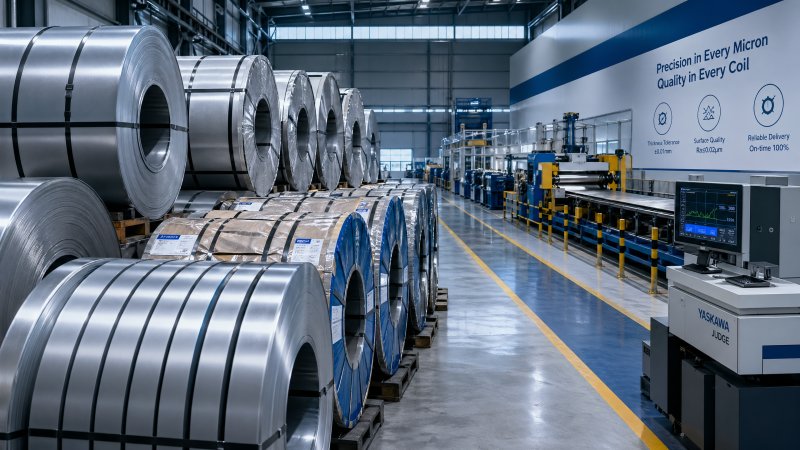
A useful reference in this context is DX53D Galvalume Steel Coil . This type of coil is commonly used in roofs, walls, garages, modular houses, mufflers, refrigerator back panels, greenhouse pipes, and other formed components. Typical specification ranges include thickness from 0.4 mm to 3 mm, widths such as 1000 mm, 1250 mm, and 1500 mm, and cut-to-length options from 200 mm to 3000 mm depending on downstream processing needs.
Why product parameters matter to processing cost
If a project requires consistent forming and corrosion resistance, material characteristics should be reviewed as part of supplier approval. For instance, low-carbon steel with an aluminium-zinc coated surface can support good corrosion resistance, high heat reflectivity, excellent adhesion, and reliable formability. Those features can reduce repaint risk, field complaints, and manufacturing disruption when the application environment is demanding.
Mechanical values also matter. A range such as yield strength of 270 to 300 MPa, tensile strength of 350 to 450 MPa, and elongation of not less than 24% may be important when parts need deformation without fracture. In practical finance terms, that can mean fewer cracked components, fewer emergency line stops, and more predictable labor efficiency over each batch.
Standards review should be included as well. If the offered material can align with common frameworks such as GB, AISI, ASTM, JIS, or DIN, it becomes easier for procurement and engineering teams to compare suitability across export markets. A new ss coil manufacturer should be able to discuss these standards clearly rather than offering only a generic low-price proposal.
The table below shows how product-fit checks can be translated into processing and financial decisions. It is a useful bridge between technical specification and investment approval.
By linking product characteristics to processing and commercial outcomes, finance approvers can evaluate a new ss coil manufacturer with more confidence. That approach is especially useful when the buyer must compare standard grades with OEM or customized requirements.
Risk reminders for different buying scenarios
Not every switching decision carries the same risk. A buyer sourcing for high-volume roll forming faces different issues than a buyer ordering mixed sizes for project-based construction. Finance teams should therefore adjust their checklist by scenario instead of applying a single rule to every supplier review.
Scenario-based review points
- For repetitive industrial production, check lot consistency over at least 3 consecutive shipments rather than approving after one trial coil.
- For export construction supply, verify compliance language, marking, packaging, and document accuracy to avoid customs or site acceptance delays.
- For OEM parts, confirm whether the ss coil manufacturer can maintain both dimensional tolerance and mechanical stability when widths or lengths are customized.
- For urgent replenishment, compare actual lead time windows, such as 15 to 35 days production plus sailing schedule, instead of relying on nominal promises.
These scenario checks matter because hidden cost often shifts by business model. In project supply, late delivery can trigger schedule disruption. In factory production, the larger risk may be quality drift that slowly reduces line efficiency over weeks. Both affect cash flow, but in different ways.
A capable ss coil manufacturer should be able to support standard specifications as well as project-specific or OEM requirements with clear communication on tolerances, testing, and packing method. That is particularly important for global buyers managing mixed demand across North America, Europe, the Middle East, and Southeast Asia.
Common signs that a quote may carry hidden cost
Finance approvers do not need to become metallurgical experts, but they should recognize warning signs. If a quotation is substantially lower yet specification language is vague, coating details are unclear, packing terms are weak, or lead time is described only broadly, the cost gap may be shifting from supplier to buyer.
Another warning sign is inconsistency between sales promise and production capability. If the supplier cannot explain testing frequency, lot traceability, or how it handles custom widths and cut lengths, it becomes harder to predict actual performance over the next 6 to 12 months.
A final warning sign is resistance to small-batch validation. Strong suppliers usually understand the value of sample support, pilot orders, and technical confirmation before scaling volume. That discipline protects both sides from preventable claim costs.
A practical approval process finance teams can use
A good supplier change process should not be complicated, but it should be structured. For most steel procurement teams, a 5-step review process is enough to reduce avoidable exposure while keeping purchasing efficient. The goal is to make the decision auditable and commercially sound.
Recommended 5-step internal workflow
- Define the real use case: grade, thickness range, width, forming method, coating expectation, and monthly or quarterly volume.
- Collect a total-cost comparison: unit price, freight, inspection, expected scrap, packaging adequacy, and lead time reliability.
- Run a controlled trial: test one or two lots under actual production conditions and track defects, yield, and setup time.
- Review repeatability: confirm whether results remain stable over at least 2 to 3 production cycles.
- Approve with safeguards: define claim handling, documentation, packaging method, and delivery milestones before scale-up.
This workflow helps separate a commercial opportunity from a risk transfer. It also gives the finance team a clearer basis for deciding whether a lower-cost ss coil manufacturer truly improves procurement performance or only moves cost into operations.
For structural steel buyers, this discipline is especially relevant because projects often depend on stable supply across multiple dimensions at once: specification compliance, quality consistency, lead time, and communication speed. A weak point in any one of these areas can reduce the value of an otherwise competitive offer.
Why work with a supplier that understands total cost, not just coil price
For buyers evaluating a long-term ss coil manufacturer, the strongest partner is usually the one that can combine stable production, clear quality control, standard compliance, and practical customization support. In steel sourcing, this balance often matters more than finding the lowest quote on a single shipment.
As a structural steel manufacturer and exporter from China, Hongteng Fengda supports global construction, industrial, and manufacturing buyers with angle steel, channel steel, steel beams, cold formed steel profiles, and customized structural steel components. Our focus is on helping customers reduce sourcing risk, control cost, and maintain dependable delivery across international markets.
If you are reviewing a new ss coil manufacturer or comparing current supply options, we can help you check the points that matter before approval. That includes parameter confirmation, product selection, thickness and width options, coating expectations, OEM feasibility, delivery cycle planning, certification reference, sample support, and quotation discussion based on actual project needs.
Why choose us
- We understand the connection between steel specification and downstream processing cost, not only ex-works pricing.
- We support both standard and customized structural steel supply for international projects and industrial applications.
- We work with common international standards such as ASTM, EN, JIS, and GB to improve communication efficiency.
- We help buyers evaluate lead time, specification fit, and risk control before volume commitment.
If you need to confirm material parameters, compare product options, review lead times, discuss custom solutions, check certification requirements, request samples, or receive a targeted quotation, contact us with your application details and purchasing plan. A well-qualified supplier decision starts with the right questions, and we are ready to support that process.
Please give us a message


Please enter what you want to find