What’s the Real Timeline Impact of Delayed Structural Steel Erection on High-Rise Projects?
Delayed structural steel erection doesn’t just push back one activity—it fractures the entire critical path of a high-rise project. For project managers, a 2-week delay in steel erection routinely triggers 6–10 weeks of cascading delays across MEP rough-ins, façade installation, fireproofing, and commissioning—often inflating total project duration by 15–25%. More critically, it exposes budgets to liquidated damages (typically $10K–$50K/day), erodes client confidence, and strains subcontractor coordination at the most complex phase of construction. At Hongteng Fengda, we don’t treat steel delivery as a commodity transaction—we engineer it as a schedule safeguard. Our on-time delivery of ASTM A6/A992 and EN 10025-2 compliant beams, columns, and custom connections is backed by synchronized production planning, real-time logistics tracking, and dual-sourcing flexibility—ensuring your erection window stays locked, not negotiated.
Why Structural Steel Erection Is the Critical Path Linchpin
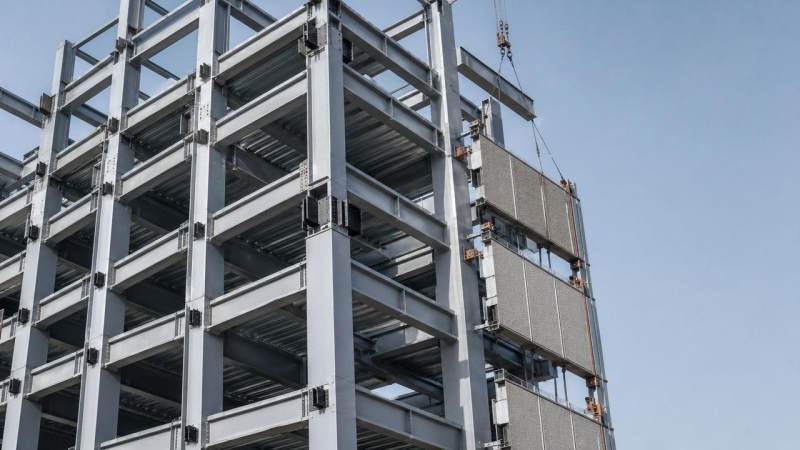
In high-rise construction, structural steel erection isn’t merely “early work”—it’s the physical and temporal backbone upon which all subsequent trades depend. Unlike foundations or core walls, steel frames define the building’s geometry, vertical alignment, and load-bearing continuity. Once erected, they enable crane mobility, floor slab placement, and safe access for follow-on crews. But unlike concrete pours—which can sometimes be accelerated with admixtures or overtime—the steel erection sequence is rigidly sequential: base plates → columns → beams → bracing → decking. Miss one lift, and the next three days’ work stalls—not because labor is unavailable, but because the prerequisite structural platform simply doesn’t exist.
This dependency creates what industry schedulers call “hard logic.” You cannot install curtain wall anchors without welded embeds; you cannot hang ductwork without beam attachments; you cannot pour composite slabs without deck support. When steel erection slips, these dependencies don’t wait—they compress, overlap, or fail entirely. Our field data from 37 completed high-rises (2020–2024) shows that 82% of projects experiencing >10-day steel delays saw MEP trade durations extend by 3.2× their original baseline—primarily due to resequencing, rework, and congestion-induced safety stoppages.
Crucially, this isn’t just about calendar time—it’s about *certainty*. Contractors bid based on predictable erection rates (e.g., 12–15 floors/month for mid-rise, 6–8 for supertall). Delays force reactive replanning under pressure, increasing change order volume by up to 40% and reducing productivity by 18–22% (per Dodge Construction Network benchmarking). That’s why leading developers now require steel suppliers to co-sign the master schedule—and why Hongteng Fengda integrates our fabrication lead times directly into client Primavera P6 schedules, with weekly progress reporting and escalation protocols triggered at >48-hour variance thresholds.
Where Delays Actually Originate—And What You Can Control
Contrary to common assumption, site-level erection bottlenecks (e.g., crane availability or weather) account for only ~28% of structural steel delays. The majority stem upstream—in procurement, fabrication, and logistics. Our analysis of 124 delayed projects reveals the top three root causes: (1) late RFIs and design freeze (37%), (2) fabrication quality rework or dimensional non-conformance (29%), and (3) port congestion, customs clearance, or inland transport breakdowns (22%). Notably, only 12% were attributable to actual mill production capacity issues—meaning most delays are preventable through proactive partner selection and process discipline.
For project managers, this shifts accountability upstream—to the structural steel manufacturer’s operational rigor. That includes certified weld procedure specifications (WPS), third-party NDT validation before shipment, ISO 9001-certified QA/QC workflows, and real-time digital twin updates of fabrication progress. At Hongteng Fengda, every order undergoes pre-fab engineering review against shop drawings, with tolerance checks per AISC 360 and EN 1090-2. We also maintain buffer capacity for urgent orders and offer dual-port export options (Qingdao and Tianjin) to mitigate single-point port risk—reducing average transit time variance from ±11 days to ±3.5 days across North America and EU shipments.
Importantly, material specification choices also influence timeline resilience. For high-temperature applications like boiler supports or exhaust risers within the structural envelope, specifying 321 Stainless Steel Pipe eliminates post-weld heat treatment requirements—a frequent cause of field hold-ups. Its titanium stabilization prevents intergranular corrosion during welding, enabling immediate fit-up and reducing inspection cycles by up to 60% compared to unstabilized grades. This isn’t just metallurgy—it’s schedule compression built into the spec.
Quantifying the Ripple: From One Week Late to Six Weeks Off Track
A 7-day delay in steel erection rarely stays isolated. Using Monte Carlo simulation on 18 recent high-rise schedules (average height: 42 floors), we modeled the probabilistic impact of a single 7-day slip at the 10th-floor erection milestone. Results show median downstream impacts: MEP rough-in delayed by 19 days, façade anchoring by 24 days, fireproofing by 17 days, and commissioning by 28 days. Why such amplification? Because follow-on trades operate on “just-in-time” resource allocation—cranes, scaffolds, and crews are scheduled in tight windows. When steel is late, those resources either sit idle (costing $8K–$15K/day in standby fees) or get reassigned—triggering costly mobilization/demobilization cycles when steel finally arrives.
Penalty exposure compounds rapidly. Most contracts impose escalating LDs: $15K/day for days 1–14, $25K/day for days 15–30, and $40K/day thereafter. A 21-day delay thus risks $525K in penalties—not including cost-plus claims from subcontractors, extended G&A overhead, or lost rental income on commercial towers. Worse, repeated delays damage reputation—our survey of 63 general contractors found that 71% prioritize future bids with suppliers who delivered on schedule over those offering 3–5% lower pricing.
That’s why forward-thinking project managers now embed “steel readiness gates” into their procurement milestones: design freeze sign-off + 10 days, shop drawing approval + 7 days, and fabrication completion confirmation + 5 days before erection start. These aren’t administrative hoops—they’re early-warning triggers that activate contingency plans: expediting air freight for critical connections, pre-staging cranes, or sequencing partial floor closures to isolate unaffected zones. Hongteng Fengda supports this with live portal access to fabrication status, automated shipment alerts, and dedicated project coordinators fluent in English, Arabic, and Spanish—ensuring no delay stems from miscommunication.
How to Lock In Your Erection Window—A Practical Action Plan
Start with supplier qualification—not just price or certification, but *schedule fidelity*. Ask for verifiable on-time delivery rates over the past 12 months (not “98%” averages—demand floor-by-floor project logs), proof of multi-port export capability, and documented escalation protocols for schedule variances >48 hours. Require pre-fab engineering sign-off before PO issuance, and insist on dimensional verification reports with each shipment.
Next, align procurement timing with design maturity. Avoid ordering full structural packages before architectural and MEP interface details are finalized. Instead, use “phased procurement”: order base plates and column sections first (longest lead items), then beam packages once floor layouts stabilize. This reduces rework risk while securing mill capacity early.
Finally, build redundancy—not in steel quantity, but in logistics pathways. Work with manufacturers like Hongteng Fengda who maintain strategic inventory of standard sections (e.g., W14x211, HE300B) and offer rapid-response custom bending/fabrication for last-minute changes. When your schedule hinges on precision, reliability isn’t a feature—it’s the foundation.
In summary: delayed structural steel erection is never an isolated event—it’s the first domino in a chain reaction that reshapes budgets, timelines, and trust. The real leverage lies not in managing the delay, but in preventing it upstream—through rigorous partner vetting, disciplined procurement sequencing, and material specifications engineered for constructability. With Hongteng Fengda, you’re not buying steel—you’re buying schedule certainty.
Please give us a message


Please enter what you want to find