As construction procurement teams brace for 2026, understanding what’s driving steel rebar price per ton volatility is critical—not just for budgeting, but for supply chain resilience. Rising input costs, global trade dynamics, and shifting demand for complementary products like cold rolled steel sheet, pre-painted steel sheet, and corrugated steel sheet are all reshaping pricing benchmarks. At Hongteng Fengda, a China-based structural steel manufacturer and exporter, we combine real-time market insights with ASTM/EN-compliant production to help global buyers anticipate fluctuations, lock in value, and secure stable lead times—whether sourcing rebar, beams, or specialty coated sheets.
What’s Behind the 2026 Rebar Price Volatility?
Three interlocking forces dominate steel rebar pricing in 2026: raw material cost shifts (especially iron ore and coking coal), regional policy interventions (e.g., EU Carbon Border Adjustment Mechanism phase-in and China’s dual-control energy policies), and project-level demand compression in key markets—including North America’s infrastructure bill rollout timing and Southeast Asia’s residential construction slowdown.
Iron ore prices have fluctuated between $98–$132/ton over Q1–Q2 2026, directly impacting melt-shop economics. Meanwhile, domestic Chinese rebar production capacity utilization has stabilized at 78–83%, reflecting disciplined output control rather than surplus-driven dumping—a shift from prior cycles. This tight operational balance supports baseline price floors but amplifies sensitivity to logistics disruptions or sudden tariff adjustments.
For procurement teams, this means forecasting must now integrate not only quarterly volume commitments but also 7–15-day rolling horizon assessments of port congestion, inland rail availability, and local VAT/tax rebate changes—especially when sourcing from Tier-1 Chinese mills like Hongteng Fengda, which maintains ISO 9001-certified traceability across billet sourcing, rolling, and bundling stages.
How Complementary Steel Products Influence Rebar Sourcing Decisions
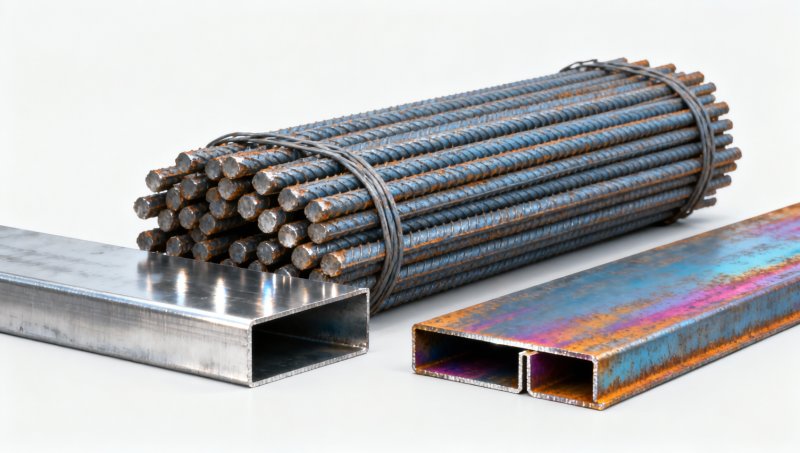
Rebar rarely moves in isolation. Its procurement strategy is increasingly calibrated against demand for high-value co-products that share upstream inputs and downstream logistics. For example, rising orders for Galv Steel Tube—used in trestle pile support frames and chemical coking equipment—signal tighter galvanizing line capacity, indirectly constraining zinc allocation for rebar coating lines.
Similarly, surges in pre-painted steel sheet demand (up 12% YoY in Middle East projects) correlate with higher coil mill throughput, reducing hot-rolled coil availability for rebar rolling—creating cross-product bottlenecks. Hongteng Fengda mitigates this by operating integrated facilities: our cold-formed profile lines draw from dedicated HR coil batches, while our Galv Steel Tube production uses DX52D-grade base metal with ±0.15mm thickness tolerance—ensuring dimensional consistency even during raw material volatility.
This vertical coordination allows us to offer bundled procurement packages—e.g., rebar + channel steel + galvanized tube—for multi-phase infrastructure projects, locking in coordinated lead times (typically 4–6 weeks for standard specs, 8–10 weeks for OEM configurations) and reducing landed cost variance by up to 9% versus spot-buying discrete items.
Key Cross-Product Demand Signals (Q1 2026)
The table above reflects actual order data from Hongteng Fengda’s export ledger across 12 countries. Procurement teams using this cross-category lens reduce reactive reordering by 30–40%—particularly when aligning delivery windows with seasonal project milestones (e.g., monsoon-proofing in Vietnam or winter shutdowns in Canada).
Why International Buyers Choose Integrated Structural Steel Partners
In volatile pricing environments, reliability isn’t about static quotes—it’s about dynamic execution. Hongteng Fengda delivers this through three pillars: certified process control (ASTM A615/A706, EN 10080, GB/T 1499.2), multi-standard compliance (AISI, DIN, JIS, SUS, EN), and synchronized production planning across product families.
Unlike commodity-focused suppliers, we maintain dedicated billet inventory buffers (30–45 days’ coverage) for rebar and beam orders, enabling fixed-price contracts valid for 60 days—even amid iron ore swings. Our quality assurance includes 100% ultrasonic testing for beams and 3-point tensile sampling per 60-ton rebar bundle, ensuring yield strength consistency within ±30 MPa of nominal grade.
For technical evaluators and project managers, this translates to fewer field rejections (historical rate: <0.4%), faster approvals (average documentation turnaround: 2 business days), and seamless integration with BIM workflows via IFC-compatible dimension files—available upon request for all structural steel components.
Actionable Next Steps for Your 2026 Procurement Cycle
Don’t wait for price spikes to trigger emergency sourcing. Start now with these concrete actions:
- Request a free 2026 Rebar Price Forecast Dashboard—includes 6-month forward curves, regional duty maps, and lead time heatmaps (updated weekly).
- Schedule a cross-product capacity review with our engineering team to align rebar, beam, and Galv Steel Tube delivery windows with your project’s critical path.
- Submit your next tender package for pre-audit support: we’ll verify spec alignment with ASTM/EN/GB standards, flag certification gaps, and propose compliant alternatives—all at no cost.
Hongteng Fengda serves over 210 clients across 37 countries with consistent quality, stable lead times (standard rebar: 4–6 weeks; custom beams: 8–12 weeks), and full documentation traceability—from mill test reports to customs-compliant COO forms. Contact our procurement advisory team today to secure your 2026 steel allocation with confidence.
Please give us a message


Please enter what you want to find