Understanding ss 304 2 inch pipe price is essential for business evaluators comparing material costs, supplier reliability, and project budgets in today’s steel market. Prices are shaped by raw material fluctuations, international standards, order volume, and manufacturing quality. For buyers sourcing from China, knowing these key factors helps reduce procurement risk and supports smarter purchasing decisions.
In practical procurement, the quoted price of a 2 inch stainless steel pipe is rarely based on diameter alone. It is usually the result of 4 to 6 linked variables, including nickel cost, wall thickness, manufacturing route, inspection scope, and shipping terms. For commercial evaluators, a low offer may reduce upfront cost by 3% to 8%, but it can increase delivery risk, quality deviation, or hidden processing expense later in the project cycle.
This article breaks down what drives ss 304 2 inch pipe price in the current market, how to compare suppliers more accurately, and what checkpoints help control sourcing risk when buying from China for construction, industrial, and manufacturing applications.
Key cost drivers behind ss 304 2 inch pipe price
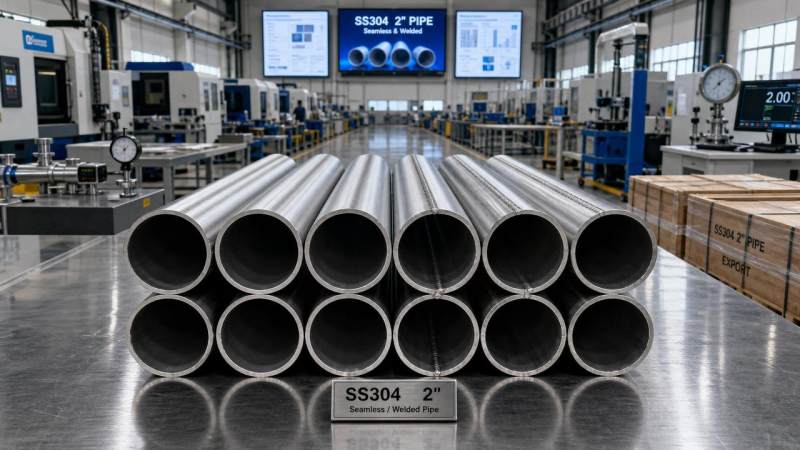
The first step in evaluating ss 304 2 inch pipe price is separating the visible quote from the real cost structure. In most cases, stainless steel pipe pricing moves with raw material markets, but it is also affected by technical specifications and transaction conditions. A buyer comparing only price per ton or price per meter may miss important cost drivers.
Raw material composition and nickel volatility
SS 304 contains chromium and nickel, and nickel is often the most volatile element in the cost stack. Even a moderate movement in nickel prices over 2 to 4 weeks can shift the final ss 304 2 inch pipe price noticeably. When mills update surcharges or base material rates, export offers can change within 3 to 7 days.
For commercial review, it is useful to ask whether the quotation is fixed for 7 days, 15 days, or linked to the order confirmation date. This matters especially when evaluating bulk purchase plans above 20 tons or repeat supply contracts over 1 to 3 months.
Size, schedule, and weight per meter
A 2 inch pipe can mean different wall thicknesses, schedules, and tolerances. Schedule differences directly change weight per meter, and weight is a primary pricing base. A pipe with a heavier wall can cost 10% to 25% more than a lighter variant, even if the outside diameter stays the same.
Business evaluators should verify outside diameter, wall thickness, length range, and allowable tolerance before comparing offers. A quote based on loose tolerance may appear cheaper, but further machining or site fitting can erase the savings.
Seamless versus welded production route
Production method also shapes ss 304 2 inch pipe price. Seamless pipe typically involves higher production complexity and higher unit cost, while welded pipe may be more economical for many structural or low-to-medium pressure applications. The price difference can range from 15% to 40%, depending on specification and inspection requirements.
The correct choice depends on end use. For decorative or general industrial use, welded options may be sufficient. For critical fluid systems, pressure-bearing environments, or stricter buyer specifications, seamless pipe may justify the premium.
The table below helps clarify which technical and commercial variables usually move the quoted level most strongly when reviewing ss 304 2 inch pipe price.
The main takeaway is that price comparison works only when specification comparison is complete. Two offers for a 2 inch SS 304 pipe can differ meaningfully even when the product name looks identical in a quotation sheet.
Standards, testing, and export documentation
International standards such as ASTM, EN, JIS, or GB influence production control and testing scope. A supplier quoting to ASTM with mill test certificates, dimensional inspection, and chemical analysis may not match the price of a mill offering a lighter document package. Added inspection can raise final cost, but it often lowers downstream commercial risk.
For cross-border procurement, evaluators should check whether the offer includes MTC, packing list accuracy, heat number traceability, and pre-shipment inspection support. These details may account for only 1% to 3% of order value, yet they can save much larger costs in customs clearance or project acceptance.
How business evaluators should compare supplier quotations
Comparing ss 304 2 inch pipe price properly requires more than ranking three quotations from low to high. A sound business evaluation should combine unit price, technical compliance, delivery certainty, and total landed cost. This is especially important for buyers sourcing from China, where manufacturing capability can vary significantly across mills, traders, and OEM-oriented suppliers.
Use a four-point quotation review method
A practical review model includes 4 checkpoints: specification match, standard compliance, commercial terms, and logistics readiness. If even 1 of these 4 points is unclear, the quoted ss 304 2 inch pipe price may not be directly comparable to another supplier’s offer.
- Confirm OD, wall thickness, length, tolerance, and weight basis.
- Check material grade, standard, and testing documents.
- Review payment term, such as 30% TT advance plus 70% balance or LC at sight.
- Verify lead time, packing method, port, and Incoterm.
Look beyond ex-works price
In many cases, a lower ex-works quote becomes less competitive after inland transport, export packing, port charges, and container optimization are included. For medium orders of 10 to 25 tons, freight efficiency can materially affect final landed cost per ton.
A business evaluator should also ask whether the supplier can consolidate related steel items into one shipment. For example, project buyers often source structural sections, beams, or reinforcing materials together. Coordinated shipment can reduce handling steps and improve schedule control across 2 or 3 product categories.
Natural cross-category sourcing in steel projects
In broader construction procurement, pipe is often only one line item. Some buyers also compare reinforcing and structural materials at the same time. For projects involving foundations, beams, columns, slabs, roads, bridges, or tunnels, Wire rod may be part of the same sourcing discussion, especially in civil engineering construction.
Typical options include HRB335, HRB400, and HRB500, with common sizes from 6mm to 50mm and lengths such as 5.8m, 6m, 9m, or 12m. Buyers may also specify hot rolled or cold rolled technique, ±1% tolerance, and surface treatments such as galvanized, black coating, color painting, or anti-rust oil according to project conditions.
The following comparison table shows how commercial evaluators can screen quotations more consistently when checking stainless pipe offers from different suppliers.
This type of side-by-side review helps evaluators identify whether a lower ss 304 2 inch pipe price is truly more competitive or simply less complete in scope. In B2B steel sourcing, definition quality is often as important as price level.
Current market conditions affecting stainless pipe procurement
Today’s market for stainless products is influenced by a combination of raw material volatility, regional demand cycles, shipping conditions, and production planning. The ss 304 2 inch pipe price can move not only because of steelmaking input costs, but also because mills adjust output between domestic orders and export orders.
Order volume and production efficiency
Volume matters. Small orders under 3 tons may carry a higher unit cost due to setup, testing, and packing allocation. Orders above 20 tons often have better room for pricing negotiation, especially if specifications are standardized and delivery windows are flexible by 1 to 2 weeks.
If your project involves recurring demand, framework purchasing may offer better stability than spot buying. Instead of chasing the lowest weekly number, some buyers lock volume over 30 to 90 days to reduce budget swings.
Delivery schedule, packaging, and export execution
Delivery timing can change final cost more than many first-time buyers expect. Urgent production may require schedule rearrangement, extra labor, or partial shipment planning. Protective export packing for long-distance sea freight also adds cost, especially for polished or surface-sensitive stainless pipe.
- Standard lead time often falls in a 15 to 35 day range after deposit.
- Special sizes or tighter tolerances may extend production by 7 to 10 days.
- Inspection by third parties can add 2 to 5 days depending on schedule coordination.
- Container loading plans affect both freight utilization and damage risk.
Supplier capability and quality consistency
For global buyers, supplier capability is one of the strongest hidden drivers behind ss 304 2 inch pipe price. Manufacturers with modern processing equipment, stricter dimensional control, and export experience may not always offer the lowest number, but they often provide more stable quality and lead time performance.
A company such as Hongteng Fengda, operating as a structural steel manufacturer and exporter from China, supports international projects by focusing on reliable steel supply, customized solutions, and compliance with standards such as ASTM, EN, JIS, and GB. For buyers managing broader construction or industrial procurement, that type of supply stability can help reduce sourcing risk and improve project planning.
Practical buying strategies to control risk and improve value
The most effective way to manage ss 304 2 inch pipe price is not simply negotiating harder. It is building a clearer buying process. Commercial evaluators who define technical scope, testing needs, and delivery expectations early often receive more accurate quotations and avoid back-end cost additions.
Five actions before placing an order
- Issue a full RFQ with diameter, wall thickness, standard, length, quantity, and end use.
- Request quote validity, lead time, and packing details in writing.
- Confirm whether the ss 304 2 inch pipe price includes testing and export documents.
- Compare at least 3 suppliers using the same Incoterm.
- Review sample photos, production capability, and previous export handling experience.
Common mistakes that distort price evaluation
One common mistake is comparing theoretical material cost with a finished export quote. Another is ignoring quality tolerances or testing scope. A third is mixing FOB, CIF, and ex-works prices in the same spreadsheet. Each of these errors can distort the real comparison by 5% or more.
Another mistake is assuming all China-based suppliers operate with the same production control. In reality, capabilities differ across integrated mills, specialized processors, and trading companies. The more demanding the project, the more important supplier screening becomes.
When a higher quote may be the better business decision
A slightly higher ss 304 2 inch pipe price can create better total value if it includes tighter tolerance, reliable documentation, stable delivery, and lower rejection risk. In projects with fixed installation windows, even a 7-day delay may cost more than the price difference between two suppliers.
That is why experienced evaluators often weigh 3 areas together: purchase cost, implementation risk, and schedule impact. The best sourcing decision is usually the one that protects both budget and project execution.
What drives ss 304 2 inch pipe price in today’s market is a combination of raw material movement, pipe specification, production method, standards, order volume, and export execution. For business evaluators, the most reliable approach is to compare complete quotations, not isolated price points, and to align every offer with the same technical and commercial baseline.
If your team is reviewing stainless pipe together with structural steel or other project materials, working with an experienced Chinese manufacturer and exporter can simplify sourcing, improve coordination, and reduce avoidable risk. Contact Hongteng Fengda to discuss your specifications, request a tailored quotation, or learn more about steel supply solutions for global construction and industrial projects.
Please give us a message


Please enter what you want to find