For sourcing teams and business evaluators, understanding the 304 stainless steel round bar price per kg is essential for accurate budgeting, supplier comparison, and project cost control. Price is influenced by raw material trends, bar size, surface finish, standards compliance, order volume, and export logistics. Knowing these factors helps buyers make informed purchasing decisions and reduce procurement risks in competitive global steel markets.
Why a checklist matters when reviewing 304 stainless steel round bar price per kg
The 304 stainless steel round bar price per kg rarely depends on one number alone. Base material cost, processing route, and delivery terms all change the final offer.
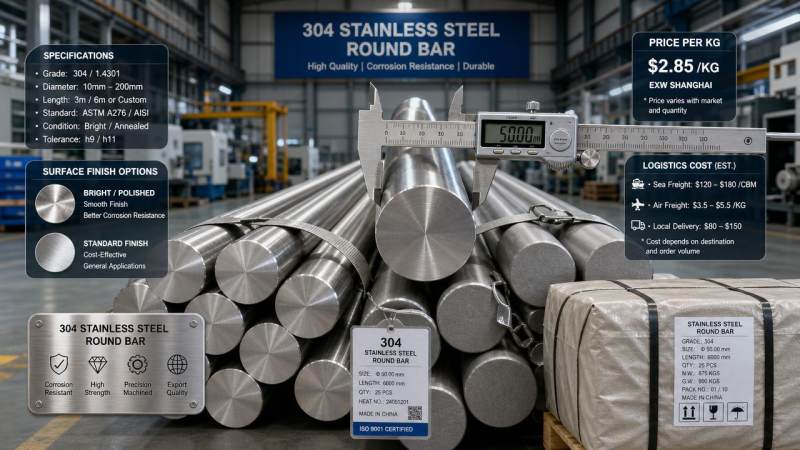
A checklist helps standardize quotation reviews. It also makes supplier comparisons clearer when specifications look similar but hidden cost items differ significantly.
In the steel industry, especially for export orders, small differences in diameter tolerance, finish, or testing can shift the 304 stainless steel round bar price per kg more than expected.
Core checklist for evaluating 304 stainless steel round bar price per kg
- Confirm grade identity before comparing prices. Verify that the offer is true 304 stainless steel, not 201 or mixed-stock alternatives with different nickel and chromium content.
- Check diameter and length carefully. Larger diameters, tight dimensional tolerances, and fixed cut lengths usually increase machining time and raise the 304 stainless steel round bar price per kg.
- Review surface finish requirements. Black, peeled, bright drawn, polished, and centerless ground bars carry different processing costs and should never be priced as equivalent products.
- Match standards and certificates exactly. ASTM, EN, JIS, or GB compliance, plus mill test certificates and third-party inspection, can add measurable cost to each kilogram.
- Ask about production route. Hot rolled bars often have lower starting prices, while cold finished bars provide tighter tolerances and smoother surfaces at a premium.
- Measure order quantity impact. Small lots increase setup, handling, and packing costs, while larger volumes often reduce the average 304 stainless steel round bar price per kg.
- Clarify weight basis in the quote. Some offers use theoretical weight, others use actual weight, and this difference directly affects total landed cost calculations.
- Separate material price from logistics charges. Export packing, inland transport, port fees, and ocean freight can distort the apparent competitiveness of one supplier.
- Verify delivery time and stock status. Immediate stock may cost more per kilogram, while mill production can lower price but extend project schedules.
- Inspect packaging method. Bundling, waterproof wrapping, wooden cases, and container loading support product protection but may alter the final quoted figure.
Main factors that move stainless round bar pricing
Raw material market movement
Nickel, chromium, and scrap stainless inputs strongly influence the 304 stainless steel round bar price per kg. When alloy surcharges rise, mill offers usually follow within a short cycle.
Exchange rates also matter for export contracts. A stable USD quotation may still reflect changing domestic costs at the production source.
Size and processing complexity
Small-diameter bright bars and precision-finished bars often cost more than basic hot rolled products. Additional peeling, straightening, polishing, or heat treatment adds value and expense.
Special length cuts, chamfered ends, or strict straightness requirements can also raise the 304 stainless steel round bar price per kg in practical purchasing situations.
Standards, testing, and traceability
Traceability requirements are often underestimated. Heat number tracking, PMI testing, ultrasonic inspection, and third-party verification increase cost but reduce downstream quality risk.
For international projects, compliance with ASTM, EN, JIS, or GB standards should be written into the inquiry to avoid non-comparable quotations.
Application scenarios that affect price expectations
Construction and structural support
In building and structural applications, price sensitivity is high because tonnage can be large. Buyers often prioritize standard sizes, reliable supply, and basic certification over cosmetic finishes.
A company such as Hongteng Fengda, a structural steel manufacturer and exporter from China, typically supports such projects by balancing production stability, export experience, and standard compliance.
Machining and precision parts
For shafts, fasteners, fittings, and turned components, the 304 stainless steel round bar price per kg is only one part of the cost equation. Machinability, diameter accuracy, and surface consistency matter more.
In some surrounding applications, galvanized carbon steel may be selected for corrosion resistance and lower cost. For example, Galvanized Round Steel is commonly used in electric power towers, street light poles, railway works, and building steel structure components where stainless is not mandatory.
Marine or outdoor exposure
Outdoor and marine-adjacent environments require close review of corrosion expectations. Although 304 is widely used, service conditions may demand additional finishing, passivation, or even a higher grade.
When comparing offers, a lower 304 stainless steel round bar price per kg can be misleading if the actual environment shortens service life or increases maintenance frequency.
Commonly overlooked cost items and risk alerts
- Ignore country of origin differences and risk mixing prices that include very different energy, labor, and compliance cost structures.
- Overlook tolerance notes and accept a low unit price for bars that later fail machining or assembly requirements.
- Assume all certificates are equivalent without checking whether the test report is original, traceable, and linked to the shipment batch.
- Miss packing and damage risk, especially for export containers where poor bundling can create hidden replacement costs.
- Compare only FOB numbers and forget that the true benchmark should often be CFR, CIF, or delivered warehouse cost.
Another common mistake is treating substitute products as direct comparisons. In corrosion-controlled outdoor projects, some engineers may evaluate Galvanized Round Steel against stainless options based on life-cycle cost rather than upfront material price alone.
Practical steps to get a more accurate quotation
- Prepare one detailed inquiry sheet covering grade, diameter, length, tolerance, finish, quantity, destination port, and certification needs.
- Request separate line items for base material, processing, testing, packing, and shipping to expose cost drivers clearly.
- Ask whether the 304 stainless steel round bar price per kg is based on actual or theoretical weight before making total cost comparisons.
- Check stock availability and production lead time together, because cheaper mill prices may conflict with installation schedules.
- Sample quality first when tolerances are critical. A small verification order can prevent large downstream losses.
Conclusion and next action
The most reliable way to judge the 304 stainless steel round bar price per kg is to compare like-for-like specifications, not headline numbers. Grade authenticity, finish, tolerance, testing, quantity, and logistics all shape the real cost.
A structured review process reduces sourcing risk and improves budget accuracy. Start by standardizing your inquiry sheet, separating cost components, and checking whether each quotation matches the same technical requirement.
When export reliability, standard compliance, and stable supply matter, working with an experienced structural steel source can simplify comparison and improve execution across global projects.
Please give us a message


Please enter what you want to find