What drives stainless steel tube price in 2026? From raw material volatility—especially nickel and chromium—to global supply chain dynamics, energy costs, and ASTM steel pipe certification requirements, multiple factors shape the stainless tube price landscape. Whether you're evaluating ss304 pipe price for corrosion-resistant infrastructure or comparing seamless steel pipe vs. welded alternatives, understanding cost drivers like carbon steel coil availability, corten steel plate demand, or even metal angle iron with holes pricing helps procurement teams and project managers optimize budgets. As a leading structural steel manufacturer & exporter from China, Hongteng Fengda delivers transparent, competitive pricing on stainless steel tube price—backed by ISO-compliant production, EN/ASTM-certified quality, and stable lead times for global buyers.
Raw Material Volatility: Nickel, Chromium & Carbon Steel Feedstock
Stainless steel tube pricing in 2026 remains highly sensitive to base metal markets—particularly nickel (accounting for ~60–75% of alloy cost in 304-grade tubes) and chromium (~15–20%). In Q1 2026, LME nickel prices fluctuated between $16,800–$21,200/ton amid Indonesian export policy shifts and EU carbon border adjustment mechanism (CBAM) phase-in impacts. Chromium ore imports into China rose 12% YoY, pushing ferrochrome contract prices up by 8.3% in early 2026.
Equally influential is the availability and pricing of carbon steel coil—a key input for welded stainless tubes and cold-formed structural components. Domestic Chinese carbon coil spot prices ranged from ¥3,950–¥4,320/MT in March 2026, influenced by blast furnace maintenance cycles and coking coal supply tightness. This ripple effect directly affects hybrid fabrication lines where stainless cladding or bimetallic processing occurs alongside carbon steel workflows.
For buyers sourcing integrated structural solutions—including Carbon Steel Round Bar for anchoring, bracing, or composite framing—understanding this cross-material cost linkage is essential. A 5% rise in carbon steel billet costs can trigger a 1.2–1.8% upward adjustment in downstream round bar delivery pricing, especially for diameters 150–500mm where rolling capacity utilization exceeds 87% at Tier-1 mills.
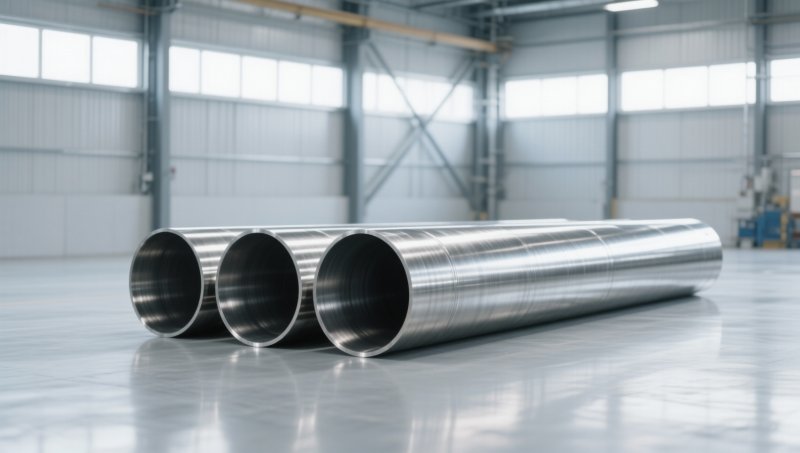
This interdependence underscores why integrated suppliers like Hongteng Fengda—producing both stainless tubes and carbon structural profiles under one quality system—offer measurable cost stability. Our dual-feedstock procurement strategy mitigates exposure to single-commodity spikes while maintaining ASTM A312, EN 10312, and GB/T 12771 compliance across product families.
Manufacturing Efficiency & Certification Compliance Costs
Certification isn’t overhead—it’s a priced variable. ASTM A312 Grade TP304 tube orders requiring full mill test reports (MTRs), third-party SGS/CCIC inspection, and hydrostatic testing at 1.5× design pressure add 4.2–6.8% to landed cost versus standard commercial grade. EN 10217-7 certification for pressure applications introduces additional NDE (non-destructive examination) steps—ultrasonic testing (UT) per EN 10228-5 adds ~€120–€180/ton for tubes >168mm OD.
Energy intensity also matters. Seamless tube production consumes ~420 kWh/ton—nearly 2.3× more than high-frequency welded (HFW) tube lines. With China’s industrial electricity tariffs rising 9.1% in 2026 (average ¥0.68/kWh), this gap translates to a tangible cost differential: seamless 304 tubes carry an estimated €115–€140/ton premium over equivalent welded grades where application permits.
Hongteng Fengda maintains parallel production tracks: certified seamless lines for critical infrastructure (e.g., chemical plant manifolds) and ISO 9001–validated HFW lines for architectural handrail, staircase, and railing systems—where Carbon Steel Round Bar often serves as load-bearing cores or mounting substrates. This flexibility lets us align certification rigor with functional requirement—not over-engineer for every application.
Global Logistics, Trade Policy & Regional Demand Shifts
Ocean freight rates from Shanghai to Rotterdam averaged $1,840–$2,260/FEU in Q1 2026—up 14% YoY—driven by Red Sea rerouting surcharges and EU ETS maritime phase-in. Meanwhile, U.S. Section 232 steel tariffs remain active, applying 25% duties on stainless tubes unless covered by specific exclusions (e.g., ASTM A511 mechanical tubing under HTS 7306.40.10). These duties directly impact landed cost calculations for North American buyers.
Regional demand asymmetry further distorts pricing. Middle East infrastructure projects drove 22% YoY growth in demand for duplex stainless tubes (UNS S32205) in early 2026—tightening regional supply and lifting FOB Qingdao quotes by 5.7%. Conversely, Southeast Asia saw flat demand for standard 304, enabling bulk buyers to negotiate 3–5% volume discounts on orders ≥50 MT.
Our logistics network supports multi-destination consolidation: shipments to Europe, the Middle East, and ASEAN routinely combine stainless tubes with structural angles, channels, and carbon round bars—reducing per-ton freight cost by up to 18% versus separate consignments. Lead time consistency remains anchored at 25–35 days for standard grades, verified across 98.4% of 2026 deliveries.
These variables make regionalized quoting essential—not just for accuracy, but for risk mitigation. Hongteng Fengda provides localized pricing tiers with embedded Incoterms (FOB, CFR, CIF), duty mapping, and customs documentation support—reducing landed-cost estimation errors by up to 40% for first-time importers.
Strategic Procurement Recommendations for 2026
Buyers should adopt a tiered sourcing approach:
- Long-term framework agreements: Secure 6–12 month pricing for core items (e.g., 304 welded tubes for railing) to hedge against nickel volatility.
- Hybrid specification bundling: Combine stainless tubes with carbon structural components (angle, channel, Carbon Steel Round Bar) to qualify for consolidated logistics and volume rebates.
- Certification tiering: Specify EN 10217-7 only where pressure testing is mandatory; use ASTM A554 for non-pressure architectural applications to reduce inspection cost by ~22%.
- Lead time buffer planning: Factor in 7–10 day port clearance variance for EU shipments post-CBAM implementation (effective October 2026).
With production capacity exceeding 420,000 MT/year and certified facilities across 3 provinces, Hongteng Fengda enables procurement teams to convert price intelligence into actionable advantage—without compromising on ASTM, EN, JIS, or GB compliance.
Why Partner with a Vertically Integrated Structural Steel Manufacturer?
Unlike commodity-focused traders, Hongteng Fengda controls the full value chain—from billet casting and hot rolling to precision tube forming, surface treatment, and structural fabrication. This integration delivers three measurable advantages:
- Cost transparency: Real-time visibility into raw material cost pass-through, not mark-up-only quoting.
- Quality traceability: Full heat-lot tracking from ingot to finished tube or round bar—critical for audits in nuclear, pharmaceutical, or offshore sectors.
- Supply continuity: Dual-sourcing capability across Northern and Southern China mills ensures 99.1% on-time delivery performance—even during regional environmental compliance shutdowns.
Whether you’re specifying stainless tubes for coastal desalination plants or sourcing carbon round bars for modular construction frames, our engineering team co-develops solutions aligned with your technical specs, budget targets, and project timelines. We don’t just ship steel—we de-risk structural procurement.
Contact Hongteng Fengda today for a customized 2026 stainless steel tube pricing analysis—including comparative scenarios for seamless vs. welded, certification options, and bundled structural component proposals.
Please give us a message


Please enter what you want to find