What affects 304 stainless steel sheet price today?
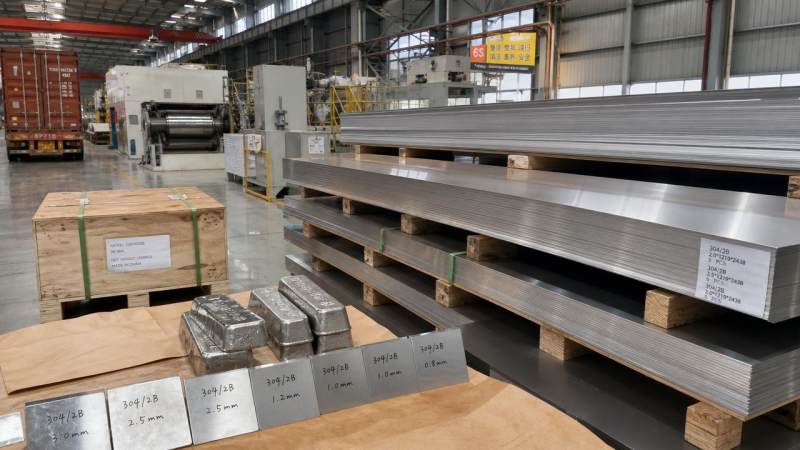
Understanding the 304 stainless steel sheet price today is essential for evaluating project budgets, supplier quotations, and long-term procurement risks.
Prices can shift due to nickel costs, market demand, mill output, thickness, surface finish, freight rates, and trade conditions.
For sourcing from China, the 304 stainless steel sheet price should never be judged by unit cost alone.
Quality standards, lead time, customization ability, export experience, and supplier reliability strongly affect the final purchasing result.
Why does the 304 stainless steel sheet price change so often?
The 304 stainless steel sheet price is closely linked to raw material movement, especially nickel and chromium.
304 stainless steel usually contains about 8% nickel, making nickel cost a major pricing driver.
When nickel futures rise, mills often adjust stainless steel sheet quotations quickly.
When nickel weakens, the 304 stainless steel sheet price may soften, but not always immediately.
Mills also consider inventory levels, energy costs, labor, production schedules, and order backlogs.
Short supply can keep prices firm even when raw material costs decline.
Demand from construction, kitchen equipment, machinery, decoration, elevators, tanks, and fabrication also affects the market.
Seasonal construction cycles may increase buying activity and support a higher 304 stainless steel sheet price.
Export demand matters too, especially when buyers shift sourcing between China, Southeast Asia, Europe, and local markets.
What market signals should be checked?
- Nickel and ferrochrome price trends.
- Stainless steel mill production plans.
- Spot stock levels in major trading regions.
- Freight rate changes and port congestion.
- Exchange rate movement against the US dollar.
- Trade policies, duties, and import restrictions.
These signals help explain why two quotations for the same grade may differ within a short period.
How do thickness, size, and finish affect 304 stainless steel sheet price?
Specification is one of the most direct factors behind the 304 stainless steel sheet price.
Common thicknesses often have better availability and more competitive pricing.
Uncommon gauges, tight tolerances, and special widths may require additional processing.
That increases production loss, handling time, and sometimes minimum order requirements.
Surface finish also changes the 304 stainless steel sheet price significantly.
No.1 finish is usually used for industrial applications and is often more economical.
2B finish is popular for general fabrication, equipment panels, and moderate appearance needs.
BA, brushed, mirror, embossed, and decorative finishes normally cost more.
Protective film, PVC coating, edge trimming, laser cutting, and surface inspection can add further cost.
Which specification details should appear in a quotation?
A detailed quotation reduces confusion and makes the 304 stainless steel sheet price easier to compare.
Is the lowest 304 stainless steel sheet price always the best option?
A very low 304 stainless steel sheet price can look attractive at first.
However, low pricing may hide risks in chemistry, thickness tolerance, surface quality, or delivery reliability.
Some offers may exclude export packaging, inspection documents, inland transport, or port charges.
Others may quote mixed stock, secondary material, or products with limited traceability.
For stainless steel sheet, the actual cost includes more than the invoice price.
Rework, corrosion failure, rejected parts, delayed containers, and inconsistent finish can create higher hidden costs.
A better approach is to compare total value against project requirements.
That includes standards, certificates, inspection process, packing method, lead time, and after-sales support.
What quality documents should support the price?
- Mill test certificate with chemical composition.
- Mechanical property report when required.
- Applicable standards such as ASTM, EN, JIS, or GB.
- Surface inspection photos or videos.
- Packing photos before shipment.
- Third-party inspection if the project requires it.
These checks help verify whether the 304 stainless steel sheet price matches the promised quality level.
How do freight, lead time, and trade terms change the final cost?
The factory quote is only one part of the final 304 stainless steel sheet price.
International freight can change quickly due to vessel space, fuel cost, port schedules, and regional demand.
A lower ex-works price may become expensive after inland freight and documentation are added.
FOB, CFR, CIF, and DDP quotations should be compared carefully.
Each term includes different responsibilities, risks, and cost boundaries.
Lead time also affects purchasing decisions because stainless steel markets can move during production.
If delivery is urgent, available stock may reduce risk even if the unit price is slightly higher.
If the schedule is flexible, forward planning may improve price negotiation and shipment consolidation.
Where can total landed cost increase?
- Export wooden pallets or seaworthy packaging.
- Container loading, port handling, and customs documents.
- Marine insurance and destination port charges.
- Import duty, tax, and local transportation.
- Currency changes during payment and shipment.
A clear landed cost comparison prevents mistakes when evaluating the 304 stainless steel sheet price from different suppliers.
When should other steel products be considered with stainless sheets?
Some projects require stainless sheets for corrosion resistance and carbon steel for structural strength.
Comparing the 304 stainless steel sheet price with related steel materials can improve budget planning.
For floors, platforms, stairs, machinery areas, and shipbuilding surfaces, patterned carbon steel may be practical.
Hongteng Fengda supplies structural steel products and customized solutions for global construction and industrial projects.
Its product range includes angle steel, channel steel, steel beams, cold formed profiles, and custom components.
For anti-skid flooring or decorative structural use, SS440 Patterned steel plate can be evaluated alongside stainless sheet options.
This product offers a patterned surface, anti-skid performance, bending resistance, steel saving, and strong appearance value.
Typical thickness is 2-8mm, with length from 2m to 12m or customized requirements.
Available width ranges from 600mm to 1800mm, with common sizes including 1250mm and 1500mm.
Materials include Q235B, A36, S235, SS400, SS440, SM400A, and other international equivalents.
Standards can align with ASTM, DIN, JIS, BS, GB, ISO, SGS, and BV requirements.
Using the right material combination may reduce total cost without compromising safety or performance.
How can a reliable supplier help control 304 stainless steel sheet price risk?
A reliable supplier cannot control every market movement, but can reduce purchasing uncertainty.
Stable production capacity helps maintain consistent availability during active market periods.
Strict quality control ensures the quoted 304 stainless steel sheet price reflects usable material.
Export experience also matters because documentation, packing, and shipment coordination affect delivery success.
Hongteng Fengda supports global steel sourcing with international standards, OEM solutions, and dependable lead times.
Its experience across North America, Europe, the Middle East, and Southeast Asia supports practical export execution.
When evaluating the 304 stainless steel sheet price, ask for complete specifications before comparing offers.
Clear technical communication reduces mistakes in grade, tolerance, surface finish, and packing requirements.
Practical checklist before confirming an order
FAQ: quick answers about 304 stainless steel sheet price
What is the main factor affecting 304 stainless steel sheet price today?
Nickel cost is usually the most visible factor, but supply, demand, finish, and freight can be equally important.
Why do suppliers give different prices for the same grade?
Different mills, stock sources, tolerances, surface grades, payment terms, and freight conditions can change the final quote.
How can the 304 stainless steel sheet price be compared fairly?
Compare grade, thickness, finish, tolerance, certificate, packing, trade term, lead time, and total landed cost.
Is it better to buy stock or customized sheets?
Stock is often faster and stable. Customized sheets fit special requirements but may need longer production and higher cost.
When should quotations be confirmed quickly?
Fast confirmation is useful when nickel is rising, mill supply is tight, or shipping schedules are limited.
Conclusion: how to make a better pricing decision
The 304 stainless steel sheet price today is shaped by raw materials, specifications, market demand, logistics, and supplier capability.
A smart comparison looks beyond the lowest unit price and focuses on total value.
Before ordering, confirm grade, finish, tolerance, certification, packing, trade term, and delivery schedule.
For projects involving stainless sheet and structural steel, request a coordinated quotation with complete technical details.
This helps control cost, reduce sourcing risk, and secure materials that match real application requirements.
Please give us a message


Please enter what you want to find