Choosing ss 304 pipe is rarely just a sizing decision. In steel projects, the real question is whether the pipe matches the required standard, carries reliable traceability, and can be verified by documentation.
That is why ASTM grades, AISI designations, and mill test reports matter so much. For industrial lines, structural supports, and fabrication work, they shape compliance, safety checks, and long-term service confidence.
Why standards matter before ss 304 pipe goes into service
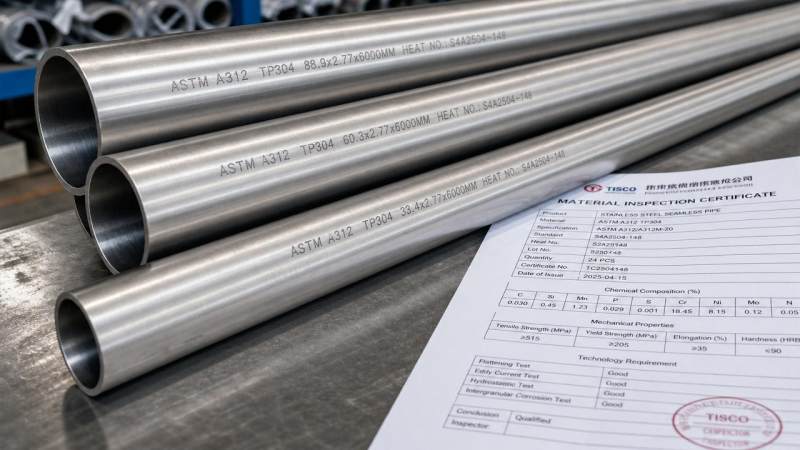
A stainless pipe may look correct on the surface and still fail documentation review. Material substitution, incomplete test data, or unclear heat traceability can create hidden risk long before installation.
In practice, ss 304 pipe is used where corrosion resistance, clean appearance, and stable fabrication performance are expected. That includes process systems, equipment frames, utility lines, and many mixed steel assemblies.
From a control standpoint, standards create a common language. They define chemistry, mechanical properties, manufacturing method, dimensional tolerances, and inspection requirements that can be checked objectively.
ASTM and AISI do not mean the same thing
A frequent source of confusion is the difference between ASTM and AISI. Both appear in discussions about ss 304 pipe, but they serve different purposes.
AISI 304 identifies the stainless steel type
AISI 304 refers to the alloy family. It typically describes an austenitic stainless steel with chromium and nickel content that supports corrosion resistance and good forming and welding behavior.
Simple labeling as “304” is useful, but incomplete. It does not by itself confirm whether the pipe was produced as seamless or welded, what tests were performed, or which dimensional rules apply.
ASTM defines the purchasing and inspection basis
ASTM standards tell buyers what the pipe must meet. For ss 304 pipe, common references include ASTM A312 for seamless, welded, and heavily cold worked stainless steel pipe.
Other standards may appear depending on use, such as ASTM A213 for tubing or ASTM A554 for ornamental mechanical tubing. That distinction matters because pipe and tube are not interchangeable in documentation.
What should be verified on the mill test report
The mill test report is often the most practical checkpoint. It connects the delivered ss 304 pipe to the actual production heat, test results, and manufacturing details.
When reviewing an MTR, the basic question is not whether a certificate exists. The question is whether the certificate proves the delivered material meets the ordered standard.
- Material grade, such as TP304 or equivalent notation
- Applicable ASTM standard and edition if specified
- Heat number and traceability to product marking
- Chemical composition, especially Cr, Ni, C, Mn, Si, P, and S
- Mechanical properties, including tensile and yield values
- Pipe size, schedule, wall thickness, and length
- Manufacturing route, such as seamless or welded
- Nondestructive or hydrostatic test records when required
- Solution annealing or heat treatment information where relevant
A missing heat number breaks traceability. A chemistry table without tolerance alignment may still leave doubt. An MTR only adds value when it matches the purchase order, markings, and inspection plan.
Where mistakes happen in real projects
The most common issue is treating “304 stainless” as enough detail. For many applications, that is too broad. Pipe standard, schedule, finish, test scope, and end use all affect acceptance.
Another problem appears in mixed-material projects. Stainless pipe may be installed beside carbon steel beams, channels, or fabricated supports, yet the document control process remains inconsistent between categories.
This is where disciplined steel sourcing helps. Suppliers with experience across ASTM, EN, JIS, and GB systems usually manage specification matching more carefully, especially on export orders and OEM production.
In broader structural packages, components often need the same documentation culture. For example, Hot Rolled H Beam products used in steel structures, bridges, shipbuilding, or automobile chassis also rely on standard-based verification.
Those sections may follow JIS G3101, EN10025, ASTM A36, ASTM A572, or ASTM A992, with flange thickness from 8-64mm and web thickness from 5-36.5mm. The lesson is consistent: documents must match the product and application.
How ss 304 pipe standards connect to safety and service life
Standards are not just paperwork. They affect weld quality, corrosion behavior, pressure performance, maintenance intervals, and failure investigation if something goes wrong later.
For example, if ss 304 pipe is installed in a chloride-rich environment, the base grade may be acceptable in some cases and inadequate in others. The MTR confirms what was supplied, but design suitability still needs review.
In sanitary or process environments, surface condition and cleanliness may carry extra weight. In structural utility use, weldability, dimensional consistency, and support compatibility may be more critical.
That is why standard review should sit beside application review. A compliant ss 304 pipe can still be the wrong choice if media, temperature, or exposure conditions were poorly defined.
A practical checklist for evaluating incoming material
A short verification routine can prevent expensive rework. It also helps separate minor paperwork gaps from material risks that require hold, segregation, or replacement.
- Confirm the purchase order names the exact ASTM product standard
- Check that “304” on markings agrees with MTR grade notation
- Match heat number on pipe, bundle tag, and certificate
- Review actual dimensions against schedule and tolerance limits
- Verify test records required by project specification
- Inspect surface for contamination, mix-up, or handling damage
- Separate pipe standard issues from application suitability issues
This approach becomes even more useful when supply covers both stainless piping and structural steel items. Companies such as Hongteng Fengda work across standard specifications and custom fabrication, so document consistency can be managed across product families.
What to clarify before placing the next order
If the requirement is simply “ss 304 pipe,” too much remains open to interpretation. A better order description reduces sourcing risk and speeds inspection after delivery.
It helps to define the product standard, grade notation, size, wall schedule, manufacturing method, finish, required tests, and certificate format. If project codes apply, include those references as well.
The same thinking applies across steel procurement generally. Whether the item is stainless pipe or a structural section, clarity on standards is usually the fastest path to fewer disputes and more reliable acceptance.
Before the next release, compare the service environment, specification language, and MTR requirements side by side. That small review often reveals whether ss 304 pipe is truly suitable, or whether a tighter standard definition is needed.
Please give us a message


Please enter what you want to find