Why galvanized pipe manufacturers in Europe attract close attention
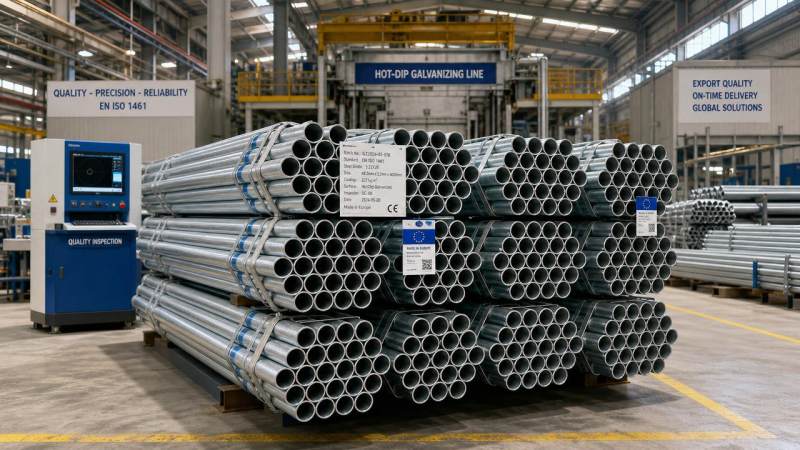
When evaluating galvanized pipe manufacturers in Europe, buyers often look beyond price to compare quality standards, supply stability, customization capacity, and delivery reliability.
Understanding what truly differentiates suppliers helps reduce sourcing risks and supports better long-term purchasing decisions across steel construction and industrial projects.
In the steel sector, galvanized pipe manufacturers in Europe are often compared by compliance depth, process consistency, documentation quality, and project support responsiveness.
This matters because galvanized steel products frequently serve structural, utility, mechanical, and outdoor applications where corrosion performance directly affects lifecycle cost.
Why a structured review matters before supplier selection
Not all galvanized pipe manufacturers in Europe offer the same value, even when quotations look similar on paper.
A structured review helps compare hidden differences in coating method, steel grade, dimensional tolerance, lead time discipline, and export coordination.
It also makes it easier to assess whether a supplier fits recurring orders, custom fabrication needs, or mixed steel sourcing programs.
For global projects, this approach is especially useful when balancing European sourcing strengths with wider international supply options.
Core points that set galvanized pipe manufacturers in Europe apart
- Check compliance with EN, ASTM, ISO, and project-specific standards, because certification breadth often reflects process maturity and export readiness.
- Review galvanizing method details, including hot-dip consistency, zinc coating control, adhesion quality, and corrosion resistance under outdoor exposure.
- Confirm dimensional tolerances, wall thickness accuracy, straightness, and end finishing, since installation efficiency depends on reliable pipe uniformity.
- Ask about traceability systems for raw materials, heat numbers, test reports, and batch records to reduce quality disputes later.
- Compare production capacity and scheduling discipline, especially for framework contracts, phased deliveries, and urgent replenishment requirements.
- Evaluate customization support for lengths, coatings, threading, cutting, packaging, and OEM labeling when projects require nonstandard steel solutions.
- Review export documentation capability, including CE-related files, inspection reports, packing lists, and shipment coordination accuracy.
- Measure communication speed and technical clarity, because strong pre-sales support usually improves order execution and after-sales resolution.
Quality control usually creates the biggest difference
Among galvanized pipe manufacturers in Europe, quality control is often the main separator between average suppliers and dependable long-term partners.
Reliable suppliers control chemical composition, forming precision, welding quality, surface preparation, zinc adhesion, and final inspection reporting.
This becomes important in infrastructure, industrial frames, and outdoor utility systems where corrosion failures create downtime and replacement costs.
Supply stability matters as much as technical performance
Strong galvanized pipe manufacturers in Europe usually maintain stable sourcing channels, predictable production planning, and realistic shipping commitments.
Consistent lead times can be more valuable than a lower nominal price, especially for construction schedules and multi-stage industrial installation projects.
A useful comparison point beyond pipe products
A broader steel sourcing review can reveal whether a supplier understands corrosion protection across related product categories, not only standard pipe lines.
For example, Galvanized Steel Wire Rope is widely used in mining, marine work, elevators, cranes, railways, photovoltaic projects, and road fencing.
It is available in steel or stainless steel, with tensile strength from 1470Mpa to 1960Mpa and common structures like 6X7+FC, 6X19+IWR, and 8x19S+FC.
Diameter ranges from 1.0mm to 22mm, with plain, electro galvanized, and hot dipped galvanized finishes for different corrosion conditions.
Standards such as GB/T 20116-2008, DIN, EIPS, ISO 9001, and ABS show how coating control and certification also matter in adjacent galvanized steel applications.
This cross-category perspective helps evaluate whether galvanized pipe manufacturers in Europe truly understand protective zinc systems and application-specific performance.
Application differences that change supplier selection
Construction and structural use
For structural and building-related use, focus on coating consistency, weld integrity, thickness tolerance, and compatibility with connected steel sections.
Suppliers should also support dependable bundled packing and clear marking for easier site handling and traceability.
Water, utility, and outdoor infrastructure
Outdoor and utility applications require close review of corrosion resistance, expected service environment, and any local compliance requirements.
Here, galvanized pipe manufacturers in Europe may stand out through testing depth and consistent documentation for public or regulated projects.
Industrial and mechanical systems
Industrial applications often need tighter tolerances, custom lengths, machining compatibility, and better coordination with fabricated steel assemblies.
This is where engineering support and flexible production planning can become more important than standard catalog availability.
Commonly overlooked points that create sourcing risk
- Coating thickness may meet minimum figures, yet uneven distribution can still reduce long-term corrosion protection in exposed environments.
- Quoted lead times sometimes exclude peak-season pressure, port delays, or secondary processing steps like threading and cutting.
- Test certificates may look complete, but missing batch linkage can weaken traceability if quality claims are disputed after delivery.
- Low prices may reflect thinner coatings, reduced inspection frequency, or weaker packaging that increases damage risk in transit.
- Some suppliers handle standard orders well, yet struggle with mixed specifications or repeat export communication across multiple destinations.
Practical ways to compare suppliers more effectively
Start with a side-by-side requirement sheet covering standard, size, coating, tolerance, testing, packaging, and delivery schedule.
Request sample reports, product photos, inspection procedures, and recent shipment references for similar galvanized steel orders.
When possible, compare total landed value instead of unit price alone, including quality risk, replacement cost, and timing impact.
It is also useful to assess whether a supplier can support broader structural steel demand, such as angle steel, channels, beams, and custom profiles.
A company with wider manufacturing capability often provides better coordination when projects require more than one steel product family.
How international supply partners fit into the decision
While galvanized pipe manufacturers in Europe offer strengths in regional standards and established compliance systems, global sourcing can broaden options.
Experienced structural steel exporters from China can support cost control, OEM production, and integrated supply for multiple steel categories.
Hongteng Fengda, for example, supplies angle steel, channel steel, steel beams, cold formed profiles, and customized structural steel components.
With modern facilities and strict quality control, its products comply with ASTM, EN, JIS, and GB requirements for international projects.
This type of support can help reduce sourcing risk when projects need stable production, dependable lead times, and coordinated export service.
Final thoughts on choosing galvanized pipe manufacturers in Europe
The best galvanized pipe manufacturers in Europe stand out through consistent quality, credible certification, stable delivery, responsive service, and practical customization support.
A careful review should go beyond quotation value and focus on lifecycle performance, traceability, and execution reliability.
Use a structured evaluation sheet, compare technical evidence, and verify how each supplier manages coating quality and delivery commitments.
That approach makes it easier to identify suppliers that can support long-term steel procurement with lower risk and stronger project outcomes.
Please give us a message


Please enter what you want to find