In 2026, understanding what drives carbon steel price is critical for business evaluators balancing procurement risk, budget control, and project timing. While both supply and demand shape market movement, their impact can vary by region, policy shifts, raw material costs, and downstream industry activity. This article explores which factor may matter more and how buyers can make more informed sourcing decisions.
Why Scenario Differences Matter More Than a Simple Supply-vs-Demand Debate
For business evaluators in steel-related purchasing, the question is rarely theoretical. The practical issue is this: in your specific procurement scenario, will carbon steel price in 2026 be driven more by supply shocks or by demand conditions? The answer changes depending on whether you are sourcing for infrastructure, factory expansion, machinery manufacturing, export contracts, or distributor inventory planning.
A contractor working on a fixed-bid project feels price changes differently from a distributor managing rolling stock. A manufacturer buying structural sections for repeated monthly use watches demand signals differently from an importer facing tariffs, freight shifts, and exchange-rate pressure. That is why a scenario-based view is more useful than a broad market prediction. In many cases, the direction of carbon steel price may look global, but the real purchasing impact is highly local, contract-specific, and time-sensitive.
For companies involved in structural steel sourcing, especially those evaluating suppliers from China, the most effective approach is to connect market signals with application needs: delivery urgency, standard requirements, processing needs, replacement flexibility, and budget tolerance. A reliable supplier with stable production and quality consistency can often reduce exposure even when the market itself remains volatile.
The Main Business Scenarios Where Carbon Steel Price Becomes a Strategic Issue
In 2026, carbon steel price will not matter equally across all use cases. It becomes especially sensitive in projects where steel represents a large share of the budget, lead time affects penalties, or material substitution is limited. The following scenarios are the most common for evaluators in construction, industrial manufacturing, and international sourcing.
This comparison shows why the same market headline can lead to very different decisions. A rise in iron ore or coking coal may immediately affect mill offers, but if downstream demand is weak, buyers may still gain negotiating space. Conversely, strong project releases can lift carbon steel price even when raw material costs are relatively calm.
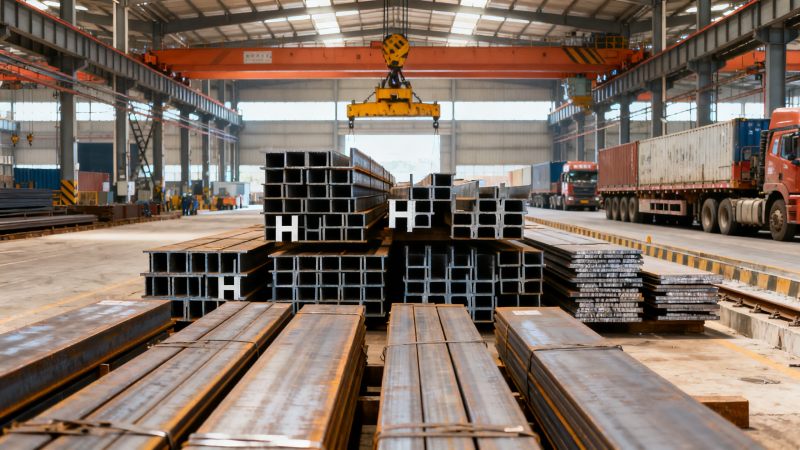
When Supply Is the Bigger Force Behind Carbon Steel Price in 2026
Supply tends to dominate carbon steel price when buyers face restricted output, energy cost surges, trade barriers, or logistics bottlenecks. In 2026, these pressures may come from environmental production controls, capacity discipline in major producing countries, geopolitical disruptions, or shipping instability. For business evaluators, these supply-side shifts matter most when projects cannot tolerate substitution or delay.
Scenario 1: Structural Projects With Fixed Delivery Deadlines
If you are sourcing angle steel, channel steel, steel beams, or cold formed profiles for a scheduled construction phase, supply reliability may matter more than demand trends. Even if the wider market is soft, local shortages in the exact specification can lift transaction prices. For example, ASTM or EN compliant sections with tight fabrication windows often become more expensive when mills allocate capacity to higher-volume items.
In this scenario, carbon steel price is not just a market number. It becomes a delivery-risk indicator. A small increase in mill offer may be acceptable if it secures lead time, test documentation, and production slot availability. That is particularly true for international buyers who must also account for inland transport, port congestion, and customs timing.
Scenario 2: Export Buying Under Policy and Freight Uncertainty
For exporters and overseas buyers, supply-side risk often outweighs pure consumption demand. Anti-dumping reviews, regional import restrictions, freight volatility, and container imbalance can all distort the final landed carbon steel price. In such cases, the price increase is not necessarily caused by booming end-user demand. It may result from reduced workable supply reaching your destination market.
This is where working with a structural steel manufacturer and exporter with stable production capacity becomes valuable. Suppliers able to support standard specifications and OEM solutions, while complying with ASTM, EN, JIS, and GB requirements, can reduce sourcing risk even in a fluctuating market.
When Demand Matters More for Carbon Steel Price
Demand becomes the stronger driver when production capacity is adequate but buying activity accelerates in selected sectors. In 2026, this may happen if infrastructure stimulus increases, manufacturing investment recovers, or energy and industrial projects restart in key regions. Under these conditions, carbon steel price rises because mills and traders gain confidence that orders will continue, not simply because supply is tight.
Scenario 3: Repeated Industrial Procurement With Rolling Forecasts
Manufacturers buying steel on a monthly or quarterly basis often feel demand-side momentum first. If machine builders, equipment makers, or fabrication shops see stronger order books, they typically increase purchase volume before a visible shortage emerges. In that environment, carbon steel price can climb gradually as restocking spreads across the market.
For evaluators, the warning signs include higher inquiry frequency, shorter quotation validity, reduced discount flexibility, and rising futures sentiment. None of these necessarily means supply has collapsed. Instead, they often reflect improving demand confidence.
Scenario 4: Public and Private Construction Recovery
When multiple construction segments recover together, carbon steel price can be pulled upward by aggregate demand. Warehouses, logistics parks, industrial workshops, bridges, and utility structures all consume structural steel in meaningful tonnage. Even moderate improvement across several regions can tighten availability for common sections and plates.
In this situation, evaluators should look beyond headline demand data. The key is whether funded projects are actually entering procurement. Announced investment alone does not move price as much as real tender release, fabrication scheduling, and shipment execution.
A Practical Mid-Project Lesson: Not Every Cost Decision Should Be Tied to Carbon Steel Alone
One common mistake in business evaluation is treating every metal purchase as if it follows identical pricing logic. In mixed-material projects, carbon steel price may be central for structural framing, yet corrosion-critical systems may require stainless products with a different cost structure and selection standard. For example, process lines, sanitary installations, or corrosive environments often rely on 304L Stainless Steel Pipe rather than carbon steel alternatives.
This ultra-low-carbon stainless option is designed to address susceptibility to intergranular corrosion while retaining corrosion resistance, toughness, and machinability. Typical specifications include wall thickness from 0.5mm to 50mm, seamless outer diameter from Φ 3mm to Φ1020mm, welded outer diameter from Φ 6mm to Φ630mm, and length from 1000mm to 12000mm, with finishes such as pickling, sandblast, bright polished, and mirror polishing. It is commonly supplied to ASTM, GB, EN, AISI, JIS, and DIN standards. The lesson for evaluators is simple: analyze each package by service condition and life-cycle fit, not by applying one pricing framework to all materials.
Which Matters More in 2026: Supply or Demand?
For most business evaluators, the best answer is conditional rather than absolute. In early-stage procurement or globally exposed import trade, supply is likely to matter more because it directly affects offer availability, lead time, and landed cost certainty. In active domestic construction or manufacturing recovery cycles, demand may have the stronger influence because it lifts transaction volume and limits negotiation room.
However, if the question is which force is more dangerous to budgeting, supply-side disruption usually creates sharper and less predictable jumps in carbon steel price. Demand-led increases are often easier to observe and plan around. Supply-led increases can appear suddenly through mill maintenance, policy intervention, energy cuts, or trade restrictions. That makes supply risk especially important for fixed-price contracts and deadline-sensitive projects.
How Different Buyers Should Evaluate Carbon Steel Price Risk
This structured approach helps convert a general market question into a sourcing decision. Instead of asking only whether carbon steel price will rise or fall, ask which factor can damage your project more: unavailable tonnage, unstable lead time, or weakening downstream demand.
Common Misjudgments in Real Purchasing Scenarios
Several mistakes appear repeatedly in steel buying decisions. First, some teams focus too heavily on benchmark price trends and ignore specification-specific tightness. Second, they assume weak macro demand guarantees lower purchase cost, even when supply for the required section is limited. Third, they compare suppliers only by ex-works offer and overlook consistency in quality control, standards compliance, and delivery reliability.
Another common error is delaying orders in the hope of a better market without checking fabrication and shipping windows. In 2026, carbon steel price may not need a broad bull market to increase for your order. A narrow bottleneck in beams, channels, or customized structural parts can be enough. This is why professional sourcing should combine market reading with supplier capability assessment.
Action Plan for More Informed Sourcing in 2026
If you are evaluating steel purchases for construction, industrial, or export use, start by classifying your scenario: deadline-driven, cost-driven, inventory-driven, or compliance-driven. Then assess whether your exposure is mainly to supply interruption or demand expansion. Review material grade, standard, section type, and processing requirements before comparing quotations.
For global buyers, it is often practical to work with a supplier that combines stable production capacity, strict quality control, and familiarity with international standards. A dependable Chinese structural steel manufacturer and exporter can support angle steel, channel steel, steel beams, cold formed steel profiles, and customized structural steel components while helping reduce sourcing risk and improve lead-time confidence.
In the end, whether supply or demand affects carbon steel price more in 2026 depends on the application scenario you are managing. But for most business evaluators, the winning strategy is the same: treat price as only one part of the decision, and weigh it together with delivery certainty, standards compliance, processing fit, and total project risk. That is how better sourcing decisions are made in a volatile steel market.
Please give us a message


Please enter what you want to find