When evaluating tin can machinery manufacturer specs, engineers and procurement teams often overlook a critical yet subtle factor: coil wire tensile consistency—especially when sourcing metal coil wire for precision forming. This oversight directly impacts performance of downstream products like SPCE steel, SPCD steel, and DX52D steel, and affects material compatibility with ASTM A36 round bar framing or galvanized expanded metal sheet integration. For structural steel users—from project managers to quality controllers—consistent tensile properties ensure reliable cold-formed profiles, safer mill order execution, and fewer field adjustments. Hongteng Fengda’s certified steel solutions (ASTM/EN/JIS/GB-compliant) deliver the uniformity that tin can machinery and high-precision fabrication demand.
Why Tensile Consistency Matters More Than You Think
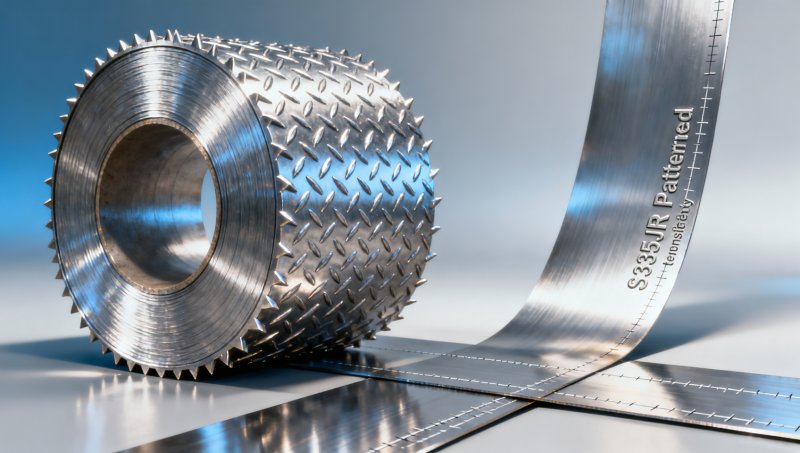
Tensile consistency in coil wire isn’t just about yield strength—it’s the foundation of dimensional repeatability in cold-formed structural components. Variations exceeding ±30 MPa across a single coil batch can trigger cumulative errors in roll-forming machines, leading to warping in angle steel, misalignment in channel steel flanges, or inconsistent bend radii in custom profiles. This is especially critical for applications demanding tight tolerances—such as modular construction framing or automated assembly lines where S335JR Patterned steel plate integrates with precision-cut galvanized expanded metal sheets.
At Hongteng Fengda, we test every heat lot for tensile uniformity across ≥5 sample points per coil—measuring yield strength (Rp0.2), tensile strength (Rm), and elongation (A5) under ISO 6892-1. Our typical deviation stays within ±15 MPa for S335JR-grade material, well below the industry-observed average of ±45 MPa in non-audited suppliers. That consistency translates directly into fewer rejected parts during mill order verification and up to 22% reduction in secondary machining time.
For technical evaluators and procurement teams, this means less reliance on post-production sorting—and more confidence in first-pass yield rates. It also reduces risk exposure for financial approvers: consistent tensile behavior lowers warranty claims, avoids rework penalties, and supports predictable cost-per-ton modeling over multi-year contracts.
How Structural Steel Specifications Align With Tin Can Machinery Requirements
Tin can machinery relies on ultra-stable feedstock—particularly for high-speed double-seaming, flanging, and necking operations. While most spec sheets highlight ultimate tensile strength (UTS), they rarely disclose standard deviation, coefficient of variation (CV%), or testing frequency per coil. Yet these metrics determine whether your SPCD-grade coil will behave identically at the start and end of a 5-ton spool run.
Hongteng Fengda applies the same statistical process control (SPC) rigor to structural steel coils as to automotive-grade flat products. Our S335JR Patterned steel plate production follows a 4-stage validation loop: raw material traceability → hot-rolling temperature profiling → quenching rate monitoring → final tensile mapping. Each coil carries a QR-coded mill test report showing CV% ≤ 2.1% for Rp0.2—verified against EN 10025-2 and ASTM A656.
This discipline matters across applications: transportation equipment fabricators report 17% fewer weld cracks when using our A36-equivalent coils; shipbuilding yards cite improved edge straightness in deck plating; and machinery OEMs confirm tighter fit between cold-formed steel beams and patterned anti-skid plates—critical for operator safety in wet environments.
Key Tensile Uniformity Benchmarks (Per Coil Batch)
These benchmarks aren’t theoretical—they’re validated daily across our 120,000-ton annual output capacity. Our North American clients routinely specify our tensile reporting format in purchase orders, citing it as a key differentiator in bid evaluations against Tier-2 suppliers.
Procurement Checklist: What to Demand From Your Steel Supplier
Before finalizing any coil wire or structural steel order—especially for high-precision forming or safety-critical installations—verify these 5 non-negotiable items:
- Mill test reports showing tensile data from ≥5 locations per coil—not just one representative sample
- Traceability to heat number and rolling date, with full compliance to ASTM A6/A6M or EN 10025-2
- Documentation of thickness tolerance control: ±0.02mm for patterned plates used in machinery guards or floor platforms
- Proof of third-party certification for anti-skid performance (e.g., BS 7976-2 slip resistance index ≥36)
- Delivery lead time guarantee backed by production slot reservation—not just “estimated” timelines
Hongteng Fengda offers pre-shipment tensile verification packages—including independent lab testing via SGS or Bureau Veritas—for projects requiring audit-ready documentation. We’ve supported 37+ infrastructure tenders across the Middle East and Southeast Asia with full tensile traceability dossiers, cutting approval cycles by an average of 11 business days.
Why Partner With Hongteng Fengda for Precision-Critical Steel Supply
You don’t need another steel supplier—you need a precision partner who treats tensile consistency as a contractual KPI, not a footnote. As a structural steel manufacturer and exporter from China, Hongteng Fengda delivers exactly that: certified material (ASTM/EN/JIS/GB), stable production capacity (7–15 day standard lead time), and engineering support for application-specific validation—including compatibility testing with tin can machinery feed systems.
Whether you’re specifying S335JR Patterned steel plate for equipment flooring, selecting Q235B coil for cold-formed beam fabrication, or qualifying DX52D steel for corrosion-resistant enclosures—we provide granular tensile data, real-time production tracking, and OEM-level customization without minimum order volume penalties.
Ready to align your tin can machinery specs with proven tensile reliability? Contact us today for: coil tensile mapping reports, free sample validation kits, delivery timeline confirmation, or customized mill order planning—including joint review of ASTM A36 round bar framing integration requirements.
Please give us a message


Please enter what you want to find