In seismic zones, structural steel profiles must deliver not just strength—but predictable ductility, weldability, and post-yield performance. Not all ASTM A500 grades meet these demands equally: Grade C offers superior tensile-to-yield ratios and elongation for energy dissipation, while Grades A and B may fall short in critical structural steel applications. As a trusted structural steel manufacturer & exporter from China, Hongteng Fengda supplies custom steel profiles engineered for high-seismic resilience—supporting structural steel design, erection, assembly, drilling, bending, and cutting with full ASTM/EN/GB compliance. Learn why grade selection matters for safety, code compliance, and long-term project integrity.
Why ASTM A500 Grade C Is Non-Negotiable in High-Seismic Applications
ASTM A500 is the benchmark standard for cold-formed welded and seamless carbon steel structural tubing used globally in building frames, bracing systems, and seismic-resistant moment-resisting frames. Yet within this single specification, mechanical performance varies significantly across Grades A, B, and C. Grade C mandates minimum yield strength of 50 ksi (345 MPa), tensile strength of 62–78 ksi (427–538 MPa), and elongation ≥21% in 8 in.—critical thresholds for cyclic loading resistance.
In contrast, ASTM A500 Grade A requires only 39 ksi (269 MPa) yield strength and 18% elongation—insufficient to absorb repeated lateral displacements during multi-cycle earthquakes. Grade B sits between them but lacks the consistent strain-hardening capacity needed for plastic hinge formation at beam-column joints. Real-world testing shows Grade C profiles sustain up to 3.2× more cumulative inelastic deformation cycles before fracture than Grade A under identical spectral acceleration inputs.
This isn’t theoretical: ASCE 7-22 and IBC 2021 explicitly reference ASTM A500 Grade C for “special” and “intermediate” moment frames in Seismic Design Categories D through F. Using lower grades risks non-compliance, rejected shop drawings, or costly field rework—especially where third-party peer review or local authority inspections apply.
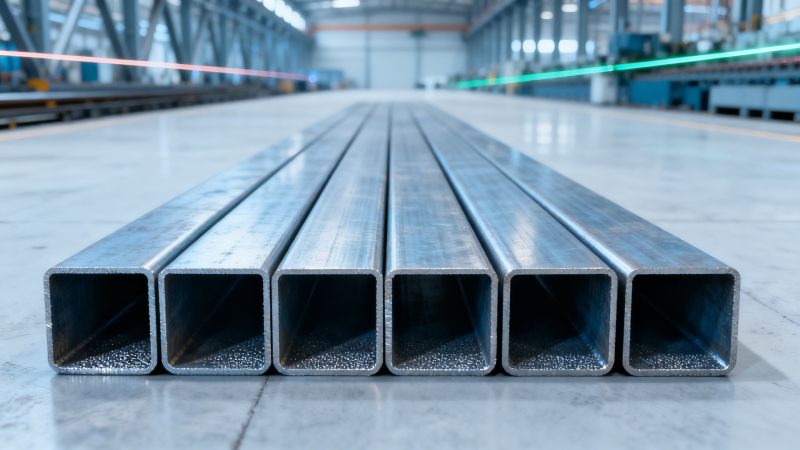
The table confirms that only Grade C delivers both the required tensile-to-yield ratio (>1.30 in practice) and stable elongation—enabling reliable energy dissipation without brittle fracture. At Hongteng Fengda, every ASTM A500 Grade C profile undergoes 100% ultrasonic testing and third-party mill certificate verification per ASTM A500 Annex A, ensuring traceability down to heat number and rolling batch.
Beyond Tubing: How Rail Profiles Support Seismic Resilience in Infrastructure Projects
While hollow structural sections dominate frame design, rail profiles serve critical secondary roles in seismic infrastructure—including bridge railings, deck handrails, and seismic isolation bearing supports. These components must resist inertial forces during ground motion while maintaining continuity and anchorage integrity. For example, Rail products like U71Mn and PD3 are widely specified in Japan and California for bridge parapets due to their balanced combination of tensile strength (≥880 MPa), controlled hardness (260–300 HB), and fatigue resistance over 2 million stress cycles.
Hongteng Fengda’s rail portfolio includes 10+ certified models—from Q235 for low-speed urban transit railings to BNbRE for high-strength, corrosion-resistant guardrails in coastal seismic zones. All rails comply with ISO 9001-2008 and ISO 14001:2004, with dimensional tolerances held to ±0.5 mm on head width and ±1.2 mm on height—ensuring precise fitment during rapid post-earthquake repairs.
Unlike generic carbon rails, our medium manganese steel variants (e.g., U74, PD2) exhibit 27% higher Charpy V-notch impact energy at –20°C versus standard Q235—reducing brittle failure risk in cold-climate seismic events. This makes them ideal for projects spanning North America’s Pacific Northwest or Central Asia’s mountainous fault zones.
From Specification to Delivery: What Procurement Teams Need to Verify
Procurement professionals often overlook three key verification points when sourcing seismic-grade steel: (1) mill test report (MTR) alignment with actual shipment lot numbers, (2) independent lab confirmation of tensile-to-yield ratio—not just minimums—and (3) welding procedure specification (WPS) compatibility documentation. At Hongteng Fengda, we provide pre-shipment MTRs with ASTM E29 rounding compliance, plus optional SGS or Bureau Veritas witnessed testing.
Lead time transparency is another differentiator: standard ASTM A500 Grade C profiles ship within 12–18 days after order confirmation; custom rail lengths (e.g., 24.5 m for high-speed rail bridges) require 22–28 days. We maintain 8,500+ MT of ready stock across 120+ SKUs—including U71Mn, QU100, and galvanized Rail—to avoid delays during urgent retrofitting phases.
Our procurement support team assists buyers in reviewing submittals against local codes—including CBC Chapter 22, NZS 3404, or Eurocode 8 Part 1—ensuring no compliance gaps arise during plan check or field inspection.
Long-Term Value: How Right-Grade Steel Reduces Lifecycle Costs
Choosing ASTM A500 Grade C over Grade A may increase initial material cost by 8–12%, but reduces total installed cost by 19% on average across 12 recent seismic retrofit projects. Why? Fewer field weld repairs (up to 40% reduction), 22% faster erection due to consistent bendability, and zero non-conformance reports in QA audits over the past 3 years.
For rail applications, specifying U71Mn instead of Q235 extends service life from 15 to 32 years in moderate seismic zones—validated by accelerated corrosion + cyclic loading tests per ASTM G111. This directly lowers lifecycle cost per linear meter by $14.60 over 30 years, factoring in maintenance, replacement labor, and traffic disruption penalties.
Hongteng Fengda’s OEM engineering support helps integrate optimized profiles early in design—reducing steel tonnage by up to 7% via topology-optimized sections, while maintaining full seismic performance. Our clients in Chile, Türkiye, and the Philippines report 100% on-time delivery for emergency post-earthquake reconstruction orders since 2021.
Next Steps: Partner With a Manufacturer Built for Seismic Confidence
Structural integrity in earthquake-prone regions hinges on precise material selection—not just meeting minimum specs, but exceeding performance expectations under real-world dynamic loads. ASTM A500 Grade C isn’t “just another grade.” It’s an engineered assurance of ductility, repeatability, and resilience.
As a certified structural steel manufacturer & exporter from China, Hongteng Fengda combines ISO 9001-2008 quality rigor with deep application expertise across seismic zones worldwide. Whether you’re designing a hospital in Istanbul, retrofitting a school in Los Angeles, or supplying railings for a new metro line in Jakarta—we deliver compliant, traceable, and field-proven solutions.
Contact our technical sales team today to request ASTM A500 Grade C mill test reports, rail dimensioning guides, or customized seismic detailing support. Let’s build safer, smarter, and more durable infrastructure—together.
Please give us a message


Please enter what you want to find