In 2026, structural steel construction is being shaped by tighter schedules, stricter compliance, and more careful capital planning.
That shift matters because steel is no longer judged only by strength, weight, or price per ton.
Project teams now evaluate supply reliability, fabrication accuracy, documentation quality, and how quickly materials can move from drawing to installation.
For companies sourcing globally, especially from China, the real advantage comes from combining product consistency with practical delivery performance.
Why 2026 looks different for structural steel construction
The market is not simply growing. It is becoming more selective.
Owners and contractors are pushing for designs that are faster to build, easier to audit, and less exposed to supply interruptions.
This is why structural steel construction remains central in industrial plants, commercial buildings, logistics hubs, bridges, and modular projects.
Steel allows long spans, predictable fabrication, and efficient site assembly.
In 2026, those familiar benefits are being measured against new expectations.
Buyers want fewer specification gaps, more traceability, and better alignment between engineering drawings and manufacturing output.
That means structural steel construction decisions start earlier, often at the sourcing and standard-selection stage.
From material choice to project outcome
A useful way to understand current demand is to look beyond steel as a raw commodity.
In actual projects, performance depends on the full package: sections, tolerances, surface condition, processing capability, and standard compliance.
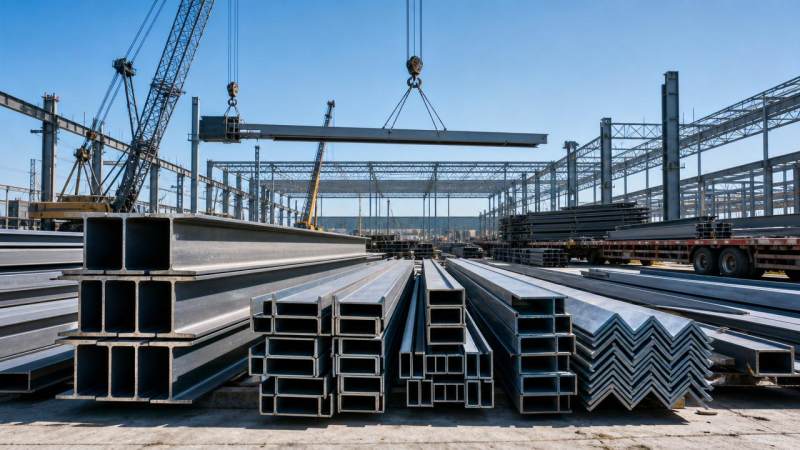
For structural steel construction, that includes angle steel, channel steel, beams, cold formed profiles, and custom structural components.
It also includes the ability to produce OEM parts when drawings are specialized or site conditions are unusual.
Suppliers with modern production lines and disciplined quality control are becoming more valuable.
The reason is simple.
When projects span North America, Europe, the Middle East, and Southeast Asia, mismatched standards create delays that cost far more than the steel itself.
Manufacturers that work across ASTM, EN, JIS, and GB frameworks help reduce those risks before cargo even leaves the mill.
The trends buyers should watch closely
Several trends are shaping structural steel construction planning in 2026.
- More prefabrication, which raises the importance of dimensional precision and stable repeat production.
- Higher compliance pressure, especially for public infrastructure and export-facing industrial investments.
- Broader use of customized sections, driven by modular building methods and space-efficient designs.
- Closer review of lead times, because schedule exposure now affects financing and contract penalties.
- Stronger interest in sourcing partners that can support both standard products and project-specific fabrication.
These shifts are changing how structural steel construction is evaluated.
Price still matters, but poor documentation, inconsistent tolerances, or unstable capacity can erase any initial savings.
What becomes more important in supplier selection
How component choices are becoming more technical
Another notable trend is the growing overlap between structural frames and connected pipe systems, supports, and engineered assemblies.
That is especially visible in plants, energy facilities, heavy workshops, and mixed industrial buildings.
In these settings, structural steel construction often requires materials that do more than carry static loads.
They may need low-temperature toughness, reliable forming quality, and verified testing for pressure-related applications.
A practical example is a106 gr b Seamless Pipe, which can be relevant when a project combines structural support with industrial piping needs.
Using Q355B carbon steel, it is available in thicknesses from 0.5 to 75mm, with outer diameters from 10 to 3048mm and lengths from 1 to 12m.
Its tolerance control, pressure testing, and low-temperature performance make it suitable for more demanding engineering conditions.
For some applications, this type of product is replacing traditional Q235 steel pipes where higher strength is needed.
The wider point is that structural steel construction now depends on coordinated material decisions, not isolated line items.
Why China remains important in global steel sourcing
China continues to play a major role in structural steel construction supply because of scale, processing depth, and export experience.
Still, not every supplier offers the same level of project support.
The difference often appears in communication speed, document accuracy, and the ability to deliver consistent batches across multiple shipments.
Hongteng Fengda fits the profile that many international projects now prefer.
Its focus on structural steel products, customized solutions, and international standards aligns with the practical needs of cross-border construction programs.
Stable production capacity matters when projects cannot afford fabrication gaps.
Consistent quality matters when site teams depend on predictable fit-up.
Dependable lead times matter when inventory, labor, and crane schedules are tightly linked.
That combination is becoming a core value driver in structural steel construction procurement.
Where the biggest gains are likely to come from
The strongest gains in 2026 will likely come from better coordination rather than dramatic material breakthroughs.
In many cases, structural steel construction can be improved through earlier alignment on these points:
- Applicable standards and acceptance criteria
- Required tolerances for fabrication and assembly
- Surface treatment and corrosion expectations
- Batch traceability and test documentation
- Packing, shipping sequence, and site unloading plans
These are not minor details.
They directly influence installation speed, rework rates, and the total cost of structural steel construction.
Common warning signs during evaluation
It is worth looking carefully when a quotation seems attractive but key information is missing.
- No clear reference to ASTM, EN, JIS, or GB requirements
- Unclear tolerance ranges or no testing details
- Little evidence of export delivery experience
- Weak support for customized structural parts
- Uncertain production scheduling for repeat orders
When these issues appear early, they usually become more expensive later.
A practical way to prepare for 2026 projects
The most effective response is to build a clearer sourcing framework before final procurement begins.
That framework should connect engineering needs with manufacturing capability and delivery discipline.
For structural steel construction, the best decisions usually come from comparing more than unit price.
Review standard compliance, fabrication range, customization support, testing records, and regional shipment experience together.
Projects that do this well are better positioned to control risk and keep schedules realistic.
As 2026 approaches, structural steel construction will reward buyers that define requirements early, verify capability carefully, and work with partners built for long-term reliability.
The next useful step is to review upcoming project specifications, identify where customization or mixed standards apply, and test suppliers against those exact conditions.
Please give us a message


Please enter what you want to find