Why does structural steel construction keep winning on cost and speed?
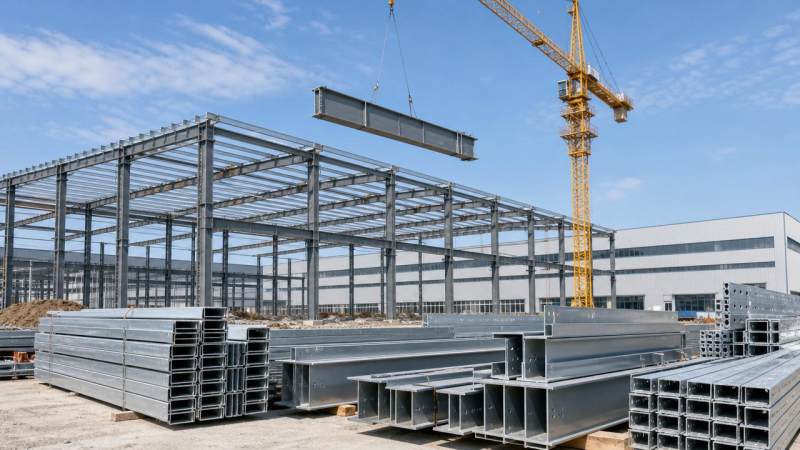
Structural steel construction is often chosen for one simple reason: it shortens the path from design to completed building.
That matters when financing costs, labor availability, and project deadlines all put pressure on the budget.
Compared with slower, wetter, and more site-dependent systems, steel allows more work to happen off site.
Fabrication can start while site preparation continues. That overlap saves calendar time, not just work hours.
The cost advantage is not only about material price per ton.
A better question is this: what does the whole project cost after schedule, labor, waste, transport, and rework are included?
In many commercial and industrial builds, steel performs well because it creates predictable sequencing and cleaner coordination.
That predictability becomes even more valuable when international sourcing is involved.
Suppliers such as Hongteng Fengda support this model with standard and customized structural sections, controlled production, and compliance with ASTM, EN, JIS, and GB requirements.
Is structural steel construction really cheaper, or just faster?
It is usually faster first. It becomes cheaper when speed reduces other project costs around it.
For example, a shorter build program can lower equipment rental, temporary works, site overhead, and interest exposure.
Steel members also arrive with more consistent dimensions than many site-made alternatives.
That reduces field adjustments and helps crews install with fewer delays.
Still, structural steel construction is not automatically the lowest-cost answer in every case.
If the design is simple, spans are short, and local labor is cheap, another system may compete well.
The stronger case for steel appears when projects need long spans, flexible interiors, repeatable frames, or quick occupancy.
A practical way to compare options is to look beyond unit rates.
When these answers favor speed, structural steel construction usually has a strong commercial advantage.
Where does steel save the most time during a real project?
The biggest time savings usually come from planning, prefabrication, and installation.
Shop fabrication allows drilling, cutting, punching, and welding to happen in a controlled environment.
That is much easier to manage than repeating the same work under changing site conditions.
Steel also supports modular thinking. Repeated bays, secondary framing, roof members, and wall supports can be standardized early.
In the middle of a project, small profile choices can influence installation rhythm more than expected.
For purlins, wall beams, and lightweight support assemblies, sections like C Channel Beam are commonly used in steel structure buildings and light manufacturing layouts.
Typical options include Q195, Q235, Q345, A36, SS400, and S235JR, with galvanized or coated finishes.
Lengths such as 6m, 9m, and 12m help match site logistics and framing modules.
When sections are formed accurately, with tolerance around ±1% and services like cutting or punching prepared in advance, crews spend less time correcting fit-up issues.
That is where a reliable exporter adds value.
Hongteng Fengda, for example, combines standard structural products with OEM processing, stable production capacity, and lead times that help keep erection sequences on track.
What hidden costs should be checked before choosing structural steel construction?
The common mistake is focusing only on the steel price and ignoring the delivery chain.
A low quote loses value quickly if documentation is incomplete or fabrication tolerances are inconsistent.
It is smarter to review the full package before making comparisons.
- Check whether the supplier works to the required standards, such as ASTM, EN, JIS, or GB.
- Confirm what fabrication services are included and what remains for the site team.
- Review coating choices, especially for corrosion exposure and maintenance expectations.
- Ask about inspection records, certificates, and traceability, not only product dimensions.
- Compare delivery windows with the actual erection sequence, not just estimated shipment dates.
Another hidden cost appears when design coordination starts too late.
Openings, MEP supports, edge conditions, and connection details should be locked early.
If not, structural steel construction can still move fast, but downstream trades may lose that advantage.
When is structural steel construction the better fit than other systems?
Steel is especially strong when the project needs long clear spans, future layout flexibility, or rapid expansion.
Warehouses, factories, workshops, logistics facilities, and multi-use commercial buildings often fit this profile.
It also works well when transportation and erection planning can be standardized.
That said, the best fit depends on project priorities, not just engineering preference.
A quick decision guide helps clarify the choice.
In short, structural steel construction performs best when time, repeatability, and adaptability carry real economic value.
How can buyers reduce risk and keep both cost and lead time under control?
The safest approach is to treat steel procurement as part of project planning, not as a late purchasing task.
Start by fixing the structural concept, required standards, corrosion protection, and processing scope.
Then compare suppliers on consistency, not only on initial offer.
This is especially important for cross-border supply.
A dependable Chinese structural steel exporter should be able to explain material grades, fabrication capability, quality control, certificates, and realistic delivery windows.
Hongteng Fengda’s business model reflects this expectation.
Its product range covers angle steel, channel steel, beams, cold formed profiles, and custom structural components for global projects.
That breadth helps reduce sourcing fragmentation and coordination risk.
Before moving ahead, it helps to verify a few practical points.
- Match section sizes and lengths to transport and lifting constraints.
- Confirm whether perforation, welding, bending, and cutting are factory completed.
- Align shipment batches with erection priorities on site.
- Request clear certification and inspection records before dispatch.
- Review payment terms and trade terms alongside schedule risk.
These checks do not slow the project down.
They are often what protect the speed advantage that structural steel construction is expected to deliver.
So, what is the smart next step if steel is under consideration?
Begin with the real drivers: schedule pressure, span requirements, site labor limits, and lifecycle expectations.
From there, compare systems using total installed cost and total project duration, not material price alone.
Structural steel construction tends to create the strongest value when the program is tight and the structure must stay adaptable.
It also becomes easier to manage when supply comes from a source that combines manufacturing control, standard compliance, and dependable export execution.
A useful next move is to list the required steel grades, section types, protective finishes, fabrication services, and target delivery sequence.
That framework makes supplier comparison clearer and keeps both cost and build speed grounded in measurable decisions.
Please give us a message


Please enter what you want to find