For buyers of structural steel components, fabrication cost is rarely determined by material alone.
Design complexity, processing methods, tolerance requirements, surface treatment, and production volume shape the final quotation far more than many expect.
Understanding these variables makes supplier comparison more accurate and helps control budget, schedule, and quality risk.
This guide answers the most common questions about what affects the cost of structural steel components most.
What cost element matters first in structural steel components?
The first cost layer is usually material grade, section size, and market steel pricing.
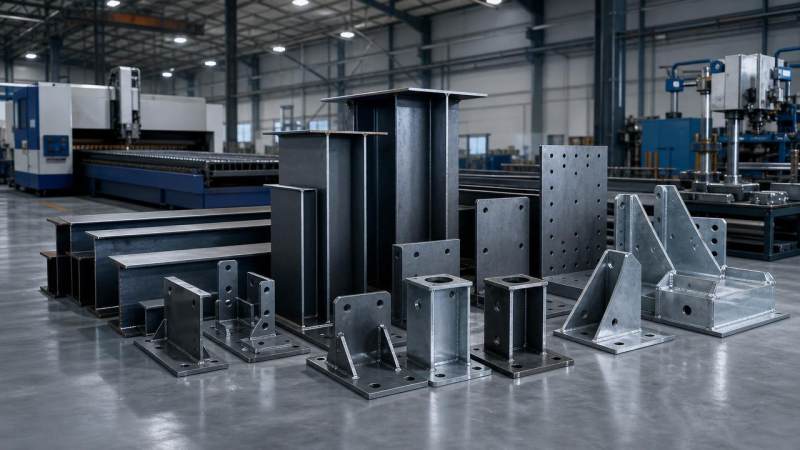
However, raw material often becomes only the starting point for structural steel components pricing.
A simple beam cut from standard stock may stay close to commodity value.
A customized bracket with holes, bevels, welds, and coating can cost much more per ton.
Section type also changes efficiency.
Angle steel, channel steel, H beams, and cold formed profiles each require different handling, fixturing, and processing time.
Imported standards can affect cost too.
Projects requiring ASTM, EN, JIS, or GB compliance may need traceability, mill certificates, and tighter inspection control.
That extra documentation adds management time, even before fabrication starts.
Key early-stage cost drivers
- Steel grade and section availability
- Weight per component
- Yield loss from cutting layout
- Standard versus custom dimensions
- Certification and traceability requirements
How does design complexity raise fabrication cost?
Design complexity is often the largest hidden cost in structural steel components.
More cuts, more holes, more weld seams, and more assembly steps mean more labor hours.
Labor usually changes faster than material in custom steel fabrication.
For example, a plate with ten hole sizes costs more than one with repeated standard holes.
A welded assembly with many small parts also increases alignment and inspection time.
Tight tolerances can magnify this effect.
If fit-up must be exact, the workshop may need CNC processing, trial assembly, or corrective grinding.
Every extra operation creates more touchpoints and a higher chance of rework.
Design details that often increase cost
- Non-standard shapes and irregular geometry
- Mixed thicknesses in one assembly
- Complex welding joints
- Very small batch customization
- Strict dimensional tolerances
A practical way to reduce cost is design simplification without affecting structural performance.
Standardized holes, shared plate sizes, and fewer welds can lower fabrication hours significantly.
Which processing methods affect structural steel components pricing most?
Processing method directly changes time, accuracy, and consumable usage.
Cutting by sawing, laser, plasma, flame, or shearing will not produce the same cost outcome.
Laser cutting gives precision, but cost rises with thickness and machine time.
Flame cutting suits thick carbon steel, but edges may need more finishing.
Bending, drilling, punching, machining, and welding each add their own setup time.
Setup cost is especially important for small orders of structural steel components.
One related example appears in filtration and industrial accessory supply chains.
Products such as 304 Stainless Steel Welded Mesh show how material grade, mesh specification, roll width, and corrosion resistance influence processing value.
Available grades include SS 201, 304, 304L, 316, 316L, and 430.
Applications range from filters and sieves to architecture, residences, chemical industry, and mine industry.
Although different from heavy structural sections, the same pricing logic applies.
Specification complexity, corrosion requirements, and processing precision always change manufacturing cost.
Why process selection matters
- Machine type determines speed and accuracy
- Thickness affects energy and consumables
- Secondary finishing can exceed primary cutting cost
- Welding procedure affects strength and inspection needs
Do surface treatment and quality control significantly change cost?
Yes, often more than expected.
Structural steel components for outdoor or corrosive environments need protective treatment.
Common options include primer coating, painting, powder coating, and hot dip galvanizing.
Each option adds material, labor, inspection, and transport considerations.
Galvanizing may seem expensive initially, but it can reduce maintenance cost over time.
Quality control also influences the final price of structural steel components.
Dimensional checks, weld inspection, coating thickness tests, and third-party verification all require labor and coordination.
Projects for export markets often demand more complete records and packaging standards.
That is valuable, because better control reduces claims, delays, and replacement risk.
Common quality-related cost additions
- WPS or welding qualification requirements
- UT, MT, or visual weld inspection
- Coating thickness verification
- Salt spray or corrosion-related testing
- Export packing and labeling
How do order volume and lead time influence cost?
Volume strongly affects the unit cost of structural steel components.
Larger orders spread programming, tooling, setup, and inspection cost across more pieces.
They also improve material nesting and workshop scheduling.
Small urgent orders usually cost more per piece.
Rush production may require overtime, interrupted production flow, premium freight, or faster subcontract services.
Stable forecasting often creates better pricing than last-minute release schedules.
Packaging and container loading also matter for export structural steel components.
Poor loading efficiency can quietly raise logistics cost, even when ex-factory pricing looks competitive.
Best ways to improve cost efficiency
- Combine repeat items into larger batches.
- Freeze drawings before production starts.
- Allow realistic lead time.
- Use standard finishes where possible.
- Clarify inspection scope early.
How can suppliers be compared more accurately?
The lowest quote does not always mean the lowest total project cost.
A better comparison checks scope, process capability, quality consistency, and delivery reliability.
For structural steel components, quotation clarity is essential.
Missing items often appear later as variation charges, delivery delays, or quality disputes.
Suppliers with modern facilities and strict quality control usually offer more predictable outcomes.
That predictability matters in global projects where replacement time is expensive.
FAQ cost comparison table
Structural steel components cost is shaped by a chain of decisions, not one single input.
Material matters, but design, fabrication method, finish, inspection, and order planning usually decide the final result.
A reliable supplier should help identify avoidable cost drivers before production begins.
Hongteng Fengda supports global projects with structural steel manufacturing, export experience, customized solutions, and stable quality control.
When reviewing new structural steel components, request a detailed breakdown, confirm standards, and optimize drawings early for better total value.
Please give us a message


Please enter what you want to find