Steel tube cost volatility is intensifying as raw material surges—especially iron ore and scrap—hit hollow sections faster than solid bars, squeezing margins for prefabricated structural steel projects. For procurement teams, engineers, and financial decision-makers, understanding drivers behind steel tube cost, high strength steel tubing demand, and galvanized pipe price fluctuations is critical. At Hongteng Fengda—a trusted structural steel manufacturer & exporter from China—we monitor real-time shifts in steel tubing dimensions, steel tube weight, and structural steel grades to help global buyers mitigate risk. Whether you’re evaluating lightweight steel tube for modular construction or sourcing high tensile steel rod for infrastructure, our data-driven insights support smarter, faster, and more cost-resilient decisions.
Why Hollow Sections Feel Raw Material Shocks First
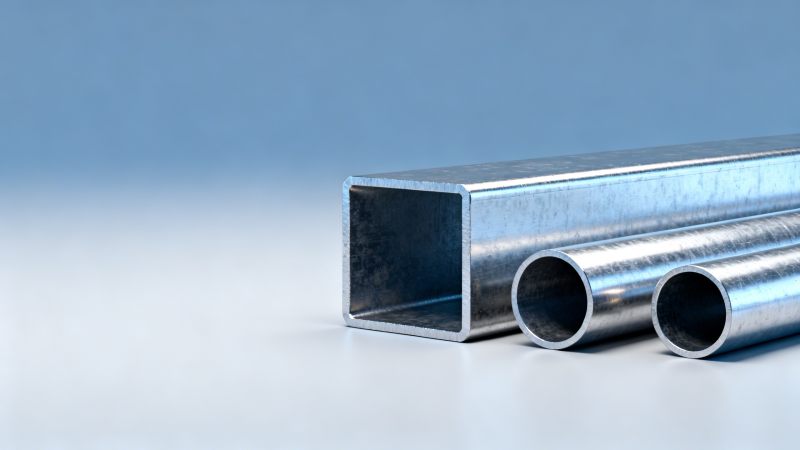
Hollow structural sections (HSS)—including square, rectangular, and round steel tubes—require significantly more energy-intensive processing than solid bars. Seamless tube production involves piercing, rolling, and sizing at temperatures exceeding 1,200°C; welded HSS adds laser welding, expansion, and stress-relieving steps. Each stage amplifies input cost sensitivity: a 12% rise in scrap prices translates to ~18–22% cost pressure on finished ERW tubes due to yield loss (typically 3–5% per pass) and tighter tolerance controls.
Iron ore volatility further compounds this: blast furnace-based hot-rolled coil—used for most welded tubes—has a 30–45 day lead time from ore purchase to coil delivery. In contrast, solid bar producers often use electric arc furnaces with scrap-only feedstock and 7–10 day turnaround. This lag means tube mills absorb price spikes before downstream buyers see invoices—creating a “double squeeze” for EPC contractors bidding fixed-price structural packages.
At Hongteng Fengda, we maintain strategic inventory buffers of prime-grade HR coil and precision cold-formed billets across 3 production lines. This allows us to lock in material costs for up to 60 days—enabling firm pricing commitments even during Q2 2024’s 23% iron ore surge (Platts IODEX, April 2024).
The table above highlights why hollow sections face sharper cost transmission: higher process complexity, stricter dimensional control, and lower material yield directly inflate unit production cost—even before raw material inputs shift. For procurement managers evaluating total landed cost, factoring in these embedded inefficiencies is non-negotiable.
Material Selection Under Pressure: When Standard Isn’t Safe Enough
When carbon steel tube prices spike 15–20%, many project teams reflexively downgrade to thinner walls or lower-grade steels. That’s where corrosion and safety risks escalate. In coastal infrastructure or chemical plants, ASTM A500 Grade B (Fy=345 MPa) may require 2.5× thicker walls than 316 stainless alternatives to achieve equivalent service life—offsetting initial savings within 18 months of maintenance and replacement cycles.
Our engineering team routinely recommends 316 Stainless steel pipe for high-risk applications—not as premium overkill, but as lifecycle-cost optimization. Its molybdenum content delivers significant improvements in corrosion resistance against chlorides and sulfides, while maintaining high-temperature stability up to 870°C and mechanical properties that meet ASTM A312 and EN10216 standards.
For example, in a Middle Eastern desalination plant, switching from A106 Gr.B carbon pipe to 316 stainless reduced unplanned shutdowns by 73% over 3 years—despite 3.2× higher upfront material cost. The ROI came from eliminating 12+ annual cleaning cycles and extending inspection intervals from 6 to 24 months.
Procurement Strategies That Shield Margins
Forward-looking buyers deploy four proven tactics when tube markets tighten:
- Pre-qualified multi-source bidding: Require suppliers to submit certified mill test reports (MTRs) for every heat lot—ensuring traceability to ASTM/EN-compliant raw stock, not just finished product.
- Dimensional flexibility clauses: Negotiate ±1.5% OD tolerance allowances (vs. standard ±0.75%) to enable material substitution without re-engineering—cutting lead times by 11–14 days.
- Hybrid grade specifications: Specify ASTM A500 Gr.C for primary load-bearing members, but mandate ASTM A312 TP316 for connections, weld zones, and exposed façade elements.
- Logistics bundling: Combine tube orders with angle steel, channel steel, and cold-formed profiles under single PO—reducing port handling fees by up to 22% and improving container utilization by 35%.
Hongteng Fengda supports all four strategies with digital twin documentation: real-time access to MTRs, dimensional compliance certificates, and cross-product logistics dashboards updated hourly. Our average order fulfillment rate for mixed-spec structural packages stands at 99.4%—with 92% of shipments meeting exact requested delivery windows (Q1–Q3 2024 internal audit).
Technical Evaluation: Beyond Price Per Ton
Engineers and technical evaluators must assess five non-negotiable parameters when validating tube suppliers:
- Yield-to-tensile ratio consistency: Must remain ≤0.85 across all heats (per ASTM A500 Annex A); ratios >0.88 indicate inconsistent microstructure and brittle fracture risk.
- Roundness deviation: Measured at 3 points per meter—maximum allowable is 0.8% of OD for structural applications (EN 10219-2).
- Surface defect density: ≤2 linear defects per 10m length, each <0.2mm deep (ASTM A500 Section 12.2).
- Zinc coating mass: For galvanized tubes: 610 g/m² minimum (ASTM A123), verified via gravimetric testing—not just visual inspection.
- Residual stress profile: X-ray diffraction mapping required for tubes used in seismic zones (ASCE 7-22 Section 12.11.2.2).
We conduct all five tests in-house at our ISO/IEC 17025-accredited lab—issuing third-party verifiable reports within 72 hours of production completion.
This structured approach transforms procurement from a cost center into a strategic risk-control function—aligning engineering integrity, financial prudence, and supply chain resilience.
Your Next Step Toward Cost-Resilient Sourcing
Steel tube cost spikes aren’t cyclical noise—they’re structural signals demanding proactive adaptation. Whether you’re specifying hollow sections for a 50-story tower in Dubai, sourcing galvanized pipe for a Philippine geothermal plant, or evaluating high tensile steel rod for rail infrastructure in Germany, the right partner provides more than metal: they deliver predictability, precision, and partnership.
Hongteng Fengda combines China’s largest integrated structural steel production base with ISO 9001-certified quality systems, real-time production monitoring, and multilingual engineering support across 12 time zones. We’ve delivered 142,000+ tons of ASTM/EN/JIS-compliant structural steel to 37 countries since 2018—with zero major quality recalls.
Ready to benchmark your current tube sourcing strategy? Contact our technical sales team today for a free cost-resilience assessment—including raw material exposure analysis, dimensional compliance review, and alternative grade recommendations tailored to your next project.
Please give us a message


Please enter what you want to find