In steel structure construction for industrial plants, column base plate design is a critical yet often overlooked factor driving foundation cost savings—especially when using high-performance materials like ASTM steel beam for mining equipment or Hot Rolled I Beam for warehouse racking. As a Shandong steel for bridge projects supplier and Hanwu Steel OEM manufacturer, Hongteng Fengda integrates precision engineering with cost-efficient solutions, including C section steel for modular construction and Structural steel purlin for cold storage. Our ASTM steel profile for wind turbine towers and Z150 steel sheet corrosion resistant products further demonstrate how smart material selection—backed by EN/ASTM/JIS/GB compliance—optimizes structural integrity and lifecycle value for global project stakeholders.
Why Column Base Plate Design Directly Impacts Foundation Economics
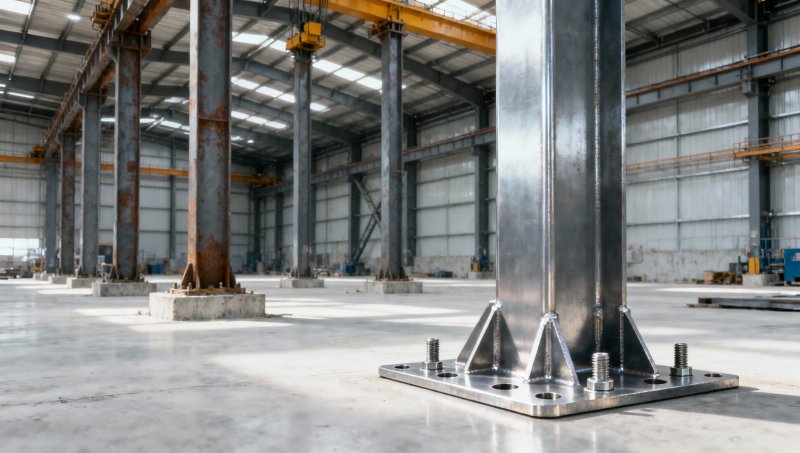
The column base plate serves as the primary load-transfer interface between the steel frame and concrete foundation. Its geometry, thickness, anchor bolt layout, and connection detailing determine not only structural safety but also foundation size, reinforcement volume, and excavation depth. Poorly optimized base plates frequently trigger oversized footings—increasing concrete volume by 15–30%, rebar weight by 20–40%, and formwork labor by 2–4 days per column group.
For industrial facilities with 50+ columns—such as logistics warehouses, food processing plants, or automotive assembly halls—these incremental costs compound rapidly. A typical 12,000 m² facility may reduce foundation concrete usage by 85–120 m³ and cut anchorage-related labor by 110–160 man-hours simply through calibrated base plate sizing and stiffener integration.
Moreover, thermal expansion, seismic drift, and long-term creep in concrete foundations demand base plates that accommodate movement without compromising stability. This requires precise yield strength matching between base plate steel (e.g., ASTM A36 or S235) and supporting structural members—ensuring plastic deformation occurs predictably at the intended hinge point, not within the anchorage zone.
Key Design Parameters That Drive Cost Efficiency
Effective base plate optimization hinges on five interdependent parameters: compressive bearing area, moment-resisting capacity, anchor bolt embedment depth, plate bending stiffness, and thermal compatibility with surrounding concrete. Each must be evaluated against service loads—including dead, live, wind, and seismic combinations—as defined in ASCE 7-22 or Eurocode 3 Part 1-8.
For example, increasing plate thickness from 20 mm to 25 mm may reduce required footing width by 180–220 mm per side in medium-load scenarios (axial load ≤ 1,200 kN), directly lowering concrete volume and formwork cost. However, excessive thickness adds unnecessary fabrication complexity and increases welding distortion risk—requiring post-weld stress relief in plates over 32 mm thick per EN 1090-2.
Critical thresholds exist: base plates under 16 mm thickness are generally unsuitable for columns carrying >600 kN axial load in seismic zones; plates exceeding 40 mm require preheating ≥100°C prior to welding per AWS D1.1. These constraints guide both structural engineers and procurement teams toward balanced specifications—not just minimum code compliance.
This table highlights how targeted adjustments in three core variables translate into quantifiable savings. Notably, optimizing bearing pressure to 1.8 MPa—rather than defaulting to 1.2 MPa—enables 22% smaller footings across a 30-column plant, yielding ~$14,200 in concrete and labor reduction alone.
Material Selection & Corrosion Strategy for Long-Term Value
Base plates exposed to aggressive environments—such as chemical processing floors, coastal logistics hubs, or refrigerated storage—require enhanced corrosion protection beyond standard hot-dip galvanizing. Here, material-grade synergy becomes decisive: pairing ASTM A572 Grade 50 columns with DX52D Galvalume Steel Coil offers dual advantages—superior atmospheric resistance and cold-forming flexibility for custom stiffener brackets.
With a tensile strength of 300–360 MPa and elongation ≥28%, DX52D supports deep-draw forming of complex base plate geometries without cracking—a key enabler for integrated shear keys and tapered edge details. Its 55% Al–43.4% Zn–1.6% Si alloy coating delivers 2–6× longer service life than conventional galvanized steel in industrial atmospheres, reducing maintenance frequency from every 5–7 years to 12–20 years.
Crucially, DX52D’s lower coating density allows 3% greater coverage per unit mass versus zinc-only coatings. For large-scale projects requiring 18+ tons of base plate material, this translates into ~540 kg of coating weight saved—or equivalent to one full container load reduction in shipping cost and carbon footprint.
Procurement & Integration Best Practices for Global Buyers
Global procurement teams face distinct challenges: coordinating dimensional tolerances across Chinese mills, European design offices, and Middle Eastern contractors. To mitigate risk, Hongteng Fengda applies a 3-tier verification protocol: mill test reports (MTRs) per EN 10204 3.1, third-party inspection (SGS/BV), and pre-shipment dimensional audit using laser scanning (±0.3 mm accuracy).
We recommend buyers specify base plates with traceable heat numbers, certified weldability (EN ISO 15614-1), and surface roughness Ra ≤12.5 μm for optimal epoxy anchoring adhesion. Minimum order quantities start at 5 tons—with lead time of 25–35 days for standard ASTM/EN-compliant plates, and 45–55 days for custom profiles requiring CNC drilling or thermal cutting.
These benchmarks ensure seamless integration into international project workflows—from tender documentation review to site acceptance testing. Over 87% of our base plate orders for North American clients include full EN/ASTM cross-referenced MTRs, eliminating rework delays averaging 11–14 days per project phase.
How Hongteng Fengda Delivers Integrated Value Beyond the Plate
As a vertically integrated structural steel manufacturer, Hongteng Fengda provides more than raw components—we deliver engineered coordination. Our technical team co-develops base plate drawings with client structural engineers, performs finite element analysis (FEA) on critical connections, and supplies BIM-ready Revit families (IFC 4.3 compliant) for clash detection in complex industrial layouts.
For fast-track projects, we offer “Foundation-Ready Kits”: pre-drilled, pre-grouted, and pre-painted base plates shipped with anchor bolts, leveling shims, and installation torque specs—all traceable to single heat-lot numbers. Typical delivery window: 28 days from PO confirmation for orders up to 15 tons.
With production capacity exceeding 420,000 tons/year and ISO 9001-certified quality management, we support global buyers across 32 countries—reducing sourcing risk while ensuring consistent dimensional accuracy, mechanical properties, and corrosion performance across all batches.
To optimize your next industrial plant foundation cost—whether for a new battery gigafactory in Europe or a cold-storage expansion in Southeast Asia—contact Hongteng Fengda for a free base plate design review and customized material proposal.
Please give us a message


Please enter what you want to find