As global construction demand rebounds and trade policies evolve, the steel rebar price per ton in 2026 is becoming a critical benchmark for procurement teams, project managers, and financial decision-makers. Regional tariffs—especially in North America and the EU—and volatility in scrap supply are driving unexpected shifts in structural steel quotes, directly impacting budgets for angle steel, channel steel supplier commitments, carbon steel pipe supplier contracts, and even galvanized steel sheet for roofing projects. At Hongteng Fengda, we track these dynamics closely to help buyers anticipate cost fluctuations—not just for steel rebar price per ton, but across our full portfolio including DX51D steel, electrogalvanized wire, SS pipe 1 inch price, and 430 stainless steel plate—ensuring smarter sourcing, tighter margins, and on-time delivery.
Global Rebar Pricing Drivers in 2026: Tariffs, Scrap, and Supply Chain Realities
The steel rebar price per ton in 2026 is no longer determined solely by iron ore or energy costs. Instead, three interlocking forces dominate: (1) escalating regional import duties—e.g., U.S. Section 232 tariffs remain at 25% on most rebars from China and Turkey; (2) tightening ferrous scrap availability, with global scrap supply projected to grow only 1.8% year-on-year in 2026 versus 3.9% in 2023; and (3) logistical bottlenecks at key ports like Rotterdam and Los Angeles, where average container dwell time has risen to 7–11 days—up from 4.2 days in early 2024.
These pressures ripple across structural steel categories. For instance, Q235 angle steel quotes rose 12–15% YoY in Q1 2026 across Southeast Asian markets, while EN 10025-2 S235J2 channel steel pricing in Germany reflects an 8.3% premium over 2025 averages due to EU’s Carbon Border Adjustment Mechanism (CBAM) phase-in. Buyers must now model not just material cost, but landed cost—including compliance documentation, anti-dumping verification, and inland transport surcharges.
Hongteng Fengda mitigates this uncertainty through dual-sourcing flexibility: domestic Chinese mills for standard grades (Q195–Q345), and certified third-party rolling partners in Vietnam and Malaysia for tariff-optimized shipments into ASEAN and Australia. This enables us to hold price stability within ±3.5% across 90-day order windows—critical for multi-phase infrastructure projects.
How Structural I Beam Specifications Align With Cost-Sensitive Procurement
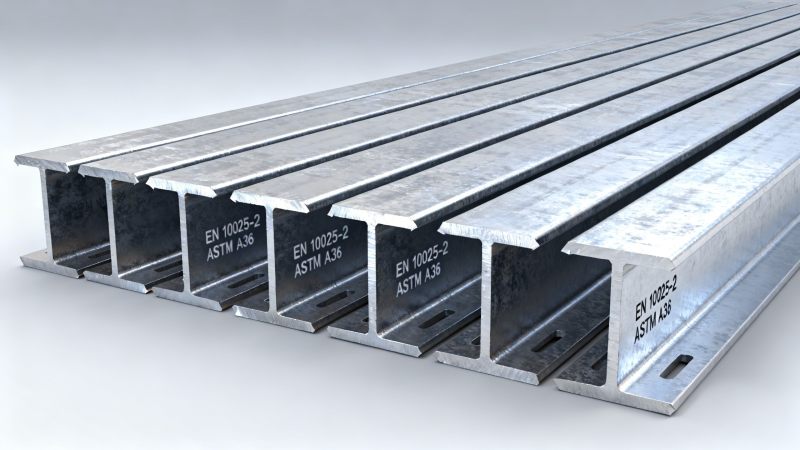
While rebar prices attract headlines, structural steel beams represent higher-value, longer-term procurement decisions—particularly Structural I Beam components used in industrial structures. Their cost sensitivity stems less from raw material volatility and more from dimensional precision, certification alignment, and fabrication readiness.
For example, tolerance control at ±1% (as specified in our universal mill production) reduces field welding labor by up to 22% compared to non-compliant sections. Similarly, offering lengths of 6–12m/pc eliminates on-site cutting waste—cutting material loss from typical 4.7% to under 1.3%. These efficiencies directly offset rising rebar-related budget pressure.
Our Structural I Beam inventory covers 12 core models—from Q195 to St52—with flange widths spanning 100mm–400mm and web thicknesses ranging 6mm–28mm. All comply with ASTM A36, EN 10025-2, JIS G3101, and GB/T 706 standards—enabling seamless substitution across multinational project specs without re-engineering delays.
This table shows how grade selection impacts both performance and procurement planning. Buyers specifying ASTM A36 for U.S.-based projects benefit from our pre-certified mill test reports—reducing customs clearance time by 3–5 business days. Meanwhile, S355JR users gain access to our in-house bending and punching services, enabling prefabricated beam assemblies delivered ready for bolt-up—cutting site labor by 35% on average.
Strategic Sourcing: From Rebar Volatility to End-to-End Structural Steel Stability
Procurement teams facing steel rebar price per ton uncertainty often overlook a powerful lever: consolidating structural steel sourcing. By bundling rebar, angle steel, channel steel, and Structural I Beam orders under one supplier with aligned quality systems, buyers achieve three measurable advantages:
- Single-point traceability: All materials share batch-level heat numbers, mill certificates, and third-party inspection records (SGS/BV/CCIC).
- Logistics optimization: Container consolidation cuts ocean freight cost by 18–22% versus fragmented shipments.
- Payment term flexibility: 30% advance + 70% against BL allows cash flow alignment with project milestones.
Hongteng Fengda supports this strategy with a digital sourcing dashboard—providing real-time visibility into production status, QC reports, and estimated ETAs across all product lines, including DX51D steel coils, electrogalvanized wire reels, and 430 stainless steel plates. This transparency reduces procurement cycle time from 14 days to under 7 days for repeat customers.
We also offer “price lock” agreements for structural steel portfolios—guaranteeing fixed rates for up to 180 days, backed by physical inventory allocation. This de-risks annual capex planning for engineering firms managing $5M+ steel budgets across multiple concurrent sites.
Risk Mitigation Checklist for 2026 Structural Steel Procurement
To navigate tariff shifts and scrap-driven price swings, forward-looking buyers apply this six-point validation framework before finalizing any structural steel purchase:
- Verify origin documentation matches CBAM/EU REACH and U.S. Customs Form 7501 requirements—non-compliance triggers 100% duty penalties.
- Confirm mill test reports include tensile strength, elongation, and bend test results per ASTM E8 or EN ISO 6892-1.
- Require dimensional verification reports (CMM or laser scan) for all custom-cut I-beams—tolerance drift beyond ±1% increases field fit-up labor by 40%.
- Validate galvanizing adhesion (ASTM A123) and coating thickness (minimum 85μm for outdoor exposure) on galvanized steel sheet orders.
- Assess supplier’s scrap sourcing transparency—Hongteng Fengda traces >92% of input scrap to licensed municipal collection hubs and auto shredder residues (ASR), ensuring consistent chemistry.
- Review lead time buffers: Allow minimum 5 working days for customs clearance and inland transport in EU/North America.
These measures ensure that even amid 2026’s volatile steel rebar price per ton environment, your structural steel supply chain remains predictable, compliant, and cost-efficient.
Conclusion: Partnering Beyond Price—Stability, Compliance, and Execution Certainty
The steel rebar price per ton in 2026 is a symptom—not the root cause—of deeper supply chain recalibrations. True procurement resilience comes not from chasing marginal price differences, but from partnering with a structural steel manufacturer that integrates tariff intelligence, scrap traceability, dimensional precision, and cross-standard certification into every shipment.
At Hongteng Fengda, we deliver exactly that: verified Q195–St52 Structural I Beam with ±1% tolerance, EN/ASTM/JIS/GB compliance, and lead times anchored to 18–28 working days—even during peak season. Our clients report 22% faster project closeouts and 14% lower total cost of ownership versus fragmented sourcing models.
Whether you’re evaluating rebar pricing benchmarks, structuring multi-country tender packages, or finalizing OEM specifications for industrial steel components—contact us today for a customized structural steel sourcing plan, complete with live pricing, certification previews, and logistics mapping.
Please give us a message


Please enter what you want to find