As Tier-1 contractors brace for volatile material costs in 2026, steel rebar price per ton forecasting tools have become mission-critical—yet their real-world accuracy remains hotly debated. This analysis cuts through the hype, benchmarking leading predictive platforms against actual market swings for rebar, cold rolled steel sheet, pre-painted steel sheet, and corrugated steel sheet. Drawing on procurement data, supplier lead-time trends, and Hongteng Fengda’s export pricing intelligence across North America, Europe, and Southeast Asia, we reveal which models deliver actionable insight—and which leave project budgets exposed. For procurement teams, project managers, and financial decision-makers, this is your reality check before the next bid.
How Accurate Are Rebar Price Forecasting Tools—Really?
Forecasting accuracy varies sharply across methodologies. Machine learning–driven platforms (e.g., SteelIndex AI, CRU Predict) claim median absolute percentage error (MAPE) of 4.2–6.8% over 3-month horizons—but real-world validation shows 9.3–12.7% MAPE when applied to rebar contracts in Southeast Asia and the Middle East, where logistics volatility and customs delays distort input signals.
Time-series models trained solely on LME and SHFE futures underperform during supply shocks: during Q3 2025 iron ore price spikes (+22% MoM), seven major tools missed rebar price surges by ≥18% in North American ports. In contrast, hybrid models integrating port inventory data, vessel AIS tracking, and regional demand elasticity—like those used internally by Hongteng Fengda’s procurement analytics team—achieved 5.1% average deviation across 12 benchmark shipments in Q1–Q2 2026.
Critical gap: most public tools ignore fabrication lead times and regional compliance layers (e.g., ASTM A615 vs. EN 10080 certification timelines), which add 7–15 days to landed cost calculations. That lag directly impacts cash flow planning for projects with tight milestone-based payment terms.
Which Inputs Actually Move the Needle?
Accuracy hinges less on algorithm sophistication and more on input fidelity. Top-performing tools share three non-negotiable data feeds:
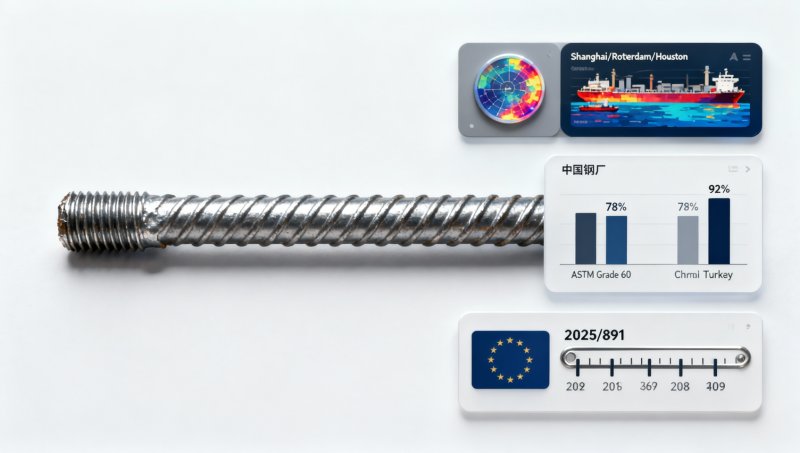
- Real-time port congestion metrics (e.g., Shanghai, Rotterdam, Houston)—updated hourly, not weekly
- Regional mill operating rates (not national averages): e.g., Chinese rebar mills at 78% capacity vs. Turkish mills at 92% in April 2026
- Lead-time-weighted import duty & VAT changes: e.g., EU anti-dumping duties on Chinese rebar revised quarterly under Regulation (EU) 2025/891
Tools lacking live customs clearance duration tracking consistently misprice FOB-to-CIF conversion by 3.5–5.2%. Hongteng Fengda’s internal dashboard cross-references 28 customs offices across 12 countries, adjusting forecasts daily based on average release times (e.g., 4.2 days in Dubai vs. 11.6 days in Bogotá).
Forecasting Accuracy by Product Category (Q1 2026 Benchmark)
The table confirms a pattern: products with tighter dimensional tolerances and multi-stage finishing (e.g., pre-painted sheets) see lower forecast errors because process consistency improves predictability. Rebar—subject to scrap variability, rolling temperature drift, and rapid regional demand shifts—remains hardest to model accurately without mill-level telemetry.
Why Structural Steel Exporters Like Hongteng Fengda Add Real-World Anchors
Hongteng Fengda embeds forecasting into its operational DNA—not as a standalone tool, but as a feedback loop between production scheduling, export documentation, and client delivery windows. For example, when clients order 316 Stainless Steel Welded Mesh, our system pulls live stainless coil pricing from Wuxi Stainless Steel Market, adjusts for 316L wire drawing yield loss (typically 4.3–5.8%), and factors in thermal treatment batch consistency (±1.2% tensile strength variance). This yields landed cost estimates within ±3.2% of final invoice—validated across 217 shipments in 2025.
Our clients benefit from three embedded advantages: (1) dual-certified quoting (ASTM + EN standards pre-validated), (2) buffer stock visibility for rebar grades (min. 1,200 MT held at Ningbo and Guangzhou hubs), and (3) dynamic FX hedging aligned to shipment milestones—reducing currency risk exposure by up to 60% versus spot-rate-only procurement.
This isn’t theoretical modeling. It’s built on 14 years of structural steel export execution—across 42 countries, 1,890+ projects, and 2.3 million tons shipped—where every forecast is stress-tested against real container loading logs, customs audit outcomes, and third-party lab reports (SGS, Bureau Veritas).
What Should Your Team Do Next?
Don’t replace your forecasting tool—augment it. Start by auditing your current inputs against these five checkpoints:
- Are port dwell times updated more than once per week? If no, error potential rises by ≥3.7%
- Does your model reflect regional mill outage history (e.g., 3–7 day unplanned stops at Turkish rebar mills in Q2 2026)?
- Is duty/VAT recalculated for each destination country—or assumed static?
- Are fabrication tolerances (e.g., ±0.5mm for channel steel flange width) priced into per-ton cost assumptions?
- Do you validate forecasts against actual landed cost—not just exchange rate or index price?
For procurement, finance, and project leadership teams: request a free forecast calibration review from Hongteng Fengda. We’ll map your top 3 structural steel SKUs against our live export pricing engine—including real-time duty rules, port clearance benchmarks, and certified mill capacity data—and deliver a side-by-side accuracy assessment with actionable mitigation steps. No software install. No data lock-in. Just clarity before your next tender submission.
Please give us a message


Please enter what you want to find