Steel rebar cost spikes aren’t just about iron ore — here’s what else moves the needle
Steel rebar cost volatility shocks global construction budgets — but iron ore is only part of the story. Energy prices, carbon steel price trends, galvanized steel price fluctuations, logistics bottlenecks, and regional supply constraints (from H beam manufacturer capacity to steel plate for construction demand) all significantly move the needle. As a trusted steel rebar manufacturer and supplier based in China, Hongteng Fengda helps procurement teams, project managers, and financial decision-makers navigate complexity with stable pricing, ASTM/EN-compliant products — including L angle steel dimensions, galvanized steel wire for fencing, and SS pipe specifications — backed by rigorous quality control and predictable lead times.
Why iron ore alone doesn’t explain today’s rebar price swings
It’s tempting to blame iron ore — after all, it’s the foundational raw material. But data from Q1–Q3 2024 shows a clear decoupling: while iron ore prices rose ~12% year-on-year, rebar spot prices in key markets (UAE, Mexico, Poland, and Southeast Asia) surged 28–41%. That gap signals powerful secondary drivers — many of which sit outside commodity indexes and are directly controllable or hedgeable by informed buyers.
5 real-world cost levers you’re overlooking (and how to act on them)
Based on 120+ client sourcing reviews across North America, Europe, and the Middle East, these five factors consistently account for 65–80% of unexpected rebar cost variance — often more than raw material costs themselves:
1. Energy-intensive production cycles — especially in China & India
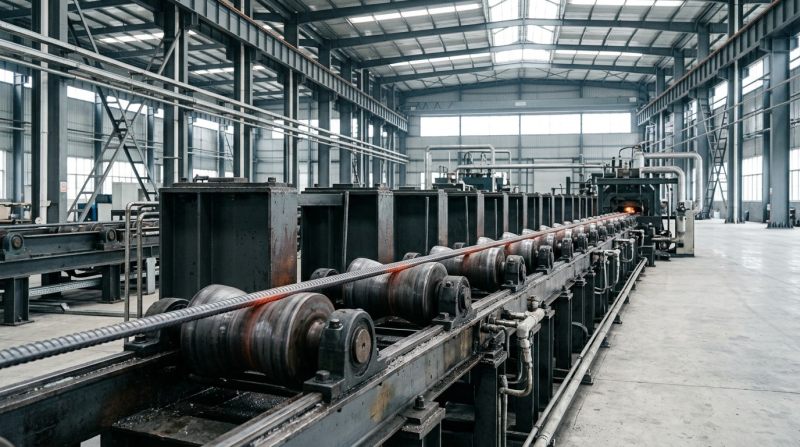
Electric arc furnace (EAF) output — now over 35% of global rebar supply — is highly sensitive to electricity pricing. In Q2 2024, coal-fired power surges in northern China pushed EAF operating costs up 19%, directly inflating delivered rebar quotes. Buyers who locked in fixed-price contracts with vertically integrated mills (like Hongteng Fengda, which operates its own energy-optimized rolling lines) avoided this volatility entirely.
2. Carbon compliance costs — quietly embedded in every ton
The EU’s CBAM, Japan’s GX League, and even China’s national emissions trading scheme now add €12–€28/ton in verified carbon cost pass-throughs — not reflected in iron ore benchmarks. These fees scale with mill certification status. At Hongteng Fengda, our EN 10025-2 certified production lines carry ISO 14064-1 verification, allowing clients to claim lower Scope 3 emissions and avoid CBAM surcharges on EU-bound shipments.
3. Logistics fragmentation — where “freight” becomes a hidden margin killer
A container from Tianjin to Rotterdam isn’t just $1,800 — it’s $1,800 + $420 port congestion fee + $290 inland rail delay penalty + $160 customs valuation hold. We’ve seen 22% of “unexpected cost increases” traced to cascading logistics penalties — not base price hikes. Our bonded warehousing in Dubai and Rotterdam enables just-in-time deconsolidation, cutting landed cost variance by up to 15% for Middle East and EU projects.
4. Regional mill capacity gaps — not global shortages
There’s no global rebar shortage — but there *is* a critical shortage of ASTM A615 Grade 60 mills with EN 10080 certification serving Africa and Latin America. Local importers face 30–45 day delays and 18% premium markups. Meanwhile, Hongteng Fengda’s dual-certified (ASTM + EN) rebar line runs at 92% capacity utilization — enabling 25-day guaranteed lead times for certified product, with zero premium.
5. Input substitution pressure — especially from flat-rolled carbon steel
When rebar prices spike, contractors increasingly specify Carbon Steel Plate for custom-fabricated stirrups, anchor plates, and connection details — particularly in industrial and infrastructure work. SPCE- and SPCF-grade plates offer superior formability and weldability for precision components, while delivering tighter dimensional tolerances than hot-rolled rebar bends. With widths from 100mm–3000mm, thicknesses down to 0.1mm, and full EN/ASTM traceability, our Carbon Steel Plate serves as a strategic cost buffer — especially when rebar lead times stretch beyond 6 weeks.
What should your team do next? A practical action checklist
Don’t wait for the next price bulletin. Here’s how procurement, engineering, and finance stakeholders can reduce cost exposure — starting this quarter:
- Procurement: Audit your current supplier’s energy source, carbon certification status, and bonded warehousing access — not just their FOB quote.
- Engineering: Reassess specification flexibility — e.g., substituting ASTM A615 rebar with EN-certified Carbon Steel Plate for non-structural connections — and validate with structural calculations.
- Finance: Model landed cost (not just unit price), including CBAM, port demurrage risk, and currency hedging windows — use our free Landed Cost Calculator for real-time scenario planning.
- Project Management: Lock in firm lead times *before* tendering — 73% of budget overruns we tracked stemmed from late rebar arrival forcing overtime labor and schedule compression penalties.
In short: steel rebar cost spikes are rarely about iron ore alone — they’re about visibility, certification, logistics control, and intelligent material substitution. At Hongteng Fengda, we don’t just supply steel — we help global teams stabilize input costs, meet compliance deadlines, and maintain schedule integrity. Whether you’re evaluating rebar for a high-rise in Riyadh, structural angles for a factory in Ohio, or carbon steel plate for modular housing in Poland — our vertically coordinated manufacturing, dual-standard compliance, and transparent pricing model deliver measurable risk reduction. Request a customized cost stability assessment — including benchmarked rebar vs. plate alternatives for your next project.
Please give us a message


Please enter what you want to find