Achieving consistent ductility in steel metal wire—critical for applications ranging from carbon seamless steel pipe reinforcement to stainless steel coil wire fabrication—demands precision across melting, hot rolling, pickling, and controlled cooling. At Hongteng Fengda, a leading structural steel manufacturer and exporter from China, we integrate real-time metallurgical monitoring, batch-traceable heat treatment, and ISO/ASTM-aligned QC to ensure uniform elongation and bend performance—batch after batch. Whether you're a procurement professional sourcing coated stainless steel wire, a technical evaluator assessing ss wire manufacturer capabilities, or a project manager specifying stainless steel metal wire for high-integrity structures, this article reveals the process controls that turn variability into reliability.
What Makes Ductility Consistency So Hard to Achieve?
Ductility—the ability of steel wire to undergo plastic deformation before fracture—is not an intrinsic constant. It’s highly sensitive to microstructural variations: grain size distribution, ferrite-pearlite ratio, inclusion morphology, and residual stress gradients. Even minor deviations in chemical composition (e.g., ±0.02% C or ±0.03% Mn), temperature control during coiling (±5°C), or cooling rate (±3°C/s) can shift elongation values by 8–12% across batches.
Most manufacturers treat ductility as a “pass/fail” metric against minimum ASTM A510 or EN 10270-1 requirements. But for structural reinforcement, spring manufacturing, or medical device wire, consistency—not just compliance—is non-negotiable. Variability forces downstream users to over-engineer components, increase scrap rates, or delay production due to requalification.
At Hongteng Fengda, we treat ductility as a *controlled output*, not a statistical outcome. Our process design targets ±1.5% elongation tolerance across 50+ consecutive heats, verified via dual-lab tensile testing on every coil lot.
Four Critical Process Controls That Deliver Batch-to-Batch Uniformity
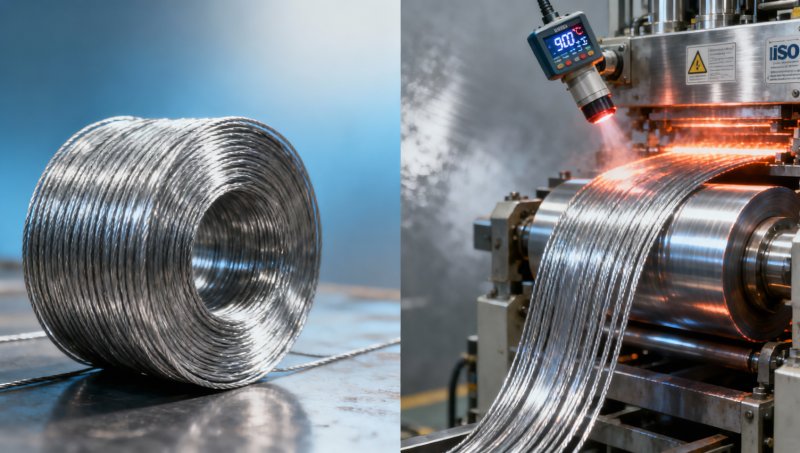
Consistent ductility begins long before wire drawing—and ends only after final inspection. Here are the four non-negotiable controls embedded in our production system:
- Melt Chemistry Tightening: We limit carbon variation to ±0.015% and manganese to ±0.025% per heat, using online OES (Optical Emission Spectrometry) with automated ladle adjustment—reducing segregation risk by 40% vs. standard practice.
- Hot-Rolling Temperature Banding: Coiling temperature is held within 890–910°C (±3°C) using infrared pyrometers and closed-loop PLC control—ensuring optimal pearlite spheroidization and minimizing banded structure formation.
- Pickling & Surface Integrity Monitoring: Acid concentration, temperature, and immersion time are logged per coil. Surface roughness (Ra ≤ 0.8 µm) is verified pre-drawing to prevent localized strain concentration during cold reduction.
- Controlled Cooling with Traceability: Each heat number is linked to its thermal history (cooling curve, hold times, ambient humidity). This enables root-cause analysis if any elongation deviation exceeds ±1.2%.
These controls aren’t theoretical—they’re audited quarterly by SGS and certified under ISO 9001:2015 Clause 8.5.2 (Identification and traceability).
How Does This Translate to Real-World Structural Performance?
Ductility consistency directly impacts structural safety, fatigue life, and fabrication yield. For example, in carbon seamless steel pipe reinforcement, inconsistent wire ductility causes uneven stress distribution during helical winding—increasing the risk of delamination under hydrostatic pressure testing (typically 2–4 MPa). Our wire maintains ≥22% elongation across 300+ coils tested at 20°C and 40°C—ensuring reliable performance in tropical and temperate climates alike.
For stainless steel coil wire used in architectural façade cables or seismic dampers, bend test repeatability (ASTM A938) is critical. Our 304 and 316 grades achieve zero failures in 180° bend tests (d=2×wire dia.) across 12 consecutive batches—validated by third-party BV reports.
This reliability extends beyond wire: our Channel Steel Supplier leverages identical metallurgical discipline—delivering Q235B and Q345B channel sections with thickness tolerance of ±0.02mm and height tolerance of ±2mm, enabling precise bolt-hole alignment in modular steel frame assembly.
Comparing Ductility Control Approaches Across Supplier Tiers
Not all steel wire suppliers apply equal rigor to ductility management. The table below compares three typical tiers based on verifiable process transparency, documentation depth, and audit readiness:
Choosing Tier 1 means eliminating rework delays, reducing QA overhead by up to 30%, and gaining full traceability for ISO 9001, ASME BPVC, or EN 1090-2 compliance audits.
Why Partner With Hongteng Fengda for Your Structural Steel Needs?
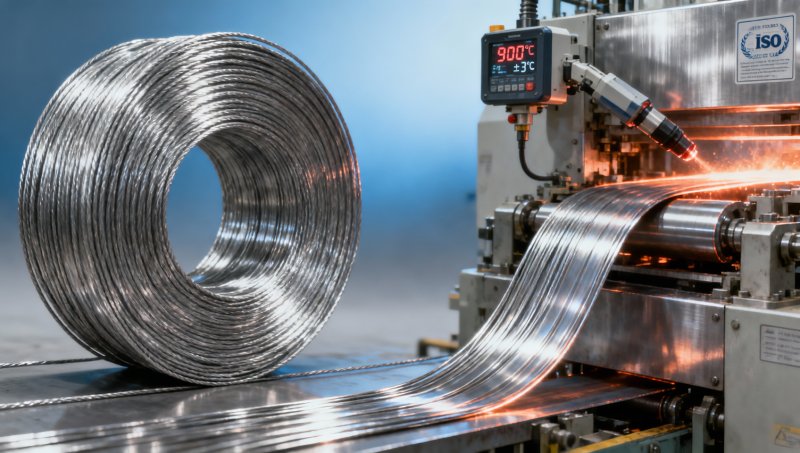
As a structural steel manufacturer and exporter from China with over 15 years of global delivery experience, Hongteng Fengda bridges the gap between industrial-grade reliability and responsive partnership. We don’t just supply steel—we co-engineer solutions aligned with your project timeline, certification needs, and cost targets.
Our integrated facility handles everything from raw material smelting to final packaging—enabling tight control over ductility-critical steps. Every order receives dedicated engineering support: material selection guidance, dimensional validation, mill test reports (MTRs), and optional third-party inspection (SGS/BV/UL).
Whether you require stainless steel metal wire for seismic bracing, carbon wire for reinforced concrete, or precision Channel Steel Supplier for lightweight roof purlins, we deliver stable quality, predictable lead times (standard 25–35 days FOB Tianjin), and full documentation for customs clearance and site acceptance.
Ready to validate ductility consistency for your next project? Contact us today for a free technical consultation—including sample testing protocol, MTR format review, and customized delivery planning.
Please give us a message


Please enter what you want to find