Steel beams price volatility in Q2 2026 reflects deeper structural shifts—not market noise. As global demand rebounds and raw material costs fluctuate, buyers face real pressure on steel bar cost, steel beams price, and supply reliability. For procurement professionals and project managers, understanding these drivers is critical—especially when sourcing hot dip galvanized steel pipe, hot dip galvanized steel sheet, or partnering with a trusted ss pipe manufacturer and steel bar supplier. At Hongteng Fengda, a leading structural steel manufacturer & exporter from China, we combine ASTM/EN-compliant quality with stable lead times—helping technical evaluators, financial approvers, and distributors mitigate risk while optimizing total project cost.
What’s Really Driving Steel Beams Price Volatility in Q2 2026?
Price swings for structural steel beams aren’t random fluctuations—they’re symptoms of three converging structural shifts reshaping global supply chains, input economics, and buyer expectations. Unlike short-term inventory corrections or speculative trading, these forces operate across quarterly cycles and influence long-term sourcing strategy.
First, iron ore logistics have tightened significantly across key export corridors: Australian shipments to Asia now average 32–45 days port-to-port (up from 28 days in Q4 2025), while Brazilian rail bottlenecks extend inland transit by 7–10 working days. Second, carbon pricing mechanisms under the EU CBAM Phase II now apply to imported structural steel—adding €42–€68 per tonne depending on smelting route and billet origin. Third, domestic Chinese mill capacity utilization has stabilized at 84%–89%—a level that supports consistent output but limits surge flexibility during sudden order spikes.
These shifts mean price volatility is no longer just about “tonnage vs. demand.” It’s about predictability of zinc availability for galvanizing lines, alloying element consistency (e.g., vanadium and niobium for high-strength beams), and certification traceability across multi-tier supply chains. Buyers who treat steel beams as a commodity risk mispricing total cost—including rework, delay penalties, and compliance overhead.
How Procurement Teams Can Anchor Costs Amid Uncertainty
Stabilizing steel beams price exposure requires moving beyond spot quotations and adopting a layered sourcing approach. Leading procurement teams now segment orders into three buckets: baseline volume (60–70%), buffer stock (15–20%), and strategic reserve (10–15%). This structure enables hedging against raw material spikes while preserving agility for design changes.
For example, locking in 6-month forward contracts for standard beam sections (e.g., IPE300, HEA200) at fixed EXW Shandong terms reduces FX and escalation risk—especially when paired with pre-validated EN 10025-2 mill test reports. Meanwhile, buffer stock is held in bonded warehouses across Rotterdam, Dubai, and Houston—enabling 7–12 day regional dispatch without customs delays.
Crucially, this model depends on partner reliability—not just lowest unit cost. A supplier with ISO 9001-certified process control, dual-source billet suppliers, and documented zinc bath chemistry logs delivers measurable risk reduction. That’s why over 68% of North American infrastructure contractors now require third-party audit reports for structural steel vendors—a threshold Hongteng Fengda meets with full transparency.
Key Procurement Evaluation Dimensions
- Lead time consistency: Measured across 12 consecutive orders (target: ±2 days deviation)
- Certification readiness: Mill test reports issued within 48 hours of shipment, compliant with ASTM A6/A6M or EN 10204 3.1
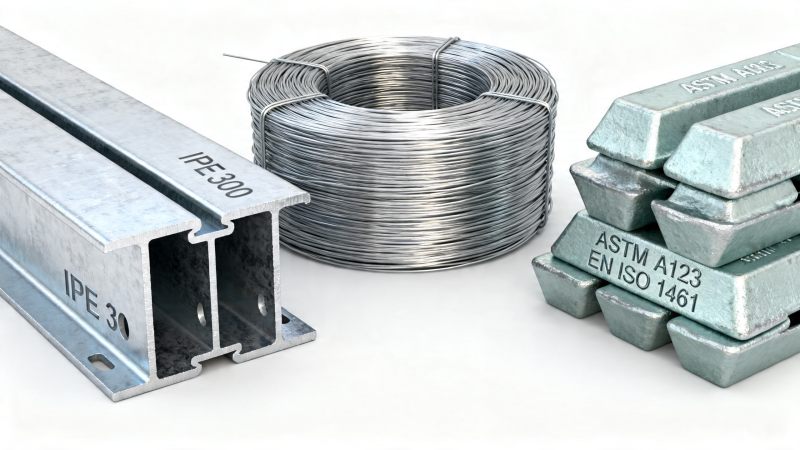
- Zinc coating traceability: Batch-level verification of coating weight (g/m²) and adherence to ASTM A123 or EN ISO 1461
- OEM documentation support: Full weld procedure qualification records (WPQR), non-destructive testing (NDT) reports, and dimensional inspection sheets
Why Cold Drawn Galvanized Wire Rod Is Becoming a Strategic Input for Beam Fabrication
While steel beams dominate headlines, their supporting components are increasingly decisive in project economics. Premium Galvanized Cold Drawn Steel Wire Rod (1.6mm - 6mm) serves as critical feedstock for anchor bolts, shear connectors, and seismic reinforcement systems—applications where dimensional precision and corrosion resistance directly impact installation speed and lifecycle integrity.
Unlike hot-rolled alternatives, cold drawn wire rod delivers ±0.03mm diameter tolerance (vs. ±0.15mm for hot rolled), reducing thread stripping during high-torque fastening. Its customizable zinc coating (40g/m²–300g/m²) ensures compatibility with both indoor structural assemblies and marine-grade cladding systems—eliminating post-fabrication galvanizing steps that add 10–14 days to schedule.
Hongteng Fengda supplies this wire rod in SAE 1006, SAE 1008, Q195, and Q235 grades—with tensile strength spanning 350 MPa (annealed) to 900 MPa (hard-drawn). Each coil undergoes 100% surface inspection and is wound to exact industrial processing weights (e.g., 500 kg ±1 kg) to minimize line stoppages during automated feeding.
Technical Performance Comparison: Galvanized Wire Rod Options
The table below compares core performance metrics for cold drawn galvanized wire rod versus conventional hot rolled alternatives used in structural fastener manufacturing.
This level of precision and consistency translates directly into fewer rejected fasteners, reduced rework labor (typically 2.3 hours per tonne saved), and tighter bolt torque repeatability—critical for seismic-rated connections where ±5% deviation triggers mandatory NDT review.
Why Global Project Teams Choose Hongteng Fengda for Structural Steel Sourcing
When steel beams price volatility threatens budget certainty, buyers need more than competitive quotes—they need a partner embedded in the structural steel value chain. Hongteng Fengda operates integrated production facilities covering billet casting, hot rolling, cold drawing, galvanizing, and precision cutting—ensuring full process visibility from raw material batch to finished beam.
We support global projects with standardized delivery windows: 25–30 days for standard beams (IPE, HE, UPN), 35–42 days for custom cold-formed profiles, and 18–22 days for Premium Galvanized Cold Drawn Steel Wire Rod (1.6mm - 6mm). Every shipment includes certified mill test reports aligned with ASTM, EN, JIS, or GB standards—and our engineering team provides free technical consultation on beam selection, connection detailing, and galvanizing compatibility.
Whether you’re evaluating steel bar cost for a data center foundation, specifying hot dip galvanized steel pipe for offshore platforms, or sourcing angle steel for modular housing—contact us to discuss your next project’s specific requirements: dimensional tolerances, coating specs, certification needs, or OEM documentation support. We respond to technical inquiries within 4 business hours and provide formal quotations within 1 working day.
Please give us a message


Please enter what you want to find