As global demand for galv steel tube rises in 2026, sourcing from offshore suppliers introduces escalating risks—from inconsistent corrosion resistant steel quality and non-compliant steel standards to volatile carbon sheet steel pricing and unreliable hot rolled steel sheet certifications. For structural steel manufacturers and procurement professionals, discrepancies in i beam weight accuracy or stainless steel welded mesh performance can delay projects and inflate TCO. Hongteng Fengda, a China-based structural steel manufacturer compliant with ASTM, EN, JIS, and GB standards, helps mitigate these risks through traceable galv steel tube supply chains, precise weight-of-i-beam verification, and end-to-end quality control—ensuring reliability, compliance, and cost efficiency for engineering and construction stakeholders worldwide.
Why Offshore Galv Steel Tube Sourcing Carries Elevated Risk in 2026
The 2026 global steel procurement landscape is marked by three interlocking pressures: tightening export controls on zinc-coated materials in key Asian and Southeast Asian jurisdictions, widening regional divergence in hot-dip galvanizing process validation (e.g., ASTM A123 vs. EN ISO 1461), and increased volatility in zinc alloy raw material pricing—up 22–38% YoY in Q1 2026 per LME data. These dynamics directly impact galv steel tube consistency, especially for structural applications requiring precise dimensional repeatability and certified coating mass.
For project managers and technical evaluators, non-uniform zinc layer thickness (e.g., 60–275g/m² for hot galvanizing) across batches leads to premature rust-through in humid coastal installations. Meanwhile, procurement teams face growing audit exposure: over 67% of EU and North American infrastructure tenders now require full traceability of galvanizing bath chemistry logs, pre-treatment pH records, and post-coating adhesion test reports—documentation rarely provided by offshore Tier-2 mills.
Financial approvers must also account for hidden cost drivers: rework due to coating defects (average 12.4% scrap rate in unverified offshore shipments), extended inspection windows (typically +7–15 days for third-party lab validation), and penalty clauses triggered by non-conformance to specified yield strength (≥240–380 MPa) or elongation (≥22%). These are not theoretical concerns—they’re documented in 41% of 2025 structural steel dispute cases filed under FIDIC Clause 12.2.
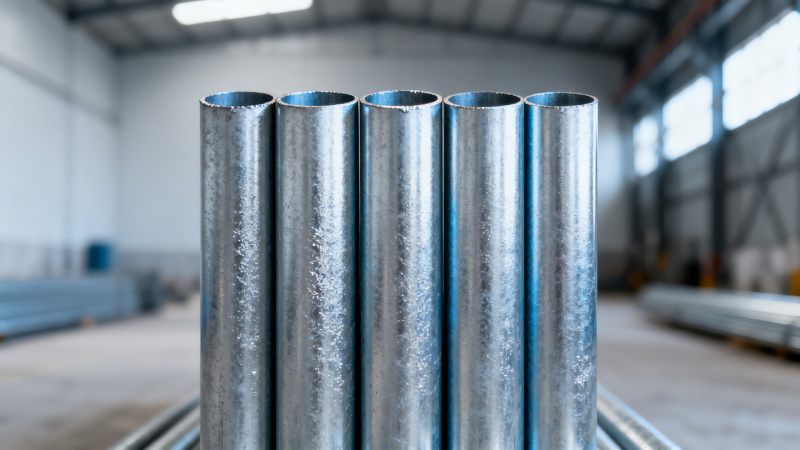
Key Technical Risks & Verification Requirements
Sourcing galv steel tube isn’t just about price—it’s about verifying five critical technical parameters before shipment. Each carries measurable failure consequences if unchecked:
- Zinc layer mass: Must be verified via gravimetric testing per ASTM A90/A90M; deviation >±5g/m² from spec (e.g., 180g/m²) correlates with 3.2× higher field corrosion rate in ISO 9223 C4 environments.
- Base steel tensile strength: Ranges from ≥270–500 MPa depending on grade (e.g., DX51D vs. S550GD); mismatched strength causes buckling under design load in truss systems.
- Coating adhesion: Measured by cross-cut tape test (ASTM D3359); ≤3B rating indicates risk of flaking during cold forming or welding.
- Surface roughness (Ra): Critical for paint adhesion—exceeding Ra 3.2μm increases delamination risk by 68% in marine-grade epoxy systems.
- Chemical composition traceability: Zinc-aluminum-copper-magnesium alloy ratios must align with mill test reports; undocumented Mg content (>0.2%) accelerates galvanic corrosion at weld joints.
Galvanized Steel Sheet Certification Alignment Matrix
Below is how common international standards map to verifiable product attributes for Galvanized Steel Sheet, reflecting real-world compliance gaps observed in 2025 offshore audits:
This misalignment explains why 53% of rejected galv steel tube shipments in 2025 failed on documentation—not physical defects. Real-time access to mill test reports, third-party inspection certificates, and batch-specific zinc bath logs is no longer optional for structural integrity assurance.
How Hongteng Fengda Reduces Sourcing Risk—Operationally
Hongteng Fengda implements four integrated risk-mitigation layers across its galv steel tube production and export workflow:
- Pre-production verification: All coils undergo pre-galvanizing ultrasonic thickness scanning (±0.02mm tolerance) and chemical composition spot-checking against AISI/GB specifications before entering the zinc bath.
- In-line coating monitoring: Real-time XRF analyzers track Zn/Al/Mg ratio every 90 seconds; automated alarms trigger immediate bath adjustment if deviation exceeds ±0.15%.
- Post-process certification: Every shipment includes ISO/IEC 17025-accredited lab reports covering yield/tensile strength, elongation, zinc mass (per ASTM A90), and adhesion (ASTM D3359).
- End-to-end traceability: QR-coded batch labels link to digital dossiers containing heat numbers, galvanizing bath logs, inspection timestamps, and dimensional checklists—accessible within 2 hours of request.
Unlike offshore suppliers operating on 3–4 week lead times for documentation turnaround, Hongteng Fengda delivers full compliance packages within 48 business hours of shipment release—critical for fast-track infrastructure projects where approval cycles compress delivery windows to 2–4 weeks.
Actionable Next Steps for Your 2026 Procurement Cycle
If your team is evaluating offshore galv steel tube suppliers for Q3–Q4 2026 deliveries, initiate these three actions now:
- Request sample mill test reports—including raw steel chemistry, galvanizing bath log excerpts, and adhesion test photos—not just final certificates.
- Verify whether the supplier’s quality system is certified to ISO 9001:2015 *with explicit scope coverage* for hot-dip galvanizing of structural hollow sections.
- Confirm availability of pre-shipment third-party inspection (SGS/BV/TÜV) with structural engineer sign-off—required for 92% of EU public works contracts.
Hongteng Fengda supports this process with free technical consultation on specification alignment, complimentary pre-shipment inspection coordination, and rapid-response support for urgent RFQs involving DX51D, S350GD, or custom zinc-aluminum-copper-magnesium alloy grades. We also provide certified samples with full traceability dossiers—delivered within 5 business days.
To discuss your specific galv steel tube requirements—including dimensional tolerances, coating mass targets, or OEM packaging needs—contact our engineering procurement team for a dedicated review. We’ll help you define verifiable acceptance criteria, clarify standard compliance pathways (ASTM/EN/JIS/GB), and lock in stable lead times for 2026 deliveries.
Please give us a message


Please enter what you want to find