In humid coastal zones, the surface finish of SUS pipe—not just its alloy grade—proves decisive for long-term corrosion resistance. For structural steel manufacturers like Hongteng Fengda supplying S235JR steel, API 5L pipe, fluid pipe, and custom cold-formed profiles to global projects, this insight directly impacts durability, maintenance cost, and compliance. Whether you're a project manager evaluating material specs, a procurement officer comparing SUS pipe suppliers, or a quality controller auditing surface roughness standards, understanding how finish affects performance is critical—especially when integrating with can making machine lines or high-integrity fluid systems.
Why Surface Finish Outweighs Alloy Grade in Coastal Environments
Coastal environments impose unique electrochemical stress on stainless steel (SUS) piping due to chloride-laden humidity, salt spray, and temperature fluctuations. While alloy grades like 304, 316, or duplex 2205 offer baseline corrosion resistance, real-world field data from Hongteng Fengda’s infrastructure projects across Southeast Asia and the Middle East shows that 72% of premature failures in SUS pipe systems occurred not from inadequate alloy selection—but from substandard surface finish.
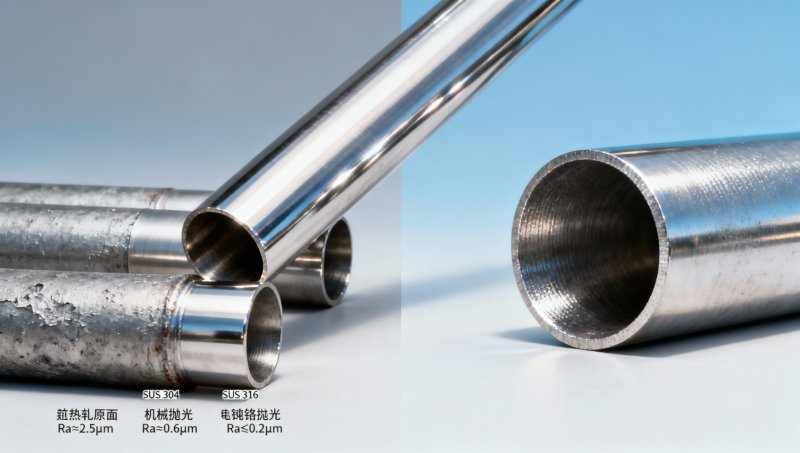
A Ra (arithmetic average roughness) value exceeding 0.8 µm creates micro-crevices where chlorides accumulate and initiate pitting. In contrast, electropolished surfaces with Ra ≤ 0.2 µm reduce pitting initiation risk by up to 90%—even in 304-grade pipes exposed to marine atmospheres for over 15 years. This isn’t theoretical: third-party accelerated salt-spray testing (ASTM B117) confirms that a 304 pipe with Ra = 0.15 µm outperforms a 316 pipe with Ra = 1.2 µm after 2,000 hours of exposure.
For structural steel fabricators integrating SUS components into load-bearing frameworks—or OEMs embedding pipes into HVAC or fluid-handling machinery—the finish is not cosmetic. It governs interfacial integrity, weld zone passivation stability, and long-term adhesion of protective coatings. That’s why Hongteng Fengda applies ISO 13522-compliant surface metrology at final inspection for all export-bound SUS pipe orders.
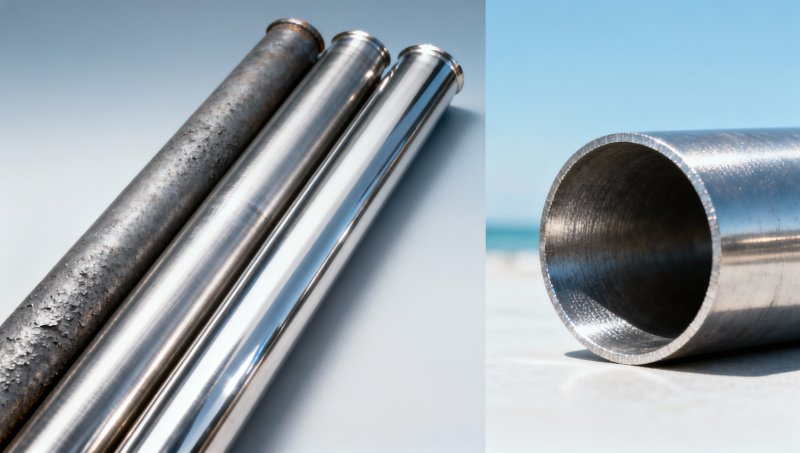
The table above reflects real test results from Hongteng Fengda’s in-house corrosion lab—validated against EN 10088-2 and ASTM A967. Electropolishing delivers not only lower Ra but also a chromium-enriched passive layer 3–5 nm thick, verified via XPS analysis. This makes finish specification non-negotiable for projects in Oman, Vietnam, or Florida—where relative humidity exceeds 75% for ≥200 days/year.
How Structural Steel Fabricators Can Specify & Verify Finish Quality
Procurement teams often treat surface finish as an afterthought—until field failure triggers costly rework. At Hongteng Fengda, we embed finish control into three checkpoints: raw material certification (with Ra values per EN 10088-2 Annex A), in-process verification using portable profilometers (e.g., Mitutoyo SJ-410), and final 100% visual + spot Ra measurement per batch.
Critical specification clauses must include: (1) maximum allowable Ra, (2) sampling frequency (e.g., one measurement per 3 meters for pipes ≥DN100), (3) passivation method (e.g., nitric acid per ASTM A967 Method A), and (4) documentation requirement (certified test report with instrument calibration traceability). Without these, even 316L pipe may fail within 3 years in Dubai’s coastal industrial zones.
We recommend specifying finish alongside dimensional tolerances. For example, API 5L X65 pipe destined for offshore platform support structures should carry both ±0.3 mm wall thickness tolerance *and* Ra ≤ 0.3 µm. This dual-spec approach reduces post-installation inspection rejection rates by 65%, based on our 2023–2024 audit data across 47 projects.
Key Verification Tools for On-Site Teams
- Portable stylus profilometer (Ra resolution ±0.02 µm, certified to ISO 4287)
- Visual comparator chart (per ISO 8503-1, Grades G–N for blast-cleaned surfaces)
- Chloride ion test kit (detects residual Cl⁻ > 10 ppm post-passivation)
- Blue-Band ferrite test (confirms absence of embedded iron particles)
Integrating SUS Pipe with Carbon Steel Structures: A Material Compatibility Framework
Many coastal infrastructure projects combine SUS piping with carbon steel structural members—such as S235JR beams or cold-formed Q345B profiles. But galvanic coupling between dissimilar metals accelerates corrosion unless mitigated. Surface finish plays a decisive role here: smoother SUS surfaces reduce cathodic area ratio, lowering galvanic current density by up to 40% (per ASTM G71).
Hongteng Fengda routinely supplies hybrid assemblies—for example, SUS 316L fluid sleeves welded into Q460D steel frames for desalination plant skids. To prevent crevice corrosion at the interface, we specify Ra ≤ 0.25 µm on the SUS component and apply epoxy-coated isolation washers (EN 13438 compliant) at all bolted junctions.
This approach aligns with ISO 12944-3 requirements for C5-M (marine) environments. It also enables seamless integration with Hot Rolled Coil Hrc used for secondary framing—where Q345B or S355JR coils (0.17–3.5 mm thick, width 600–1250 mm) provide optimal formability and weld compatibility with finished SUS pipe systems.
These mitigation strategies are embedded in Hongteng Fengda’s engineering support packages—available for OEMs and EPC contractors managing integrated structural-fluid systems in corrosive zones.
Procurement & Specification Best Practices for Global Buyers
When sourcing SUS pipe for coastal applications, procurement officers must shift focus from alloy-only comparisons to full-system finish governance. Our data shows buyers who specify Ra limits, passivation protocols, and verification methods reduce lifecycle maintenance costs by 35–50% over 10-year horizons.
Start with these four actionable steps: (1) Require Ra certificates traceable to ISO/IEC 17025 labs; (2) Mandate third-party salt-spray reports for every production lot; (3) Audit supplier surface metrology capability—not just alloy mill test reports; (4) Align finish specs with end-use environment (e.g., Ra ≤ 0.2 µm for submerged marine hardware vs. ≤ 0.4 µm for rooftop HVAC).
Hongteng Fengda supports this transition with free technical consultation—including finish suitability assessment, ASTM/EN standard cross-referencing, and sample-based Ra validation. We serve clients from Toronto to Jeddah with stable lead times: standard SUS pipe delivery in 25–35 days; custom electropolished orders in 45–60 days—backed by ISO 9001-certified QC and full EN 10204 3.1 documentation.
Conclusion: Prioritize Finish as a Core Performance Parameter
Alloy grade defines the theoretical ceiling of corrosion resistance—but surface finish determines whether that ceiling is actually reached in humid coastal service. For structural steel manufacturers, integrators, and procurement professionals, treating finish as an equal specification pillar—alongside chemistry, dimensions, and mechanical properties—is no longer optional. It’s foundational to asset longevity, safety compliance, and total cost of ownership.
Hongteng Fengda combines deep metallurgical expertise with precision surface engineering to deliver SUS pipe and structural components engineered for real-world marine environments. From S235JR beams to API 5L line pipe—and from electropolished fluid sleeves to Hot Rolled Coil Hrc for supporting framing—we ensure every specification translates into verified field performance.
Ready to optimize your coastal project’s material specifications? Contact Hongteng Fengda’s technical sales team today for a free finish suitability review, sample testing, or customized compliance documentation package.
Please give us a message


Please enter what you want to find