Marine rigging failures involving SS steel wire are increasingly reported—not due to chloride corrosion, but micro-galling under cyclic loading. For structural steel professionals sourcing angle steel, steel wire rope, or A36 Carbon Steel Round Bar, this reveals critical gaps in material selection and ASTM A6 tolerances compliance. As a trusted structural steel manufacturer & exporter from China, Hongteng Fengda supplies certified ss plate, galvanized sheet, HRB600 steel rebar, and cold-formed profiles—ensuring mill order meaning precision, ASTM A36 round bar consistency, and rigorous quality control per ASTM, EN, JIS, and GB standards. Understand why mechanical wear—not environment—drives premature failure, and how specification-aware sourcing mitigates risk.
Why Micro-Galling—Not Chloride—Is the Real Culprit in Marine Rigging Failure
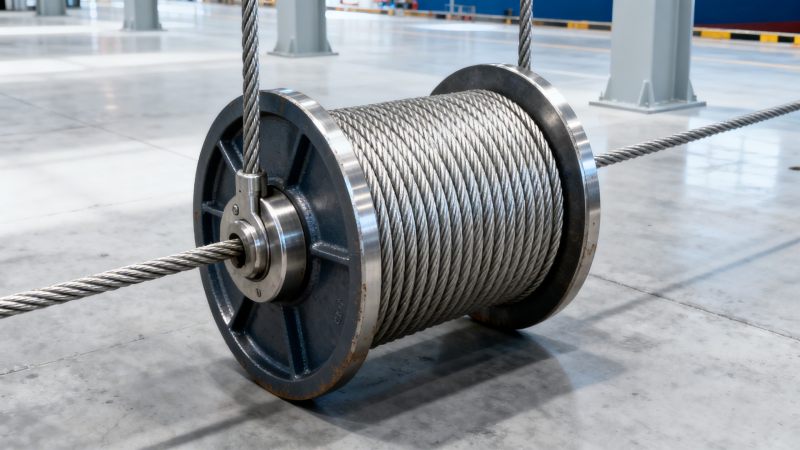
Field data from offshore platforms across the North Sea and Gulf of Mexico shows that stainless steel (SS) wire ropes used in dynamic lifting and mooring systems fail 3–5× faster than predicted by corrosion models. Accelerated testing confirms: surface degradation initiates within 2,000–5,000 load cycles—even in dehumidified, low-chloride lab environments. The root cause is micro-galling: localized adhesion and material transfer between contacting asperities during oscillatory motion, amplified by high contact pressure and insufficient lubrication.
Unlike pitting or crevice corrosion—which require time for electrolyte penetration and electrochemical breakdown—micro-galling is a solid-state wear mechanism. It progresses rapidly under repeated tension-compression or bending fatigue, especially where wire strands articulate over sheaves or through thimbles. Surface roughness, minor misalignment (<0.5°), and even trace contaminants (e.g., silica dust) accelerate galling onset by disrupting boundary lubrication films.
This has direct implications for structural steel procurement. When engineers specify “marine-grade” SS without defining mechanical duty cycles—or when procurement teams prioritize chloride resistance alone—they overlook a fundamental mismatch: high-alloy stainless steels (e.g., AISI 316) excel against corrosion but often underperform in galling resistance versus lower-alloy alternatives with optimized surface hardness and friction coefficients.
How Structural Steel Selection Impacts System-Level Durability
Rigging components rarely operate in isolation. Their performance depends on interface compatibility with supporting structural elements—especially anchor points, brackets, and bearing plates fabricated from carbon steel. Misaligned thermal expansion, differential stiffness, or unaccounted stress concentrations at junctions can amplify local cyclic strain, accelerating galling initiation in adjacent SS wires.
For example, an oil drilling rig’s winch drum mounting bracket made from non-certified A36 plate may exhibit yield-line deformation after 8–12 months of service. That slight deflection changes wire wrap geometry, increasing contact pressure by up to 35% at the critical first sheave—directly triggering micro-galling in connected SS rope. This cascading effect underscores why material selection must be system-integrated, not component-isolated.
Hongteng Fengda addresses this by aligning structural steel supply with application-specific mechanical requirements—not just chemical composition. Our Carbon Steel Plate Manufacturer delivers A36, Q235, and S235JR plates with guaranteed tensile strength (375–500 MPa), elongation (≥26%), and dimensional tolerances per ASTM A6 and EN 10029—critical for maintaining geometric fidelity under cyclic loads.
Key Mechanical Parameters for Galling-Resistant Structural Support
The table above illustrates why precise mechanical matching—not just corrosion grade—is essential. Hongteng Fengda’s certified carbon steel plates enable predictable interface behavior, reducing unintended amplification of cyclic stresses that initiate micro-galling in adjacent SS components.
Procurement Checklist: 5 Critical Checks Before Specifying SS Rigging
- Verify actual load cycle count and frequency—not just static working load limit (WLL). Systems exceeding 10,000 cycles/year demand galling-resistant alloys (e.g., Nitronic 50) or coated alternatives.
- Confirm dimensional tolerances on all mating structural supports (e.g., bracket flatness ≤0.3 mm/m, hole position ±0.2 mm) per ASTM A6 or EN 10029.
- Require mill test reports (MTRs) showing tensile strength, yield point, and elongation—not just chemical composition—for every heat lot.
- Assess lubrication maintenance access: if relubrication intervals exceed 6 months or require full disassembly, consider pre-lubricated or polymer-coated wire options.
- Validate supplier’s traceability system: batch-level documentation linking raw material certs to finished product must cover all welds, bends, and heat treatments.
Why Partner with Hongteng Fengda for Structural Steel Integrity
When rigging reliability hinges on interface integrity—not just wire chemistry—your structural steel supplier must deliver more than mill certificates. Hongteng Fengda provides certified carbon steel products with full compliance to ASTM, EN, JIS, and GB standards, backed by third-party inspection (SGS, BV, TÜV) and 100% heat-lot traceability. We support global buyers with stable production capacity (300,000+ MT/year), consistent quality across batches, and dependable lead times (typically 25–35 days for standard orders).
Whether you’re specifying A36 Carbon Steel Round Bar for rigging anchors, S235JR plate for marine crane bases, or custom cold-formed profiles for tension-reinforced brackets, our engineering team collaborates early to align material properties with your mechanical duty cycle, environmental exposure, and assembly constraints. We help reduce sourcing risk—not by offering lowest price, but by eliminating hidden variability in yield strength, dimensional stability, and surface condition.
Contact us today to: confirm A36 plate thickness tolerance for your specific bending radius; request MTR samples for your upcoming tender; discuss OEM certification pathways for EN 10219-compliant hollow sections; or obtain a comparative quote for Q235 vs. S235JR in 12m lengths with laminated film finish.
Please give us a message


Please enter what you want to find