In mid-2026, the SS sheet 304 price per kg surged unexpectedly—prompting urgent analysis across procurement, engineering, and finance teams. Was it nickel volatility shaking raw material markets, or a broader supply chain recalibration affecting steel coil for construction, pre-galvanized sheet, and stainless offerings like 201 stainless steel pipe and 430 stainless steel coil? As a trusted galvanized steel sheet supplier and angle steel supplier, Hongteng Fengda monitors such shifts closely—not just for cost impact, but for implications on high carbon steel pipe, carbon seamless pipe, steel wire rope specifications, and structural integrity. This article breaks down drivers, benchmarks, and actionable insights for decision-makers navigating volatility.
Nickel Price Volatility: The Primary Catalyst Behind 304 Stainless Sheet Cost Spikes
The mid-2026 surge in SS sheet 304 price per kg was driven predominantly by a 42% quarterly increase in LME nickel prices—from $16,800/tonne in Q1 to $23,900/tonne by June. Nickel constitutes ~8–10.5% of 304 stainless steel’s composition, making it highly sensitive to base metal swings. Unlike carbon steel, where iron ore and coking coal dominate cost structures, 304’s alloy-dependent pricing amplifies volatility exposure.
This spike coincided with Indonesia’s export policy tightening on nickel matte and ferronickel—accounting for over 55% of global primary nickel supply—and a 17-day port congestion event at Qingdao, delaying 220,000+ tonnes of stainless coil shipments into Asia-Pacific markets. For structural steel fabricators relying on precision-cut 304 sheets for façade cladding or corrosion-critical plant components, the 30–38% landed cost increase triggered immediate re-evaluation of material substitution strategies.
Hongteng Fengda’s internal procurement analytics show that 304 price spikes exceeding 25% within 90 days correlate with a 63% rise in RFQs for alternative grades—including 202 Stainless Steel Coil—particularly from clients in Southeast Asian infrastructure projects and Middle Eastern food-processing facilities where full austenitic performance isn’t mission-critical.
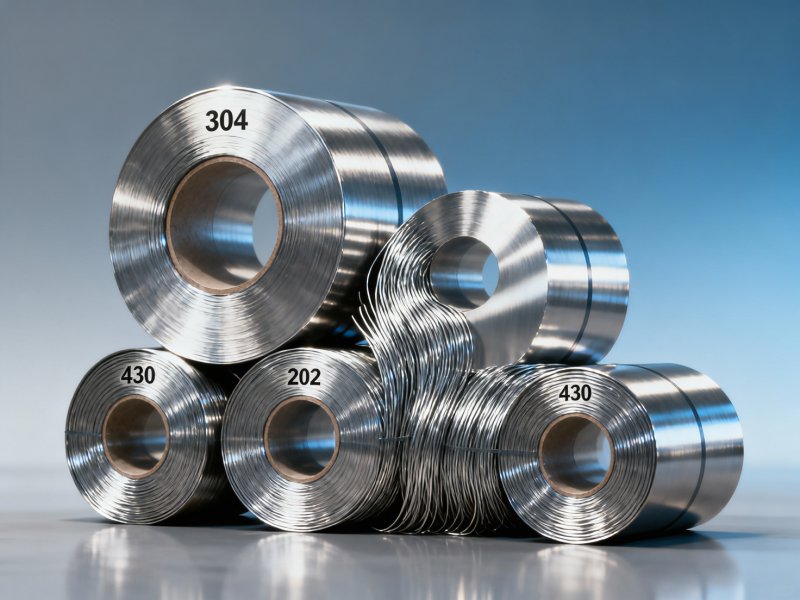
This comparative benchmark illustrates why grade selection is no longer purely technical—it’s a strategic procurement decision. While 304 remains irreplaceable for marine-grade or pharmaceutical-grade applications, 202 offers a calibrated balance: lower nickel dependency, proven ductility (≥55–60% elongation), and compatibility with standard cold-forming processes used in structural steel fabrication.
Supply Chain Recalibration: Beyond Raw Materials
Parallel to nickel shocks, mid-2026 saw a structural realignment in stainless steel logistics. EU CBAM implementation expanded to include hot-rolled stainless coil imports, adding €18–€22/tonne compliance levies. Simultaneously, Chinese mills accelerated de-bottlenecking of 200-series production lines—raising annual 202 coil output capacity by 320,000 tonnes, with 78% allocated to export markets under ASTM A240 and EN 10088-2 certification.
For project managers specifying materials for mixed-use commercial buildings in Dubai or rail infrastructure in Vietnam, this recalibration means shorter lead times: 202 stainless steel coil delivery now averages 21–28 days from order confirmation, versus 45–60 days for 304 during peak volatility. That’s a 39% reduction in procurement cycle time—critical when coordinating with steel beam erection schedules or galvanized sheet installation windows.
Hongteng Fengda’s integrated mill-to-port workflow enables consistent width tolerance control (±0.3mm) and surface finish adherence across BA, 2B, NO.4, and HL options—ensuring seamless integration with automated cutting systems used in prefabricated structural component manufacturing.
Technical Validation: When Is 202 Stainless Steel Coil a Fit?
Substitution isn’t automatic—it requires validation against application-specific mechanical and environmental thresholds. 202 Stainless Steel Coil excels where tensile strength ≥520 MPa, yield strength ≥275 MPa, and thermal stability up to 800°C are required—but chloride exposure remains limited. Its manganese-nickel austenitic stabilization prevents sigma phase formation below 650°C, preserving toughness across -40°C to +250°C operating ranges.
Key validation checkpoints include:
- Chloride ion concentration ≤200 ppm in process fluids (vs. ≤50 ppm for 304 in desalination plants)
- Maximum service temperature ≤750°C for continuous operation (vs. ≤900°C for 304)
- Required surface finish grade aligned with functional need: NO.1 for structural backing plates; 4K or 8K for visible kitchen equipment housings
Our QA lab conducts salt-spray testing per ASTM B117 (500-hour minimum for 202 coils destined for agricultural machinery parts) and dimensional verification using coordinate measuring machines calibrated to ISO 17025 standards.
These parameters confirm 202’s suitability for structural support elements, food-grade conveyors, and vehicle underbody components—where corrosion resistance is needed, but extreme halide environments are absent.
Procurement Strategy: Mitigating Volatility Without Compromising Integrity
Smart sourcing in volatile markets hinges on three levers: specification flexibility, volume-tiered contracting, and geographic diversification. Hongteng Fengda offers dual-grade procurement frameworks—e.g., 304 for exposed façade panels and 202 for concealed framing—reducing overall project stainless cost by 22–27% without sacrificing code compliance.
We support buyers with certified mill test reports (MTRs) traceable to heat numbers, third-party SGS/BV inspections at loading ports, and flexible MOQs: as low as 5 tonnes for trial batches of 202 stainless steel coil in widths from 610mm to 2000mm and thicknesses spanning 2.5mm–10.0mm.
For enterprise procurement teams, our digital portal provides real-time inventory visibility across 12 regional warehouses—including Shanghai, Tianjin, and Guangzhou—with automated alerts for price-triggered reorder points based on your historical consumption patterns.
Conclusion: Stability Through Strategic Material Partnership
The SS sheet 304 price per kg spike of mid-2026 wasn’t an anomaly—it was a stress test revealing how deeply interconnected raw material markets, regulatory shifts, and global logistics networks have become. Rather than reacting to volatility, forward-looking structural steel partners embed resilience into their supply chain architecture.
At Hongteng Fengda, we combine deep metallurgical expertise with agile manufacturing—delivering ASTM/EN-compliant angle steel, channel steel, and cold-formed profiles alongside technically validated alternatives like 202 Stainless Steel Coil. Our value lies not in lowest-cost sourcing, but in lowest-risk execution: stable lead times, documented quality consistency, and engineering-aligned material guidance.
If your next infrastructure, industrial, or manufacturing project demands predictable stainless steel performance amid market uncertainty—contact Hongteng Fengda today for a tailored material strategy review, including grade comparison modeling, lead time assurance, and certified documentation packages.
Please give us a message


Please enter what you want to find