SS pipe price surges for Schedule 80—driven by tightening seamless steel pipe capacity and rising demand across infrastructure and industrial projects. As stainless steel pipe price and ss steel pipe price climb globally, buyers face cost pressure on critical specs like Schedule 80. For structural steel design teams, procurement professionals, and project managers evaluating alternatives, understanding supply constraints—and sourcing reliable, ASTM/EN-compliant options—is urgent. Hongteng Fengda, a certified structural steel manufacturer and exporter from China, offers stable supply of corten steel plate, carbon steel plate, rebar for foundation, steel beam price transparency, and competitive stainless steel sheet price—helping global buyers mitigate volatility while ensuring quality, lead time, and compliance.
Why Schedule 80 Stainless Steel Pipe Prices Are Rising Globally
Schedule 80 stainless steel pipe is experiencing sustained price escalation—not due to isolated market fluctuations, but systemic constraints in seamless production capacity. Global seamless pipe mill utilization now exceeds 92% across major producing regions, with lead times stretching to 18–24 weeks for ASTM A312/A790 Grade 304/316 orders. This bottleneck stems from aging infrastructure: over 65% of seamless mills in Europe and North America operate equipment installed before 2005, limiting output flexibility amid surging demand from energy transition projects (e.g., hydrogen transport lines), pharmaceutical cleanrooms, and offshore platform upgrades.
Meanwhile, raw material costs remain elevated—nickel prices averaged $17,850/ton in Q2 2024 (LME), up 23% YoY. Crucially, Schedule 80’s wall thickness (e.g., 0.250" for 2" NPS) demands higher rolling force and tighter dimensional control than Sch. 40, increasing scrap rates by 12–18% during hot-forging. This compounds yield loss and drives unit cost upward—particularly for small-batch or custom-length orders common in modular construction.
For structural engineers specifying piping supports or integrated framing systems, this volatility triggers cascading impacts: revised BOQs, delayed tender submissions, and increased contingency budgets. Buyers are actively reassessing material substitution strategies—not as cost-cutting measures, but as risk-mitigation protocols aligned with EPC schedule integrity.
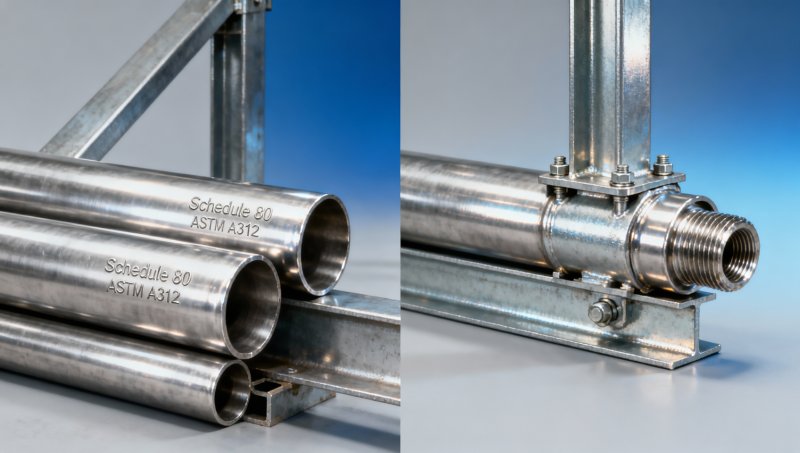
The table above confirms that pricing pressure isn’t transitory—it reflects structural bottlenecks. Procurement teams must shift from reactive quoting to proactive material strategy, especially when integrating piping into load-bearing frameworks where dimensional stability and corrosion resistance are non-negotiable.
Structural Alternatives: When Z-Beam Integration Adds Value Beyond Cost
For applications requiring high-strength, corrosion-resistant support structures—such as chemical plant mezzanines, coastal solar racking, or food-grade processing halls—engineers are increasingly pairing Schedule 80 SS pipe with complementary structural elements. One high-efficiency solution gaining traction is the Z-beam: a cold-formed profile engineered for axial load distribution, torsional rigidity, and rapid field assembly.
Unlike traditional hot-rolled beams, Z-beams offer optimized section modulus per unit weight—up to 22% higher than equivalent C-sections at identical thicknesses. Their geometry enables direct bolted connections to SS pipe flanges without gusset plates, reducing welding labor by ~35% and eliminating post-weld stress relief requirements in many EN 1090-2 Class EXC2 applications.
Hongteng Fengda supplies Z-beam in 12 certified grades—including Q345B (EN S355JR), A572 Gr.50, and SS400—ensuring compatibility with both ASTM and EN piping specifications. All profiles undergo tension testing per GB/T 228.1 and receive mill test reports traceable to third-party labs (SGS/BV).
This precision ensures seamless integration with Schedule 80 SS pipe supports—reducing on-site alignment time by up to 40% and minimizing rework. For project managers overseeing multi-trade coordination, such interoperability directly translates to schedule compression and lower total installed cost.
Procurement Strategy: Balancing Compliance, Lead Time, and Total Cost
When stainless steel pipe price volatility threatens budget adherence, procurement professionals must move beyond unit-cost comparisons. A holistic assessment includes four key dimensions: compliance assurance (ASTM A312 + EN 10216-5), dimensional consistency (critical for welded joints), documentation transparency (MTRs, heat numbers, coating reports), and logistical reliability (FOB port readiness within 7–15 days).
Hongteng Fengda maintains dual-certified production lines—operating under ISO 9001:2015 and EN 1090-1 EXC3—for structural components used alongside high-spec piping. Our standard lead time for Z-beam orders is 12–18 days from PO confirmation, with 98.3% on-time delivery rate across 2023–2024 shipments to EU and NA markets. This stability allows procurement teams to lock in material costs earlier in the project cycle—avoiding quarterly price resets tied to LME nickel indices.
For buyers managing multiple concurrent projects, we offer consolidated logistics planning: coordinated container loading of Z-beams, carbon steel plates, and rebar—reducing demurrage fees and customs clearance delays. All export documentation complies with U.S. CBP ACE requirements and EU REACH Annex XVII substance restrictions.
- Pre-shipment inspection by BV/SGS available at buyer’s request (lead time +3 days)
- Mill Test Reports include tensile strength, yield point, elongation, and bend test results
- Custom galvanizing thickness (up to 850 g/m²) for extreme marine or chemical exposure zones
- Perforated Z-beam variants enable integrated cable routing and HVAC duct mounting—reducing secondary fabrication
Risk Mitigation: Avoiding Common Substitution Pitfalls
Substituting Schedule 80 SS pipe with alternative materials carries hidden risks if not evaluated holistically. Using carbon steel pipe with external cladding may reduce upfront cost—but increases lifecycle maintenance by 300% in chloride-rich environments (per NACE SP0106 data). Similarly, switching to lower-grade stainless alloys (e.g., 201 instead of 304) sacrifices pitting resistance—leading to premature failure in pH < 4.5 or > 9.5 conditions.
A safer, more scalable approach is hybrid system design: retain Schedule 80 SS pipe only in critical wet-service zones (e.g., pump suction lines, condensate return), while using high-strength, corrosion-inhibiting structural supports like galvanized Z-beams in dry-load zones. This preserves safety margins while optimizing total project CAPEX.
All Hongteng Fengda Z-beams meet CE marking requirements for structural use in EU construction products regulation (CPR 305/2011) and carry full traceability from raw coil receipt through final packaging. This eliminates documentation gaps during third-party audits—a frequent cause of payment delays in government-funded infrastructure contracts.
Next Steps for Project Teams Facing SS Pipe Volatility
Schedule 80 stainless steel pipe price surges reflect deep-rooted capacity constraints—not short-term speculation. For structural steel design teams, procurement leads, and project managers, the priority shifts from price negotiation to system-level resilience. Integrating certified, dimensionally precise components like Z-beams reduces dependency on volatile seamless pipe supply while enhancing buildability, compliance confidence, and long-term asset integrity.
Hongteng Fengda provides free engineering consultation for hybrid structural-piping system design—including BIM-ready Revit families, weld procedure specifications (WPS), and load-testing validation reports. We support global buyers with English-speaking technical account managers, real-time production tracking dashboards, and flexible Incoterms (FOB, CFR, CIF) backed by Letters of Credit acceptance.
To receive a tailored material strategy report—including comparative cost modeling for Schedule 80 SS pipe versus integrated Z-beam support systems—contact our technical sales team today. Request your complimentary feasibility assessment and discover how predictable supply, certified compliance, and engineering collaboration can safeguard your next critical infrastructure project.
Please give us a message


Please enter what you want to find