In high-pressure applications, choosing between smls pipe and welded pipe can directly affect safety, performance, and long-term cost.
For supply evaluation, the difference is not only manufacturing method. It also changes inspection strategy, pressure confidence, fabrication planning, and lifecycle risk.
This article explains how smls pipe compares with welded pipe in demanding steel service conditions and what that means for practical project decisions.
Basic Definition of SMLS Pipe and Welded Pipe
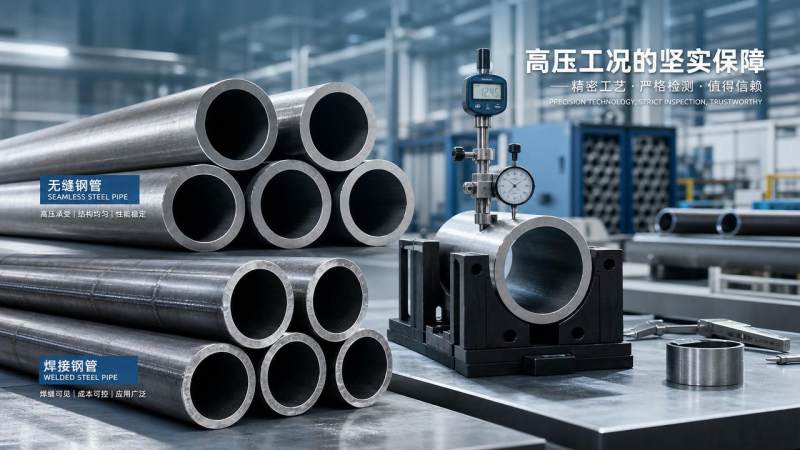
SMLS pipe means seamless pipe. It is produced without a welded seam, usually by piercing and rolling solid steel billets.
Welded pipe is made by forming steel plate or strip into a tube and joining the edges with a weld.
The seam is the key structural difference. In low and medium pressure lines, both options can perform well when standards and testing are appropriate.
In high-pressure service, however, the presence or absence of that seam changes stress behavior, defect sensitivity, and qualification requirements.
Common welded pipe types include ERW, LSAW, and SSAW. Each has different dimensional ranges, weld characteristics, and preferred applications.
Smls pipe is often selected for smaller diameters, higher pressure classes, elevated temperatures, and severe cyclic conditions.
What Changes in High Pressure Jobs
High pressure increases hoop stress, axial stress, and consequence of failure. That shifts attention from simple cost comparison to integrity assurance.
With smls pipe, there is no longitudinal seam to evaluate as a separate metallurgical zone. This often improves confidence under concentrated stress.
With welded pipe, the weld and heat affected zone require closer control. Welding quality, seam treatment, and non-destructive testing become critical.
The practical changes in high pressure jobs usually include the following:
- Higher inspection intensity for seam integrity
- Stricter tolerance review for wall thickness consistency
- Greater concern about fatigue, creep, and thermal cycling
- More conservative design choices in critical lines
- Closer attention to traceability, standard compliance, and mill testing
This is why smls pipe is regularly discussed in refinery units, boiler systems, power plants, hydraulic lines, and process pipelines.
Strength, Pressure Resistance, and Material Consistency
Many buyers assume seamless always means stronger. The reality is more technical. Actual performance depends on grade, thickness, processing, and standard.
Still, smls pipe offers several advantages in high-pressure steel applications because the wall is structurally continuous around the circumference.
That continuity can reduce concern about weld discontinuities, incomplete fusion, seam corrosion concentration, or variable weld toughness.
Welded pipe can also achieve excellent performance. Modern mills use advanced forming, welding, heat treatment, and ultrasonic inspection technologies.
However, in severe pressure service, qualification must prove that the seam performs as reliably as the base metal under design conditions.
Current Industry Concerns Behind Pipe Selection
Pipe selection today is influenced by more than pressure rating. Global projects also focus on downtime cost, certification reliability, and sourcing stability.
In steel procurement, these are the most common concern signals:
- Whether material meets ASTM, EN, JIS, or GB requirements
- Whether heat numbers and test reports are fully traceable
- Whether pressure service includes temperature fluctuation or shock load
- Whether lead time changes project installation sequence
- Whether inspection resources are available at destination
This is where an experienced structural steel and steel product supplier adds value through consistent manufacturing and document control.
Hongteng Fengda supports global steel supply with stable production, international standard compliance, and dependable delivery coordination.
Business Value of Choosing the Right Pipe Type
The right choice is not simply seamless versus welded. It is the best fit between risk level, design duty, budget, and service life expectation.
Smls pipe often reduces uncertainty in critical systems. That can lower shutdown risk, simplify approval, and support stronger long-term reliability.
Welded pipe often improves project economics in larger volume or larger diameter work, especially when pressure severity is moderate and standards are well controlled.
From a commercial perspective, the cost of failure always matters more than the purchase price difference.
That is why many projects divide systems by criticality instead of applying one pipe type everywhere.
Where SMLS Pipe Usually Creates More Value
- Boiler tubes and superheater lines
- High-pressure oil and gas process lines
- Hydraulic systems with pulsating pressure
- High temperature or corrosive service with strict integrity needs
Where Welded Pipe Often Remains Practical
- Water transmission lines
- Low to medium pressure utility systems
- Large diameter transport pipelines
- Projects with strong inspection controls and cost constraints
Typical Scenarios and Selection Priorities
A practical decision becomes easier when pipe duty is grouped by operating conditions instead of broad assumptions.
If pressure spikes, temperature cycling, or severe consequences exist, smls pipe usually moves higher on the shortlist.
Practical Advice Before Finalizing a Purchase
A smart steel sourcing decision should verify more than product name. It should confirm service conditions and proof of quality consistency.
- Match pipe type to design pressure, temperature, and media.
- Check applicable standards, wall schedule, and testing scope.
- Review mill certificates, NDT records, and traceability documents.
- Assess whether the project allows welded seam risk.
- Compare lifecycle cost, not only unit price.
- Use suppliers with proven export experience and stable quality control.
For global construction and industrial projects, reliable steel support matters as much as the product itself.
Hongteng Fengda provides structural steel products, custom processing support, and standards-based manufacturing for international requirements.
When evaluating smls pipe against welded pipe, the best outcome comes from aligning pressure duty, quality evidence, and delivery capability.
For projects that also require formed steel components or steel plates, material coordination can improve fabrication efficiency.
One useful option is High Carbon Steel Plate , available in widths from 100mm to 3000mm, lengths from 1m to 12m, and thicknesses from 0.1mm to 400mm.
It supports applications such as rails, switchboards, automobile parts, roofing, and formed surfaces, with high tensile strength, smooth finish, and broad standards coverage including ASTM, EN, JIS, and ISO.
Please give us a message


Please enter what you want to find