Understanding the mill order meaning for steel wholesalers is essential when stock risk, lead times, and purchasing costs move quickly.
In structural steel trading, a mill order is not only a buying term.
It affects production planning, minimum quantities, specification control, delivery reliability, and inventory exposure.
Why Mill Orders Matter in Structural Steel Supply
A mill order usually means steel is purchased directly for production at a steel mill or manufacturer.
Instead of buying only ready stock, the buyer commits to a planned production batch.
This makes the mill order meaning for steel wholesalers closely linked with stock strategy and cash flow.
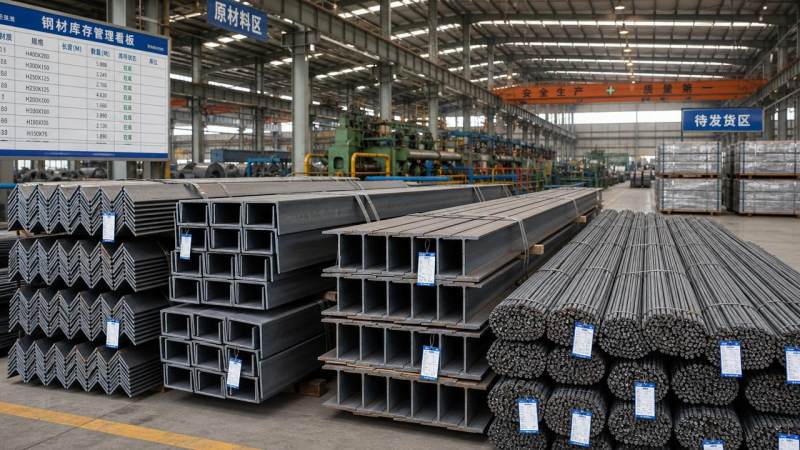
The concept is especially important for angle steel, channel steel, beams, rebar, and custom structural profiles.
The diagram below can represent how orders move from specification confirmation to production scheduling.
When handled well, a mill order can secure supply before market prices change.
When handled poorly, it can create slow-moving stock or delivery mismatch.
The Practical Meaning Behind the Term
In simple terms, a mill order is a production-based purchase commitment.
The required size, grade, length, surface condition, standard, and packaging are confirmed before manufacturing.
That differs from spot stock, where available goods are selected from existing inventory.
For this reason, mill order meaning for steel wholesalers includes both opportunity and responsibility.
It can provide stronger control over specifications, but it also requires accurate demand judgment.
A typical mill order may involve standard products or OEM structural components.
Common standards include ASTM, EN, JIS, and GB, depending on the destination market.
Mill order versus stock purchase
A stock purchase is faster, but choices may be limited.
A mill order takes more planning, yet it supports controlled dimensions and stable batch quality.
The best approach often depends on market volatility, project timing, and expected resale speed.
Stock Risk Is the Real Business Question
The mill order meaning for steel wholesalers becomes clearer when inventory risk is considered.
Steel prices can change between order placement, production, shipment, and final sale.
If demand slows, a planned batch may remain in warehouse longer than expected.
If demand rises, the same order may protect margins and improve supply reliability.
That is why mill orders should not be judged only by unit price.
Quantity, timing, grade flexibility, and customer order visibility matter just as much.
Typical stock risks connected with mill orders
- Over-ordering standard sizes that later face weaker local demand.
- Choosing uncommon grades without secured downstream projects.
- Underestimating port, customs, and inland transport lead times.
- Mixing standards without checking market acceptance and documentation needs.
- Accepting unclear tolerances that complicate resale or project approval.
These risks are manageable, but they require structured order evaluation.
Lead Time, MOQ, and Production Scheduling
Mill orders are shaped by the production rhythm of the manufacturer.
Rolling schedules, raw material availability, furnace planning, and finishing capacity can all influence delivery.
MOQ is another part of the mill order meaning for steel wholesalers.
Small quantities may be easier to sell, but they can be difficult to produce economically.
Large quantities may lower unit cost, but they increase inventory pressure.
A balanced order often groups compatible sizes, grades, and shipment windows.
This helps reduce production interruptions and keeps the final product mix more practical.
What should be confirmed before placement
- Exact steel grade, standard, size range, and tolerance requirement.
- Surface condition, marking, bundling, and export packaging.
- Production lead time and realistic shipment schedule.
- Inspection method, certificate type, and third-party testing needs.
- Payment terms and price validity under changing market conditions.
Product Mix and Specification Decisions
A mill order can include widely demanded standard steel or more specialized construction materials.
For reinforced concrete projects, rebar selection is often tied to structural design and local code acceptance.
For example, HPB300 Rebar is used in load-bearing, structural, and stirrup applications.
Its standard yield strength is no less than 300 MPa.
Common size options include 6mm, 8mm, 10mm, 12mm, 16mm, 20mm, and larger diameters.
Coils are often used for 6mm to 12mm sizes.
Straight bars may be selected for 10mm to 22mm applications.
Shapes such as spiral, herringbone, and crescent patterns support different reinforcement requirements.
This kind of product detail matters because mill orders leave less room for vague specifications.
A small mismatch can affect approval, resale, or project use.
Quality Control Reduces Uncertainty
Quality consistency is another reason the mill order meaning for steel wholesalers deserves careful attention.
A mill order should connect commercial terms with measurable technical requirements.
Material certificates, chemical composition, mechanical properties, and dimensional tolerance should be traceable.
For export orders, this documentation can decide whether goods pass inspection smoothly.
Hongteng Fengda manufactures and exports structural steel from China for global construction and industrial projects.
The company supplies angle steel, channel steel, beams, cold formed profiles, and customized components.
Products are managed under strict quality control and aligned with ASTM, EN, JIS, and GB standards.
Stable production capacity also helps reduce uncertainty around delivery commitments.
Documentation worth checking
How Market Volatility Changes the Decision
Steel markets are sensitive to raw material prices, freight costs, demand cycles, and policy changes.
This makes timing a central part of mill order planning.
A mill order may lock supply before a price increase.
It may also become expensive if the market turns downward after confirmation.
The mill order meaning for steel wholesalers therefore includes price exposure, not only procurement procedure.
A practical response is to divide demand into stable, project-based, and speculative portions.
Stable demand can support regular mill orders.
Project-based demand needs confirmed specifications and delivery milestones.
Speculative demand should be controlled carefully, especially for uncommon sizes.
A Better Way to Evaluate a Mill Order
A good mill order is not always the cheapest order.
It is the order that matches demand, specification, timing, and working capital.
Before confirming production, several questions should be answered with evidence.
- Are the sizes aligned with recent sales or confirmed project demand?
- Is the standard accepted in the destination market?
- Can the manufacturer provide consistent batches and proper certificates?
- Does the shipment schedule match warehouse and resale planning?
- Is there a fallback plan if demand shifts?
These checks make the mill order meaning for steel wholesalers more practical than theoretical.
They turn a production commitment into a controlled sourcing decision.
Working with a Reliable Manufacturer
Manufacturer capability has a direct effect on stock risk.
Reliable production planning reduces delays, substitutions, and last-minute specification changes.
Hongteng Fengda supports standard specifications and customized structural steel solutions for international projects.
Markets served include North America, Europe, the Middle East, and Southeast Asia.
The value is not only in supplying steel products.
It is also in helping align production capacity, documentation, and delivery with real project needs.
For mill orders, this alignment can reduce hidden costs behind low unit pricing.
Moving from Term Understanding to Better Decisions
The mill order meaning for steel wholesalers is best understood as a planning framework.
It connects market demand, technical specifications, production timing, logistics, and inventory control.
When these factors are reviewed together, mill orders can improve supply stability.
When they are separated, the same order can become a stock burden.
The next useful step is to organize current demand by grade, size, standard, and delivery window.
Then compare available stock purchases with production-based mill order options.
A dependable manufacturer can help verify feasibility, lead time, documentation, and cost structure.
That makes future steel sourcing decisions more stable, measurable, and easier to manage.
Please give us a message


Please enter what you want to find