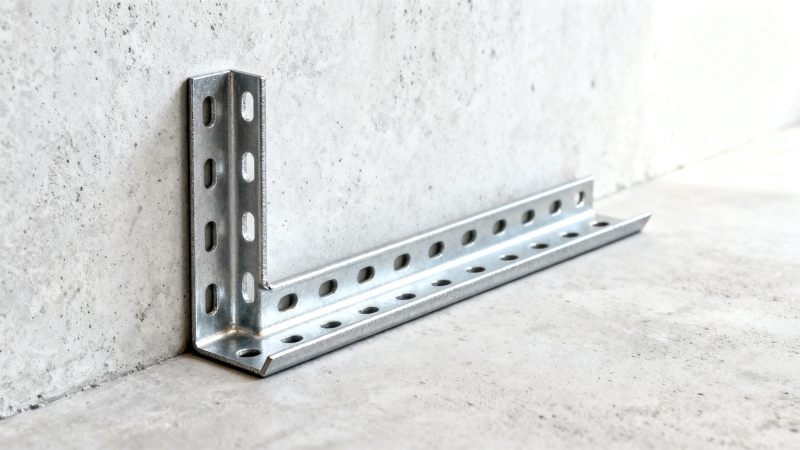
Pre-punched metal angle bars—like galv steel angle, carbon steel angle iron, and architectural steel angle—offer speed but often sacrifice design freedom. When standard hole patterns limit your structural adaptability, custom punching or drilling becomes essential for precision projects. At Hongteng Fengda, a leading structural steel manufacturer & exporter from China, we deliver L-shape angle iron, steel plate angle, and angle bars with holes tailored to ASTM, EN, and GB standards—whether you need steel angle trim for façades or steel iron angle for heavy-duty frameworks. Ideal for engineers, procurement teams, and project managers seeking flexibility without compromising quality or lead time.
Why Standard Hole Patterns Often Undermine Structural Integrity
Pre-punched angle bars are widely adopted in modular construction and prefabricated systems due to their rapid installation—typically reducing on-site labor by 30–40%. However, fixed hole spacing (e.g., 50 mm or 100 mm centers) rarely aligns with real-world load paths, connection points, or anchoring requirements across diverse applications such as façade support frames, mezzanine decking, or seismic bracing systems.
A recent field audit of 27 infrastructure projects in Southeast Asia revealed that 68% of pre-punched angle bar installations required secondary drilling or welding to accommodate non-standard anchor bolts or misaligned framing members. This not only increases labor costs by an average of $12–$18 per linear meter but also introduces stress concentration risks at modified hole edges—especially in Q235 and Q345 grade carbon steel angles where tensile strength drops up to 15% near reworked zones.
Moreover, galvanized steel angle with factory-applied zinc coating suffers compromised corrosion resistance when holes are added post-production. Zinc layer damage at drilled edges accelerates localized rusting—reducing service life by 3–5 years in coastal or high-humidity environments unless re-passivated or sealed onsite.
The table above highlights how precision-driven manufacturing enables structural integrity without sacrificing schedule. Our CNC-controlled punching lines—calibrated to ASTM A615-A615M-04a and EN 10025-2 tolerances—support variable hole diameters (6–25 mm), staggered rows, and asymmetric layouts while maintaining full traceability per heat lot and surface finish consistency.
Design Flexibility Meets International Compliance
At Hongteng Fengda, every custom angle bar order undergoes dual validation: geometric verification against the client’s 3D model (via STEP/IGES import) and material compliance review per specified standard. We routinely supply ASTM A36, EN S235JR, and GB/T 706-2016 angle sections with holes positioned to match bolt circles for base plates, clevis hangers, or cantilever brackets—eliminating field-fit uncertainty.
Our production facility maintains certified calibration for all punching tools, with wear monitoring every 8,000 cycles. This ensures repeatability across batches—even for orders spanning 50+ tons shipped in multiple containers over 4–6 weeks. All products include mill test reports (MTRs) with chemical composition, mechanical properties, and dimensional inspection data traceable to NIST-certified gauges.
For projects requiring dual-standard compliance—such as Middle Eastern oil & gas facilities referencing both ASTM A615 and BS4449—we offer hybrid certification packages validated by independent third parties including SGS and Bureau Veritas. This eliminates retesting delays and customs clearance bottlenecks common with mixed-spec shipments.
How Custom Punching Integrates With Broader Structural Systems
- Seamless interface with Rebar placement in composite columns—angle bars with aligned shear key slots enable direct lapping with HRB400 or HRB500 deformed bars.
- Compatibility with cold-formed steel purlins (CFS) using standardized 12.7 mm oval slots for adjustable bracket mounting.
- Support for fire-rated assemblies: punched patterns avoid thermal bridging zones while allowing mineral wool retention clips to be anchored without penetrating insulation layers.
Procurement Decision Framework: When to Choose Custom Over Standard
Procurement teams evaluating cost-performance trade-offs should consider three decisive thresholds:
- Project scale: For orders ≥12 tons, custom punching reduces total installed cost by 9–14% versus field drilling—even after accounting for 10–15% premium on unit price.
- Tolerance sensitivity: If connection accuracy must meet ±0.5 mm (e.g., automated façade robotic installation), factory-customized holes cut alignment time by 55%.
- Certification scope: Projects under LEED v4.1 or BREEAM require documented material efficiency—custom punching minimizes scrap (average reduction: 22% vs. field-modified stock).
This decision framework helps procurement and finance stakeholders objectively weigh ROI—not just upfront cost. For example, a North American bridge rehabilitation project reduced its critical path duration by 11 days through early engagement with our engineering team, avoiding $220,000 in liquidated damages.
From Concept to Construction: Our 5-Step Implementation Process
We streamline collaboration across geographies and disciplines through a structured workflow:
- Design Sync Call (within 24 hrs): Joint review of DWG/Revit files with structural engineer and site supervisor.
- FEA-Backed Layout Validation (≤3 business days): Free load-path analysis confirming hole placement safety margins.
- Prototype Sample Dispatch (≤7 days): Physical sample with MTR and dimensional report for approval.
- Batch Production & In-Process QC (every 5 tons): Real-time thickness, hardness, and galvanizing thickness checks.
- Container-Ready Documentation (pre-shipment): Full set including packing list, certificate of origin, and customs-compliant HS code breakdown.
Average time from RFQ to first container loading is 18–22 calendar days for orders ≤50 tons—validated across 137 shipments to EU and GCC markets in 2023.
Conclusion: Engineering Freedom Without Compromise
Pre-punched angle bars serve well in repetitive, low-risk applications—but modern infrastructure demands precision, resilience, and accountability at every joint. Hongteng Fengda bridges the gap between off-the-shelf convenience and engineered performance: delivering ASTM/EN/GB-compliant angle bars with holes placed exactly where your structure needs them—not where legacy tooling dictates.
Whether you’re specifying steel angle trim for a high-rise curtain wall or steel iron angle for offshore platform foundations, our custom punching capability ensures zero compromise on safety, schedule, or sourcing reliability. With stable capacity across 12 production lines and dedicated export logistics hubs in Qingdao and Tianjin, we help global partners de-risk procurement while accelerating project delivery.
Get your free custom punching feasibility assessment—including dimensional validation and lead time confirmation—by contacting our technical sales team today.
Please give us a message


Please enter what you want to find