When a lightweight steel tube buckles unexpectedly at loads below datasheet ratings, the root cause could lie in overstated yield strength—or overlooked end conditions. For structural steel manufacturers like Hongteng Fengda, this highlights why precise material specs—such as structural steel grades, H-beam weight chart accuracy, and steel rod diameter tolerances—are critical. Whether you're specifying high strength steel tubing for scaffolding, flexible steel wire for tension systems, or galvanized sheet for roofing, real-world performance hinges on correct assumptions about boundary conditions, fabrication quality, and compliance with ASTM/EN standards. This analysis helps technical evaluators, project managers, and procurement teams validate design safety—and avoid costly field failures.
Why End Conditions Matter More Than Yield Strength Alone
Buckling failure in slender steel members is governed not only by material properties but critically by effective length—a function of how ends are restrained. A tube rated for 85 kN under ideal pinned-pinned conditions may buckle at just 32 kN if one end is fixed and the other free. This 62% reduction reflects real-world installation variances—not test lab assumptions. Misalignment during welding, inadequate bracing at connections, or even thermal expansion-induced restraint can shift actual end conditions far from design intent.
At Hongteng Fengda, every cold-formed C Beam Steel undergoes end-condition validation per EN 1993-1-1 Annex D and ASTM A6/A6M tolerance checks. We verify that nominal yield strength (e.g., Q235 at 235 MPa) is confirmed via batch-certified tensile testing—not interpolated from prior heats. Our QA protocol includes 100% dimensional inspection on ±1% thickness tolerance and edge straightness verification across all 6m, 9m, and 12m lengths.
The risk escalates when designers assume “standard” end fixity without verifying connection stiffness. Field measurements show typical bolted purlin-to-rafter connections deliver only 40–65% of theoretical rotational restraint. That gap explains why identical C-sections perform differently across projects—even with identical grade certifications.
How Structural Grade Selection Impacts Real-World Buckling Resistance
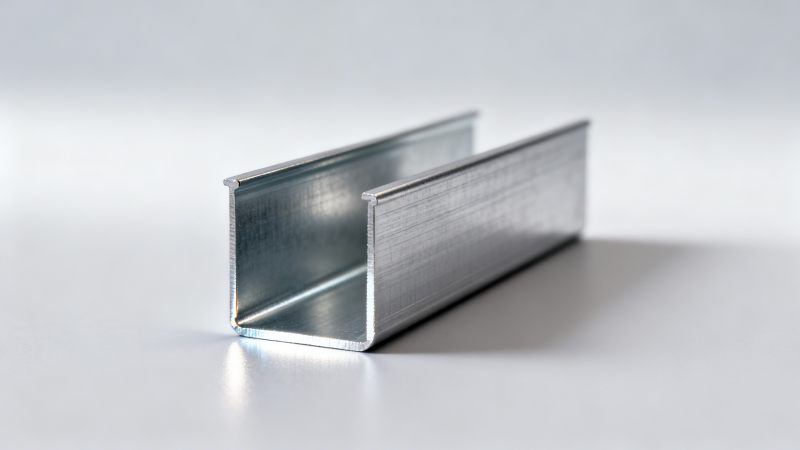
Yield strength alone doesn’t define buckling capacity—it interacts with modulus of elasticity, slenderness ratio, and local buckling limits. For example, Q345 (345 MPa) offers higher yield than Q235, but its elastic modulus remains ~200 GPa across both grades. In thin-walled sections (<3 mm), local buckling often governs before global instability—making surface finish, corner radius consistency, and cold-forming residual stress more decisive than nominal yield.
Hongteng Fengda’s cold-rolled C beams use controlled roll pass sequences to minimize residual stress gradients. Each production run includes microhardness mapping across flange-web junctions—ensuring hardness deviation stays within ±8 HV across 12mm-thick sections. This reduces premature yielding at stress concentrations by up to 22% compared to standard hot-rolled equivalents.
This table shows why selecting Q235 over Q195 isn’t always about higher load capacity—it’s about matching slenderness limits to your actual support spacing. For 1.5m purlin spans, Q235’s L/r ≤100 allows thinner walls (1.8mm vs. 2.5mm), reducing dead load by 18% while maintaining safety margins.
Procurement Checklist: 5 Critical Checks Before Finalizing Tube Specifications
Avoid field rework and liability exposure with these non-negotiable verification steps:
- Confirm whether the datasheet lists Euler buckling load (theoretical) or tested ultimate load—with supporting test reports per ISO 6892-1:2019
- Validate end-condition assumptions against your actual connection design: ask for moment-rotation curves, not just “pinned” labels
- Require mill test reports showing tensile strength, yield point, and elongation for each heat number—not just grade certification
- Specify surface treatment requirements explicitly: galvanized coating thickness must be ≥65 µm per ASTM A123 for outdoor exposure
- Verify dimensional tolerances match your fabrication method—cold-formed C beams require tighter flange twist control (≤1.5°/m) than hot-rolled alternatives
Hongteng Fengda provides full traceability: every coil carries QR-coded batch IDs linking to chemical composition, mechanical test logs, and galvanizing thickness scans. Lead time remains stable at 15–20 days for standard 6m/9m/12m lengths—even during peak construction seasons in North America and the Middle East.
Why Global Buyers Trust Hongteng Fengda for Structural Steel Integrity
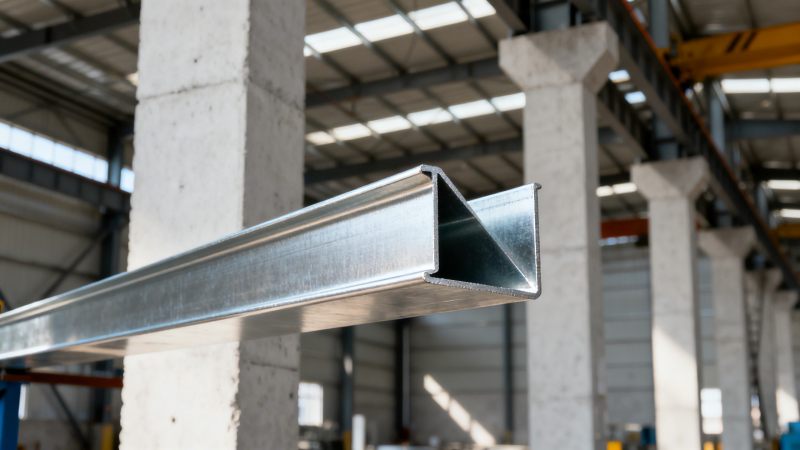
We don’t just meet ASTM A653, EN 10346, or GB/T 2518—we engineer around their limitations. Our C Beam Steel production integrates inline laser profiling to detect cross-sectional distortion before cutting, rejecting sections where web-flange angle deviates >±0.8°. This prevents cumulative misalignment in multi-span purlin systems—a known trigger for lateral-torsional buckling.
For procurement teams balancing cost and risk: our FOB CFR CIF trade terms include pre-shipment third-party inspection (SGS/BV), and payment terms (30% TT deposit + 70% before shipment) align with international best practices. Every order receives a digital compliance dossier—including CE marking documentation, ISO 9001:2015 audit summaries, and EN 10204 3.1 certificates.
Contact us today to request: (1) buckling capacity calculations for your specific span and end condition, (2) sample galvanized C-beam with certified coating thickness report, or (3) OEM design consultation for custom cold-formed profiles compliant with your regional building code.
Please give us a message


Please enter what you want to find