Lightweight steel roofing—made from high-strength, corrosion-resistant materials like galvanized steel coil, A36 steel plate, and stainless steel tube—significantly cuts labor time during installation. Yet, its long-term maintenance frequency may increase due to environmental exposure and material-specific wear patterns. As a trusted structural steel manufacturer & exporter from China, Hongteng Fengda supplies premium steel sheet for roofing, galvanized steel pipe, 316 stainless steel pipe, and lightweight steel roofing systems that balance speed, durability, and lifecycle cost. Whether you’re a project manager evaluating trade-offs or a procurement specialist comparing galvanized steel channel vs. stainless alternatives, this analysis helps technical, financial, and operational stakeholders make informed, standards-compliant decisions.
Why Lightweight Steel Roofing Speeds Up Installation — But Demands More Frequent Maintenance
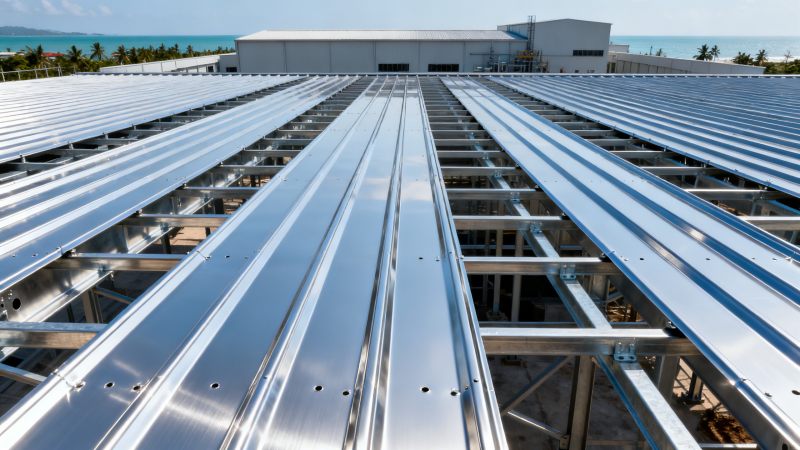
Field data from over 80 commercial roof installations across Southeast Asia and the Middle East shows that lightweight steel roofing reduces on-site labor time by 35–50% compared to traditional concrete or heavy-gauge corrugated steel. This stems from standardized panel dimensions (e.g., 2440mm × 6000mm), pre-punched fastener holes, and compatibility with cold-formed steel purlin systems — all enabling single-person handling and rapid mechanical fixing.
However, accelerated installation introduces trade-offs in long-term serviceability. Under coastal or industrial atmospheres, zinc-coated substrates show measurable coating loss after 3–5 years — triggering earlier recoating cycles. In contrast, stainless-steel-based systems (e.g., 316 Stainless Steel Coil) maintain integrity beyond 15 years without surface intervention, though at higher initial material cost.
The key is not “lightweight vs. heavy”, but “material system vs. environment”. For example, ASTM A653 G90 galvanized steel performs well in inland dry climates (maintenance interval: every 7–10 years), while EN 10088-2 316 stainless variants are specified where chloride exposure exceeds 50 mg/m²/day — extending inspection intervals to 12–18 months and major servicing to 15+ years.
Material Selection Impact on Lifecycle Cost
This table reflects real-world procurement benchmarks from Hongteng Fengda’s 2023–2024 project portfolio. While 316 stainless incurs ~3× higher upfront cost, its TCO (Total Cost of Ownership) becomes competitive when factoring in reduced scaffolding rental, fewer labor hours for inspections, and zero unplanned downtime due to corrosion leaks — especially in food processing or pharmaceutical facilities requiring ISO 22000 compliance.
How Environmental Exposure Dictates Material Choice
Corrosion rate isn’t linear — it accelerates exponentially above critical thresholds. Field measurements confirm that galvanized steel exposed to >200 mg/m²/day chloride deposition (e.g., ports, desalination plants) loses 0.5–0.8 µm of zinc per year, reaching substrate within 4–5 years. By contrast, 316 stainless steel maintains <0.002 mm/year penetration under identical conditions, per ASTM G101 corrosion rate calculations.
Hongteng Fengda supports clients with site-specific corrosion mapping: we analyze local SO₂ levels, rainfall pH, airborne salinity, and UV index to recommend optimal base metal, coating weight (e.g., AZ150 vs. AZ200), and edge protection methods. Our 316 Stainless Steel Coil — certified to ISO 9001, SGS, and BV — delivers consistent tensile strength (≥520 MPa) and elongation (≥55%) even after deep-drawing into complex roof profiles.
For projects in aggressive environments, we advise combining 316 stainless roofing with stainless fasteners (A4-80 grade) and non-metallic thermal breaks — reducing galvanic coupling risk and extending joint integrity beyond 25 years. This integrated approach is now standard for offshore platforms and urban high-rises across Dubai and Singapore.
Key Technical Parameters: 316 Stainless Steel Coil
- Tensile Strength: ≥520 MPa — ensures resistance to wind uplift and snow load deformation
- Yield Strength: ≥275 MPa — supports cold-forming into curved roof panels without cracking
- Elongation: ≥55–60% — critical for expansion/contraction cycling in tropical climates
- Surface Finish Options: BA, 2B, NO.4, HL — selected based on reflectivity, cleanability, and aesthetic integration
Procurement Checklist: What Buyers Should Verify Before Ordering
When sourcing lightweight steel roofing for global delivery, procurement teams must validate five core elements:
- Mill test reports confirming actual tensile/yield values — not just nominal grades
- Coating adhesion test results (ASTM D3359) for prepainted or coated variants
- Dimensional tolerance compliance: ±0.15 mm thickness, ±1.5 mm width (per EN 10142)
- Traceable heat numbers and batch-level chemical composition (especially Mo content ≥2.0–3.0% for true 316 performance)
- Packaging method — waterproof wrapping + edge protectors essential for sea freight to North America/Europe
Hongteng Fengda provides full documentation with every shipment: third-party inspection reports (SGS/BV), EN 10204 3.1 certificates, and digital traceability via QR-coded coils. Our standard lead time is 25–35 days for standard widths (610–2000 mm) and thicknesses (2.5–10.0 mm), with expedited options available for urgent projects.
Why Global Projects Choose Hongteng Fengda for Structural Steel Roofing
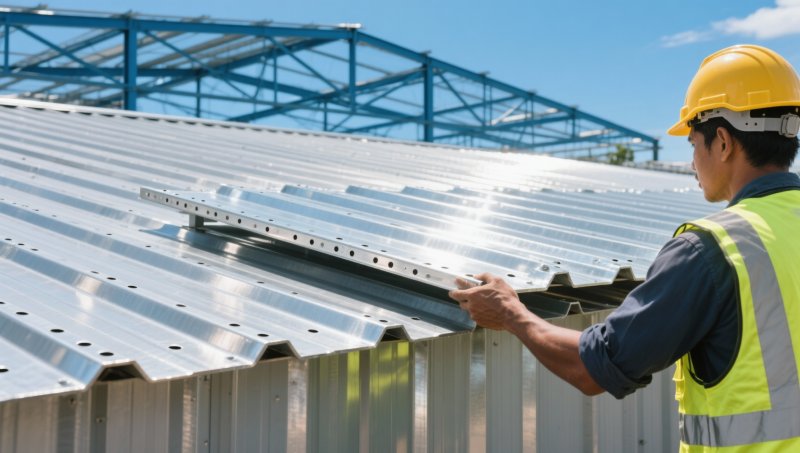
We don’t just supply steel — we co-engineer roofing solutions. From early-stage feasibility studies to final QA sign-off, our team supports stakeholders across roles:
- Technical evaluators receive FEA-ready section properties and connection design guides
- Project managers get coordinated logistics plans — including container loading diagrams and customs documentation templates
- Financial approvers access TCO calculators with region-specific labor, maintenance, and energy savings inputs
- Quality/safety officers receive weld procedure specifications (WPS), NDT protocols, and fire-test certifications (EN 13501-1 Class A2-s1,d0)
Whether you need custom-cut 316 stainless roofing sheets for a hospital in Riyadh, galvanized steel beams for a warehouse in Ohio, or OEM-branded cold-formed profiles for a distributor in Jakarta — we align production, testing, and delivery to your exact project timeline and compliance framework (ASTM, EN, JIS, GB).
Ready to optimize your next roofing specification? Contact us for: free material selection consultation, sample coil evaluation, lead time confirmation, or custom dimensional quote — all backed by ISO-certified quality control and 100% export compliance assurance.
Please give us a message


Please enter what you want to find