For business decision-makers sourcing structural steel globally, understanding lead time and MOQ risks in steel procurement is critical to avoiding project delays, budget overruns, and supply disruptions. Early evaluation of supplier capacity, production flexibility, and specification matching helps reduce procurement uncertainty. This article outlines the key warning signs buyers should identify in advance to secure reliable steel supply and improve purchasing decisions.
Why early screening matters in steel supply planning
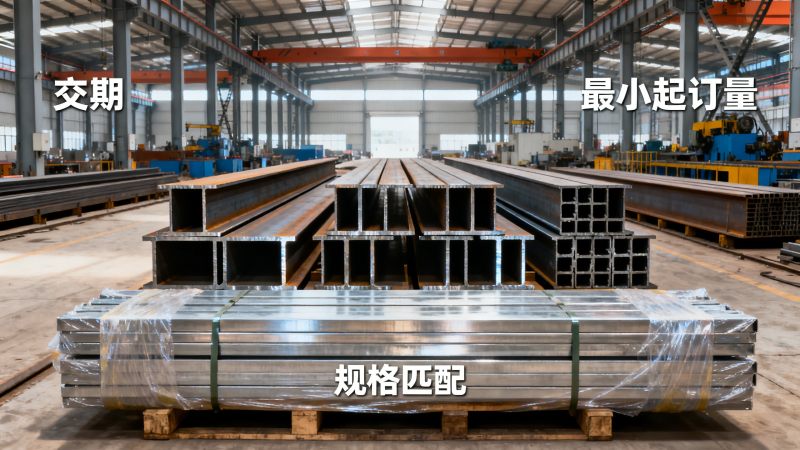
In structural steel sourcing, price is often visible first, but delivery capability and order flexibility usually determine whether a project stays on track. The most costly issues are not always obvious at quotation stage. A supplier may offer attractive pricing yet struggle with rolling schedules, raw material allocation, finishing capacity, packaging coordination, or export booking. That is why lead time and MOQ risks in steel procurement should be reviewed before technical approval and before a purchase order is released.
Steel products such as angle steel, channels, beams, cold formed profiles, and custom fabricated components often involve different production routes, stock logic, and batching requirements. Standard sections may be available quickly, while non-standard dimensions, special grades, galvanized finishes, or mixed specifications can extend production windows. When buyers fail to identify these constraints early, they often face split shipments, specification substitutions, or expensive schedule recovery actions.
A structured review helps compare suppliers beyond unit price. It also supports better sourcing decisions across international projects where compliance with ASTM, EN, JIS, or GB standards must align with delivery commitments. For companies importing from China or other major supply markets, early control of lead time and MOQ risks in steel procurement reduces uncertainty in shipping, cash flow, and site installation planning.
Key points to verify before confirming a steel order
Use the following checks before finalizing a supplier, especially for structural sections used in construction, industrial plants, machinery, bridges, and fabricated assemblies. These points help identify hidden lead time and MOQ risks in steel procurement at an early stage.
- Confirm whether quoted lead time covers raw material booking, rolling, cutting, testing, surface treatment, packing, and export documentation rather than production only.
- Check if the MOQ applies by item, by size, by steel grade, by thickness range, or by total order value, because each rule affects order flexibility differently.
- Ask whether mixed specifications can be combined in one production batch without increasing lead time, price, or inspection complexity.
- Verify available rolling schedules for the required section, especially for uncommon dimensions, heavy sections, or grades outside routine mill production.
- Review the supplier’s actual monthly capacity for similar products instead of relying only on general factory scale statements or marketing claims.
- Confirm if testing standards, third-party inspection, or special certificates will add extra waiting time before shipment release.
- Check whether galvanizing, painting, drilling, punching, beveling, or fabrication is processed in-house or outsourced to another workshop.
- Ask how the supplier handles balance quantities below MOQ and whether stock substitution is allowed without affecting compliance requirements.
- Review packaging and container loading plans early, since oversized steel sections may shift delivery timing due to transport constraints.
- Clarify what events trigger revised delivery dates, such as mill allocation changes, holiday shutdowns, power restrictions, or vessel space shortages.
How product specifications can increase procurement risk
Technical details directly affect lead time and MOQ risks in steel procurement. A standard beam in a common grade may move quickly, while the same profile with a thicker flange, stricter chemistry, or customized length may require a separate production arrangement. Specification complexity often changes both minimum tonnage and manufacturing sequence.
For example, projects using H Shape Beam should not evaluate only nominal size. Buyers should also review flange thickness, web thickness, flange width, web width, cut length, steel grade, and standard compliance. Typical options may include Q235, Q345B, Q460C, SS400, S275JR, S355JR, A572, A992, and stainless grades such as 304 or 316, with standards like JIS G3101, EN10025, ASTM A36, ASTM A572, and ASTM A992. When these variables are combined with custom lengths from 1m to 12m, MOQ logic can change significantly.
In applications such as steel structures, shipbuilding, bridging, mechanical manufacturing, and automobile chassis, the same section may require different inspection levels or processing routes. Economical, high-efficiency profiles with strong bending resistance and favorable strength-to-weight ratio can reduce total project cost, but only if availability matches the project timeline. This is why technical review and supply review should happen together rather than in separate internal steps.
Application-based checks for different sourcing situations
Construction and steel structure projects
Building projects often require multiple section types with staged deliveries. Here, lead time and MOQ risks in steel procurement usually come from mixed item orders and site-driven delivery sequencing. A supplier may produce the main tonnage on time but delay smaller supporting items such as channels, connection materials, or customized cut pieces.
Check whether the supplier can coordinate partial shipments by erection sequence, not only by factory completion date. Also verify if mill test certificates and marking systems allow fast identification after arrival at site.
Industrial equipment and mechanical manufacturing
Equipment-related orders often involve tighter dimensional tolerances, machining allowances, or custom lengths. In this setting, lead time and MOQ risks in steel procurement may be tied to post-processing rather than primary rolling. The base section may be available, but cutting, drilling, straightening, or surface treatment can become the true schedule bottleneck.
Ask for a step-by-step production timeline and identify which process is outsourced. This makes it easier to see where delays may happen and whether buffer time is realistic.
Bridge and infrastructure supply
Infrastructure projects usually require traceability, stable chemistry, and strict standard matching. The main risk is not only longer production time but also extended approval cycles for documents, testing, and third-party witnessing. Buyers should treat documentation lead time as part of physical lead time.
If the required grade or section is outside routine stock, ask whether the mill must wait for a minimum rolling campaign. This can sharply change both MOQ and confirmed shipment timing.
Export projects with mixed destinations
Orders serving different regions may need different markings, packing rules, fumigation arrangements, or document formats. Even if production is complete, shipment can be delayed by export coordination. This is a frequent but underestimated source of lead time and MOQ risks in steel procurement.
Confirm destination-specific requirements early, especially for North America, Europe, the Middle East, and Southeast Asia where compliance and customs paperwork may vary.
Commonly overlooked warning signs
Quoted lead time is unusually short without production detail. This often means the timeline is estimated from best-case conditions rather than actual workshop loading, raw material availability, and export handling.
MOQ is described only as “negotiable.” Without written rules, small-batch orders may later face surcharges, delayed batching, or substitution pressure when production is scheduled.
The supplier confirms standards broadly but not by grade and dimension. A factory may support ASTM, EN, JIS, and GB in general, while a specific size-grade combination still depends on a separate mill source or rolling window.
Processing services are promised without capacity proof. In steel procurement, drilling, galvanizing, blasting, and painting can add major schedule risk if they rely on external partners with limited slots.
Inspection timing is not defined. If third-party testing, dimensional checks, or final release documents are left to the end, completed goods may remain in storage waiting for approval.
Practical steps to reduce risk before ordering
- Prepare a specification matrix listing item, grade, size, standard, finish, quantity, and required delivery date for every steel line.
- Request a breakdown of lead time into raw material, rolling, processing, inspection, packing, and shipment readiness.
- Ask suppliers to state MOQ by line item and to identify any sizes or grades that require production batching.
- Prioritize critical-path items first, especially non-standard beams, fabricated components, or special coating requirements.
- Reserve a schedule buffer for export logistics, holiday periods, and approval milestones rather than using theoretical production dates only.
- Use trial orders or phased orders when evaluating a new steel source with uncertain delivery performance.
For global buyers seeking a dependable structural steel partner, supply stability should be measured by more than quoted price. Experienced Chinese exporters with modern manufacturing, strict quality control, and familiarity with international standards can help reduce sourcing uncertainty when they provide transparent planning, realistic delivery commitments, and flexible support for customized steel products.
Final actions to strengthen steel procurement decisions
The best way to control lead time and MOQ risks in steel procurement is to evaluate them before negotiation focuses on price alone. Early visibility into mill schedules, order batching rules, processing flow, and documentation timing gives buyers a stronger basis for comparing supply options. In structural steel sourcing, reliable execution usually comes from suppliers that can align technical compliance, production capacity, and export coordination from the start.
As a practical next step, build an internal pre-order review using the checks above and request written confirmation for lead time assumptions, MOQ conditions, and specification availability. This simple discipline can reduce delays, improve cost control, and support more secure sourcing of structural steel for construction, industrial, and manufacturing projects worldwide.
Please give us a message


Please enter what you want to find