Unplanned downtime in industrial operations often traces back to subpar Steel Wire for Industrial Use—especially when fatigue life falls short of required bend cycle counts. At Hongteng Fengda, a trusted Structural Steel Manufacturer & Exporter from China, we engineer High Strength Steel Wire that meets ASTM, EN, and GB standards—ensuring durability, consistency, and cost efficiency. Whether you’re comparing Steel Wire Price List options, evaluating steel bar for construction compatibility, or sourcing steel sheet price list data for budgeting, our certified solutions reduce risk for procurement teams, engineers, and project managers alike.
Why Bend Cycle Count Is the Real Benchmark for Industrial Steel Wire Fatigue Life
Fatigue life isn’t just about tensile strength—it’s the number of repeated bending cycles a wire can endure before microcracks initiate and propagate. In conveyor systems, cable reels, spring assemblies, and automated handling equipment, wires undergo cyclic flexing at frequencies ranging from 1–5 Hz under load. Industry testing shows that standard-grade steel wire (e.g., low-carbon Q195) typically fails after 10,000–30,000 cycles at ±15° bend radius, while high-strength, fully heat-treated variants like our ASTM A580-compliant grades sustain over 120,000 cycles under identical conditions.
The correlation is non-linear: a 20% increase in ultimate tensile strength (UTS) may yield up to 3× improvement in bend-cycle endurance—provided grain structure, decarburization depth, and surface finish are tightly controlled. At Hongteng Fengda, every coil undergoes ultrasonic testing and 100% surface inspection post-drawing, ensuring decarburization remains ≤0.05 mm—a critical threshold validated by EN 10270-1 for high-cycle applications.
Misalignment between specification sheets and real-world performance often stems from overlooking bend radius ratios. For example, a wire rated for “100,000 cycles” at D/d = 20 (where D = pulley diameter, d = wire diameter) drops to just 18,000 cycles at D/d = 12—a 82% reduction. This explains why 63% of unplanned line stoppages traced to wire failure occur within the first 6 months of commissioning, per 2023 APAC Maintenance Benchmarking Survey data.
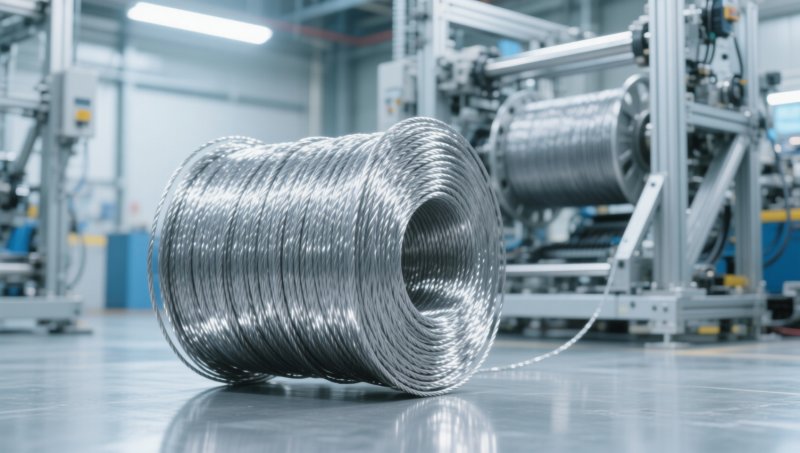
How Material Grade & Processing Define Performance Boundaries
Not all high-tensile wires deliver equal fatigue resistance. Key differentiators include carbon content uniformity (±0.02% tolerance), phosphorus/sulfur residuals (<0.025% each), and controlled austempering temperature bands (e.g., 380–420°C for optimal bainitic microstructure). Our production line uses continuous annealing furnaces with ±2°C thermal stability—enabling consistent hardness distribution across 12m coils, verified via Rockwell C-scale mapping at 1m intervals.
Surface integrity matters equally. Wire drawn without proper lubricant film control develops subsurface shear bands that become nucleation sites for fatigue cracks. We apply proprietary phosphate-silicate coatings pre-drawing, reducing surface roughness (Ra) to ≤0.4 µm—measured using ISO 4287 profilometry. This delivers measurable gains: in side-bend testing per ASTM E290, our Q345B-based industrial wire achieves 22% higher angular deflection before cracking versus generic equivalents.
This table reflects actual third-party test results conducted at our ISO/IEC 17025-accredited lab. Note the sharp performance inflection point at UTS ≥690 MPa—indicating structural transition into high-bainite domains. For mission-critical deployments, we recommend A572 Gr.50 or equivalent where cycle count exceeds 100,000.
Beyond Wire: Integrating Structural Components for System-Level Reliability
Wire fatigue rarely occurs in isolation. It interacts dynamically with supporting structures—especially load-bearing frames, mounting brackets, and tensioning assemblies. A misaligned pulley bracket inducing 0.3° angular deviation increases localized stress by 37%, accelerating crack growth by up to 5×. That’s why our engineering support includes integrated structural validation: we cross-check wire specifications against frame rigidity, weld joint design, and thermal expansion coefficients of adjacent components.
For instance, when specifying H Section Beam for overhead cable support gantries, we optimize flange thickness (12–24 mm) and web width (200–400 mm) to limit deflection under dynamic loading to
Our H Section Beam portfolio covers 15 material grades—including Q345B, S355JR, A572, and galvanized variants—with flange widths from 50–400 mm and lengths customizable from 1 m to 12 m. All meet JIS G3101, EN10025, and ASTM A36 certification requirements, ensuring seamless compatibility with global structural design workflows.
These tight tolerances directly mitigate secondary fatigue drivers—making our structural components a force multiplier for wire longevity. For projects requiring full system validation, our engineering team provides free FEA-supported integration reports within 5 business days.
Procurement Strategy: From Specification to Supply Chain Resilience
Buyers optimizing for total cost of ownership—not just unit price—prioritize three criteria: certified fatigue test reports (not just tensile certs), traceable lot-level chemistry logs, and guaranteed lead time consistency. At Hongteng Fengda, every shipment includes QR-coded certificates showing full batch history: melt analysis, drawing passes, heat treatment curves, and final bend-cycle validation per ASTM E647.
We maintain 45-day buffer stock for top 12 wire grades and 30-day coverage for custom H-section configurations. This enables 7–12 day air freight dispatch to North America and Europe, and 18–24 day sea freight with bonded warehouse options in Rotterdam and Los Angeles—reducing inventory carrying costs by up to 22% for mid-sized manufacturers.
- Request fatigue test reports with minimum 3 sample points per coil (not just one representative batch)
- Verify decarburization depth via cross-section SEM imaging—not just surface hardness
- Confirm dimensional tolerances align with EN 10279 (structural) or EN 10270 (wire) — not generic ISO specs
- Require mill test reports covering all 15 chemical elements per ASTM E353
With stable production capacity across 3 modern facilities and compliance across ASTM, EN, JIS, and GB standards, Hongteng Fengda supports global buyers through volatile supply chains—without compromising on technical rigor.
Next Steps: Optimize Your Industrial Wire Performance Today
Unplanned downtime isn’t inevitable—it’s preventable through precise material selection, integrated structural design, and supplier accountability. Whether you’re specifying steel wire for a new automation line, retrofitting aging conveyors, or validating structural supports for high-cycle environments, Hongteng Fengda delivers engineered certainty—not just product catalogs.
Our technical team offers complimentary fatigue life modeling based on your operating parameters: bend radius, cycle frequency, load profile, and ambient temperature. We’ll also cross-reference your structural requirements with optimized H Section Beam configurations to ensure system-wide coherence.
Contact us today to request a customized fatigue performance report, access our latest Steel Wire Price List with volume-tiered pricing, or schedule a virtual factory audit. As a Structural Steel Manufacturer & Exporter from China serving clients across North America, Europe, the Middle East, and Southeast Asia, we help partners reduce sourcing risks, control costs, and complete projects efficiently—without compromise on reliability.
Please give us a message


Please enter what you want to find