Choosing the right steel can directly affect warehouse durability, cost efficiency, and construction speed. For project managers evaluating cold rolled steel for warehouse construction, understanding its structural performance, fabrication advantages, and suitability for modern industrial buildings is essential. This article explores whether cold rolled steel is the right choice for today’s warehouse projects and how it can support quality, budget control, and reliable delivery.
In warehouse projects, steel selection is rarely a single-material decision. It usually involves balancing span, load demand, corrosion exposure, installation speed, fabrication accuracy, and total procurement risk across a 6- to 18-month project cycle.
For project managers, the main question is not whether cold rolled steel is good in general, but where it performs best within the building system. In many modern warehouses, cold formed members can improve efficiency, while hot rolled primary frames still carry the largest structural loads.
Understanding where cold rolled steel fits in warehouse structures
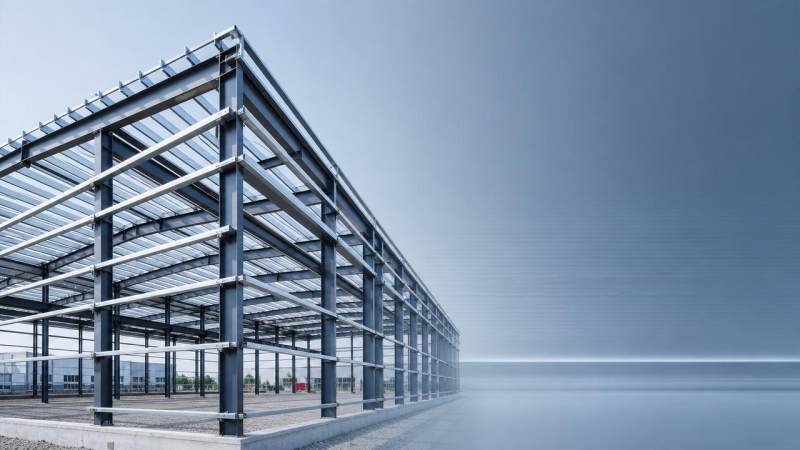
Cold rolled steel for warehouse construction is commonly used when dimensional consistency, lighter section weight, and efficient forming are priorities. It is produced through rolling or forming processes that create tighter tolerances and cleaner profiles than many conventional heavy sections.
In practical warehouse design, cold rolled or cold formed steel is often specified for secondary structural elements such as purlins, girts, wall rails, bracing components, door framing, mezzanine supports, and light-duty partitions. These applications benefit from thickness ranges such as 1 mm to 12 mm, depending on profile and load case.
Primary frame versus secondary frame roles
A modern warehouse normally includes two structural layers. The primary frame handles the main gravity and lateral loads through columns and rafters. The secondary frame supports roof sheeting, wall cladding, and local load transfer. Cold rolled steel is usually more competitive in the second category.
For example, a warehouse with spans of 20 m to 40 m may still rely on hot rolled beams or built-up sections for its main frame, while cold formed channels or C sections support roof and wall systems at regular spacing intervals such as 1.2 m, 1.5 m, or 2.0 m.
Why this matters to project delivery
This distinction matters because using cold rolled steel in the right place can reduce dead load, simplify handling, and shorten on-site assembly time. However, using it beyond its efficient structural range may create serviceability issues such as deflection, vibration, or local buckling.
The table below shows a practical comparison that helps project teams decide where cold rolled steel for warehouse construction is typically appropriate.
The key takeaway is clear: cold rolled steel is often highly suitable for warehouse construction, but mainly as part of a system. It performs best when profile geometry, thickness, span, and connection design are matched to the actual duty of each component.
Advantages of cold rolled steel for modern warehouse construction
When used in appropriate warehouse components, cold rolled steel offers several measurable advantages. These benefits are especially relevant for industrial projects where procurement timelines are tight, repeatability matters, and erection efficiency affects overall project cost.
1. Better dimensional consistency
Cold formed members are valued for stable shape accuracy and consistent profile dimensions. In procurement terms, tolerances such as ±1% can help reduce fit-up issues during installation, especially when a project includes hundreds or even thousands of repeated roof and wall members.
2. Lower self-weight and easier handling
Compared with heavier rolled sections used for the same support line, optimized cold formed profiles can reduce dead load and simplify manual positioning or light lifting operations. On medium-scale warehouse projects, this may improve erection productivity over a 2- to 6-week installation window.
3. Fast fabrication and processing flexibility
Cold rolled steel for warehouse construction also supports processing services such as bending, welding, punching, decoiling, and cutting. Pre-punched holes and standardized connection details can reduce on-site rework, which is important when labor availability is limited or multiple subcontractors share the schedule.
4. Surface protection options for industrial environments
Warehouses often face condensation, dust, periodic washdown, or regional humidity variation. Galvanized coated surfaces are widely used because they improve corrosion resistance for roof and wall support members, particularly in logistics buildings, light manufacturing plants, and export packing facilities.
- Typical surface choices include galvanized, powder coating, and black varnish.
- Common lengths include 6 m, 9 m, and 12 m, with customization for larger quantities.
- Applicable standards may include ASTM, EN, JIS, GB, DIN, and BS depending on the buyer’s market.
A good example is C Beam Steel, which is widely used in purlins and wall beams of steel structure buildings. With thickness from 1 mm to 12 mm, perforated options, and galvanized coating, it fits many warehouse secondary framing requirements where repeatability and quick installation are critical.
For project managers, these advantages do not only improve structural execution. They also support better planning across procurement, packaging, transport loading, and sequence-based installation on site.
When cold rolled steel is the right choice and when it is not
A successful warehouse steel package starts with application matching. Cold rolled steel is not automatically the best option for every member, but it can be the right choice in 4 common scenarios: secondary roof systems, wall support systems, lightweight extensions, and modular repetitive layouts.
Suitable warehouse scenarios
- Warehouses with high repetition of purlin and girt spacing across long elevations.
- Projects that require light structural weight to reduce transport and crane dependence.
- Industrial buildings with short lead-time targets, often 15 to 20 days for standard production batches.
- Buildings where pre-punched, perforated profiles improve installation speed and alignment.
Less suitable scenarios
Cold rolled steel may be less suitable as the main structural solution where the warehouse has very long clear spans, heavy suspended process loads, high forklift impact risk on exposed framing, or concentrated equipment loads that demand heavier sections and larger reserve capacity.
It also requires careful engineering in regions with high wind suction, snow loading, or seismic movement. In these cases, profile depth, lip design, bracing layout, and connection details need to be checked closely to avoid instability or excessive deflection.
The following table helps decision-makers compare common warehouse conditions before selecting cold rolled steel for warehouse construction.
The conclusion from these comparisons is that cold rolled steel is usually a strong fit for warehouse support systems and light structural applications, but not always a direct substitute for heavy primary framing.
How project managers should evaluate suppliers and specifications
Even a well-designed steel package can create delays if supplier capability is weak. For global buyers, the quality of production control, export coordination, and standards compliance is just as important as the section itself.
Check 5 specification points before ordering
- Material grade: verify whether Q195, Q235, Q345, A36, SS400, or S235JR matches the design requirement.
- Thickness range: confirm actual member thickness, not only nominal size, especially within the 1 mm to 12 mm range.
- Surface treatment: specify galvanized coated or other finishes based on exposure class.
- Processing scope: identify whether punching, cutting, welding, or bending is completed before shipment.
- Standard compliance: align purchasing documents with ASTM, EN, JIS, or GB as required by the project market.
Supplier capability matters in export projects
For warehouse projects across North America, Europe, the Middle East, and Southeast Asia, stable production capacity and dependable lead times are critical. A realistic delivery window for standard cold formed components may be around 15 to 20 days, but this depends on quantity, coating requirements, hole patterns, and packing method.
Hongteng Fengda, as a structural steel manufacturer and exporter from China, focuses on angle steel, channel steel, steel beams, cold formed steel profiles, and customized structural steel components. For project teams, this matters because a supplier familiar with ASTM, EN, JIS, and GB can reduce communication gaps and lower sourcing risk during specification review.
Practical procurement questions to ask
- Can the supplier provide section drawings, hole locations, and tolerance control details before production?
- Are CE, SGS, BV, or ISO-related documents available where required by the buyer or project package?
- What is the packing method for 6 m, 9 m, or 12 m lengths to reduce transport damage?
- Can the supplier support OEM fabrication for project-specific connection details?
In many cases, a standardized and repeatable section such as C Beam Steel is especially useful for warehouse purlins, wall beams, lightweight roof trusses, brackets, and selected light-industry structural members. The value is not only in the profile itself, but in how consistently it can be produced and delivered.
Common risks, design mistakes, and control measures
Project managers evaluating cold rolled steel for warehouse construction should also focus on risk control. Most issues arise not from the material category alone, but from under-specified design assumptions, coating mismatch, or poor coordination between engineering and fabrication.
Risk 1: Treating all cold formed profiles as interchangeable
Two sections may look similar in shape but differ significantly in thickness, yield strength, lip geometry, hole pattern, and coating. These differences affect load resistance, serviceability, and connection behavior. Always compare actual profile data rather than relying only on visual similarity.
Risk 2: Ignoring environment-specific corrosion planning
Galvanized coating is often a sound baseline, but not every warehouse environment is the same. Dry inland storage and humid coastal facilities face different exposure levels. Maintenance planning should consider expected service conditions over 5, 10, or 20 years rather than only the first installation stage.
Risk 3: Overlooking erection sequence and site handling
Even lightweight members can be damaged by poor stacking, excessive lifting points, or rushed installation. A simple 3-step control method helps: verify bundle labeling on arrival, inspect coating and deformation before erection, and confirm bolt-hole alignment before closing roof or wall panels.
Risk 4: Focusing only on unit price
The lowest per-ton quotation does not always deliver the lowest installed cost. Processing completeness, coating quality, packaging reliability, documentation accuracy, and delivery predictability can have a larger impact on total project performance than a small raw material price difference.
For this reason, warehouse steel purchasing should be based on at least 4 decision dimensions: structural suitability, fabrication quality, delivery reliability, and total installed cost. This method usually gives a more reliable outcome than price-led comparison alone.
Final decision: is cold rolled steel right for your warehouse project?
Cold rolled steel for warehouse construction is a strong choice when your project requires precise secondary framing, efficient installation, lighter member weight, and repeatable fabrication. It is especially effective for purlins, wall beams, light trusses, brackets, and other support elements in modern industrial buildings.
It becomes less suitable when the design calls for heavy primary load-bearing frames, very long spans, or unusually high concentrated loads without additional engineering support. In those cases, a hybrid steel strategy is usually more practical than a one-material approach.
For project managers and engineering teams, the best result comes from matching profile type, grade, coating, and processing scope to the actual warehouse function. With experienced manufacturing support, clear drawings, and standards-based quality control, cold rolled members can improve both buildability and procurement confidence.
If you are comparing options for an upcoming warehouse, logistics center, or light industrial building, Hongteng Fengda can support your sourcing review with structural steel products, cold formed profiles, and customized export solutions. Contact us to get a tailored recommendation, discuss section details, or request a quotation for your next warehouse construction package.
Please give us a message


Please enter what you want to find