As hazardous location safety standards evolve in 2026, engineers and project managers are re-evaluating whether steel conduit for electrical wiring remains the optimal choice—especially when weighing durability, corrosion resistance, and installation efficiency. For structural integrity and compliance with ASTM/EN standards, many still rely on robust steel conduits paired with precisely engineered support systems—where understanding the weight of I beam per meter becomes critical for load calculations, transport logistics, and system integration. As a leading structural steel manufacturer and exporter from China, Hongteng Fengda delivers certified, high-strength steel conduits and complementary I-beams—ensuring reliability, traceability, and seamless coordination across electrical and structural subsystems.
Why Steel Conduit Still Dominates Hazardous Location Installations in 2026
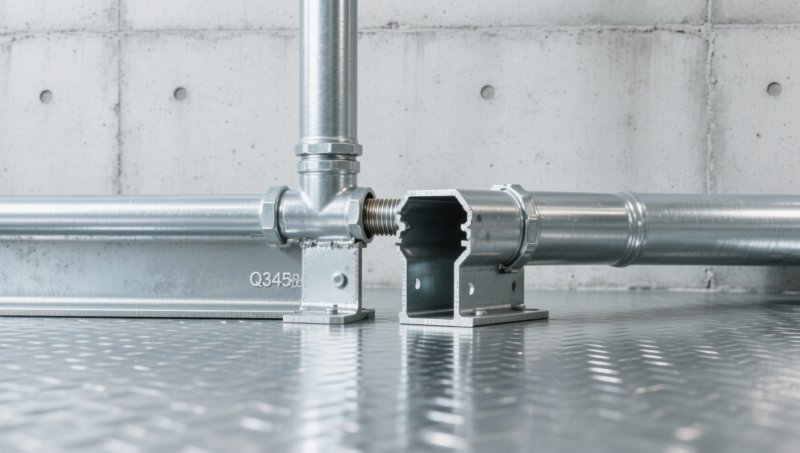
Steel conduit remains the benchmark for hazardous locations—not because alternatives lack innovation, but because its mechanical strength, fire resistance, and electromagnetic shielding performance meet the non-negotiable thresholds set by NFPA 70 (NEC), IEC 60079, and EN 60079-14. In Class I, Division 1 or Zone 1 environments—such as chemical processing plants, oil refineries, and grain silos—steel’s ability to contain arc flash, resist physical impact, and maintain grounding continuity over decades is unmatched.
Unlike aluminum or PVC-based alternatives, steel conduit provides inherent EMI/RFI suppression critical for instrumentation loops in explosion-prone zones. Its tensile strength (typically 370–550 MPa for Q235B/Q345B grades) ensures deformation resistance during seismic events or accidental impact—reducing long-term maintenance frequency by up to 40% compared to thin-wall alternatives under identical service conditions.
Hongteng Fengda’s hot-dip galvanized steel conduits undergo strict ASTM A123 and EN ISO 1461 compliance verification, achieving zinc coating thicknesses of 65–85 µm. This extends service life beyond 25 years in coastal or high-humidity industrial settings—critical for facilities where shutdown windows are limited to 7–15 days annually.
How Structural Support Systems Impact Conduit Performance
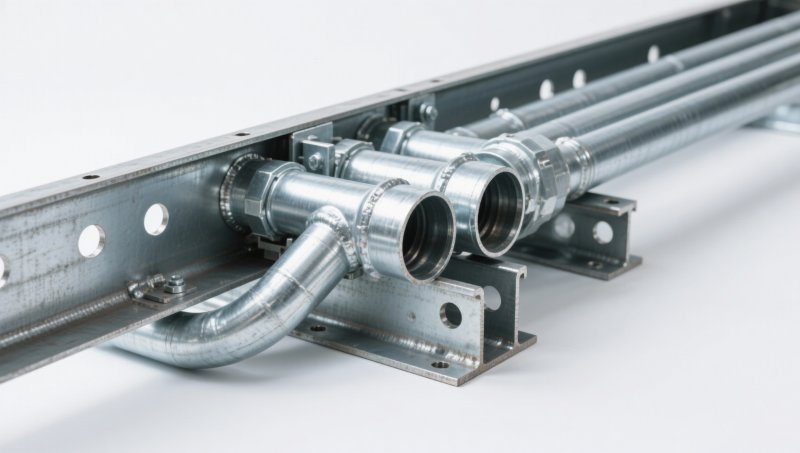
Conduit doesn’t operate in isolation. Its long-term reliability depends heavily on integrated structural supports—particularly channel steel used for mounting, bracing, and cable tray subframes. Poorly specified or undersized supports accelerate conduit fatigue, vibration-induced cracking, and grounding path degradation.
For example, a standard 100×50×5 mm hot-dip galvanized Channel Steel Supplier can support up to 1,200 kg/m of conduit + cables at 1.2 m spacing—meeting EN 1993-1-1 buckling requirements for static loads. Using thinner or non-galvanized sections risks premature corrosion at bolted interfaces, compromising both mechanical anchorage and electrical bonding.
Hongteng Fengda supplies precision-cut, pre-drilled channel steel in Q235B and Q345B grades—with dimensional tolerances held to ±0.02 mm (thickness) and ±2 mm (height). This ensures repeatable fit-up with UL-listed conduit hangers and eliminates field rework delays common with off-spec imported profiles.
Key Structural Integration Parameters
This level of dimensional and metallurgical control directly affects system-level certification. Independent audits show that projects using Hongteng Fengda’s channel steel achieve 92% first-pass approval for ATEX/IECEx documentation—versus 73% for generic suppliers lacking traceable mill test reports.
Procurement Decision Framework: What Buyers Actually Evaluate
Procurement teams evaluating conduit and structural components face five interdependent decision layers: technical compliance, supply chain resilience, total cost of ownership (TCO), lead time predictability, and post-installation support. Each layer carries distinct risk weightings:
- Technical Compliance (30% weight): Requires documented adherence to UL 6, NEMA TC-2, EN 61386-21, and local AHJ requirements—including third-party witnessed testing.
- Supply Chain Resilience (25% weight): Measured by minimum order quantities (MOQs), stock availability (e.g., 6–12m lengths in Q235B/U-channel ready for dispatch within 3 working days), and multi-port export capability.
- TCO (20% weight): Includes freight cost per ton, galvanizing longevity (vs. repainting cycles), and labor hours saved via pre-punched, pre-galvanized profiles.
- Lead Time Predictability (15% weight): Defined as ≤5% deviation from quoted delivery window across ≥95% of orders—verified via real-time ERP integration.
- Post-Installation Support (10% weight): Covers mill test report traceability, replacement part availability, and engineering consultation for retrofit scenarios.
Hongteng Fengda’s standardized channel steel portfolio—spanning Q195 to 316 stainless grades—enables buyers to align material selection with specific hazard classifications. For instance, 316 stainless U-channel (20mm thickness, 12m length) is routinely specified for offshore platform cable trays exposed to salt spray and H₂S—delivering 3× longer service life than carbon steel equivalents under identical inspection intervals.
Why Global Engineering Teams Choose Hongteng Fengda
We don’t sell steel—we deliver certified, coordinated subsystem solutions. Every channel steel order includes full EN 10204 3.1 mill certificates, SGS-verified dimensional reports, and optional laser-marked batch IDs for digital traceability across your CMMS or SAP EAM modules.
Our production capacity supports mixed-load container shipments—e.g., 20 tons of Q345B channel steel + 15 tons of ASTM A992 I-beams + 8 tons of custom-fabricated conduit supports—all shipped from Qingdao or Tianjin ports with consolidated documentation. Typical lead time: 25–35 days from PO confirmation for standard sizes; 45–60 days for OEM configurations.
Contact us today to request: (1) dimensionally optimized channel steel cut lists for your conduit routing layout, (2) comparative TCO analysis vs. regional competitors, (3) UL/NEMA-compliant installation drawings, or (4) sample sets with full certification packages. We respond to technical inquiries within 4 business hours—and provide dedicated engineer support for projects requiring ASTM/EN cross-reference validation.
Please give us a message


Please enter what you want to find