For outdoor sites that demand durability, cost control, and fast installation, galvanized steel corrugated sheet for fence applications is gaining attention among project buyers. But is it truly a better option than traditional fencing materials? For decision-makers in construction and industrial sectors, understanding its strength, corrosion resistance, maintenance needs, and long-term value is essential before making the right procurement choice.
The short answer is: it can be, but only when the site conditions and project priorities match what this material does best. A corrugated fence made from galvanized steel is not automatically the best choice for every project. Its value appears most clearly where managers need a barrier that is quick to install, hard to damage, and able to withstand rain, sun, and general outdoor exposure with limited maintenance.
What makes this option attractive is not just the metal itself, but the combination of form and coating. Corrugated profiling improves rigidity without making the sheet excessively thick, while galvanizing adds a protective zinc layer that slows corrosion. For temporary works, industrial perimeters, logistics yards, storage areas, utility sites, and construction boundaries, that balance often matters more than visual appearance.
The main decision point is environment. In mild to moderate outdoor exposure, galvanized corrugated fencing usually performs well and gives buyers a predictable service life. In coastal areas, chemical plants, or locations with persistent humidity, the corrosion load increases sharply. In those cases, zinc coating weight, post-processing, and maintenance planning become more important than the fence shape itself. Buyers who ignore this often choose based on initial cost and later face early rusting at edges, fasteners, or cut surfaces.
Another reason project teams consider this material is installation speed. Corrugated sheets are easy to handle in modular fence systems, and they can reduce labor time compared with heavier welded solutions. That is especially useful when a project has a tight schedule or when the fence is part of a larger site setup that must be completed before equipment delivery or commissioning. In these situations, time saved at installation can be as important as the material price.
Still, buyers should not confuse “easy to install” with “low risk.” Fence performance depends on the full system: sheet thickness, zinc coating, support frame, fastening method, and site exposure. A thin sheet with weak framing may look acceptable on day one but deform under wind load or repeated impact. For industrial users, the real question is not whether the panel is galvanized, but whether the entire fence structure can handle the operating environment for the intended service period.
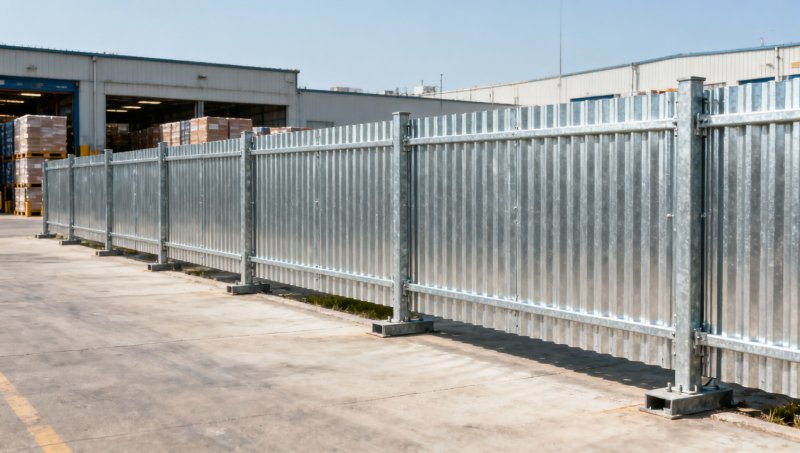
Specification discipline matters here. Coil Coated Galvanized Steel is often used in projects where buyers need a balance of forming performance and corrosion protection. Depending on the application, available thickness ranges from 0.12mm to 3.5mm, with widths from 600mm to 1500mm and customizable lengths. Zinc layer options such as hot galvanizing at 60-275g/m² or pre-galvanized at 80-275g/m² can affect durability in very different ways. Mechanical properties also matter: yield strength of ≥240-380 MPa, tensile strength of ≥270-500 MPa, and elongation of ≥22% indicate whether the material can be processed and installed without excessive cracking or deformation.
For fence buyers, that means the purchasing decision should go beyond a simple “galvanized or not” question. It should also ask: what is the expected wind load, how often will the fence be disturbed, whether the project requires a temporary or permanent boundary, and whether local standards demand a specific coating or steel grade. A fence around a construction site may need different properties from one used to shield industrial equipment or separate storage zones in a port or warehouse.
Another overlooked factor is edge protection. Corrosion rarely starts evenly across a galvanized fence panel. It often begins at cut edges, drilled holes, scratches, and contact points. If fabrication is done poorly, the coating advantage can be reduced quickly. That is why buyers sourcing through international channels should ask for process details, not just certificates. Standards such as ASTM, EN, JIS, and GB can be relevant, but the real issue is whether the supplied material matches the processing route and the final environment.
Maintenance expectations should also be realistic. Galvanized corrugated fencing is not maintenance-free. It is low-maintenance, which is different. In practical terms, that usually means fewer repainting cycles than painted steel, less vulnerability than untreated sheet metal, and lower replacement frequency than some cheaper alternatives. But inspection is still needed, especially after storms, impact events, or site modifications. If the fence is part of a larger asset protection strategy, small repair costs should be planned into the operating budget from the start.
For procurement teams, one useful way to compare options is lifecycle cost rather than purchase price alone. Wood fencing may appear cheaper initially, but it can degrade quickly outdoors. Welded mesh can be strong, but in some environments it offers less privacy and may require more structural support. Concrete or masonry barriers provide higher permanence, but they raise foundation cost and construction time. Galvanized corrugated sheet fencing usually sits in the middle: not the cheapest in every case, not the strongest in every case, but often the most balanced when speed, durability, and cost control all matter.
That balance is why it is frequently chosen for sites that need a practical boundary rather than a decorative one. Industrial yards, logistics parks, temporary project enclosures, and utility work zones are typical examples. In these settings, the fence must define space clearly, resist weather, and avoid becoming a maintenance burden. If those are the priorities, galvanized steel corrugated sheet for fence use can be a rational choice rather than just a material preference.
However, a better fence option is not always the one with the longest theoretical lifespan. Decision-makers should also consider replacement logistics, local labor availability, and project timing. A material that performs well on paper but is difficult to source consistently can create more risk than a slightly less durable option with stable supply. For cross-border buyers, lead time reliability and specification consistency often influence project success as much as mechanical performance.
That is where supplier capability becomes part of the fence decision. A manufacturer that can provide consistent coating weight, stable dimensional control, and customized sizing reduces downstream problems in fabrication and installation. In practice, this can matter more than marginal differences in raw material cost. When the fence is used on a large site, one batch inconsistency can affect an entire phase of deployment.
For companies planning outdoor site fencing, the most sensible approach is to match the material to the operating risk. If the site is exposed to moderate weather, installation time is tight, and maintenance access is limited, galvanized corrugated sheet is often a strong candidate. If the site is highly corrosive, impact-prone, or requires high visual permanence, additional protection measures or another system may be more appropriate.
The decision, then, is not whether galvanized corrugated fencing is universally better. It is whether it is better for your site conditions, service life target, and project budget. In that sense, its advantage is practical rather than absolute: it offers a workable combination of protection, speed, and cost control that fits many outdoor industrial applications, but only when the specification is matched carefully to the job.
Please give us a message


Please enter what you want to find