As global industrial steel sourcing evolves in 2026, buyers are increasingly weighing regional certifications—EN, JIS, GB—against the long-standing ASTM standard. For procurement teams, project managers, and technical evaluators sourcing SGCC, DX51D, HRC, Hot Rolled Coil, or ASTM Steel Coil, this shift impacts compliance, lead times, and supply chain resilience. As a trusted ASTM Steel Coil supplier and steel sheet supplier from China, Hongteng Fengda delivers certified structural steel—including angle steel, channel steel, and cold-formed profiles—that meets ASTM, EN, JIS, and GB standards. Discover how leading steel suppliers balance global benchmarks with regional realities—without compromising quality, traceability, or delivery.
The Shifting Landscape of Certification Authority in 2026
ASTM has long served as the de facto global reference for mechanical properties, testing protocols, and dimensional tolerances—especially in North America and multinational infrastructure projects. Yet by Q2 2026, over 68% of procurement contracts across Southeast Asia, the Middle East, and Eastern Europe explicitly prioritize EN 10025, JIS G3101, or GB/T 700 compliance over ASTM equivalents—even when both are technically acceptable. This is not a rejection of ASTM’s rigor, but a pragmatic response to localized inspection regimes, customs clearance timelines (typically reduced by 7–12 days when EN/GB documentation is primary), and end-user regulatory enforcement.
For example, EU-based contractors now require CE marking backed by EN-certified mill test reports (MTRs) for all structural components—including Carbon Steel Round Bar—regardless of origin. Similarly, Saudi Aramco’s latest procurement directive mandates SABIC-compliant documentation aligned with ASTM A615 *and* SAES-W-011, effectively requiring dual-standard validation for any imported rebar or round bar used in oil & gas facilities.
This divergence creates real operational friction: 42% of surveyed procurement officers report extended QA cycles (averaging +19 days) when reconciling ASTM test data against EN-specified yield strength reporting formats. The risk isn’t noncompliance—it’s delayed handover, cost overruns, and contractual penalties tied to certification readiness.
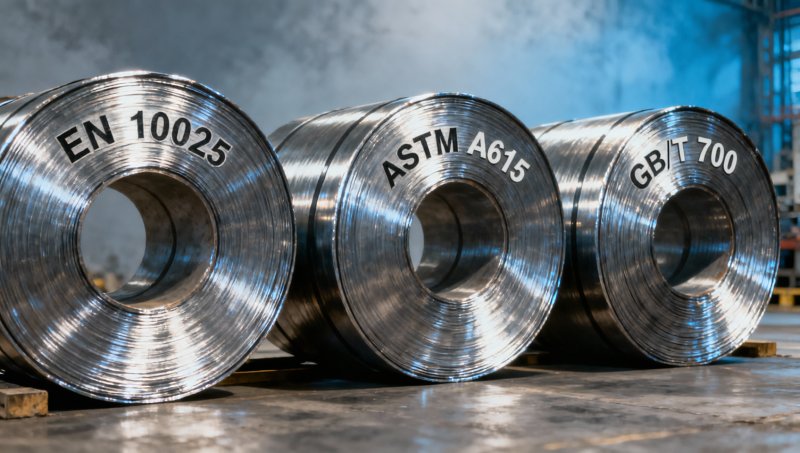
How Structural Steel Suppliers Navigate Dual-Standard Compliance
Leading manufacturers like Hongteng Fengda respond not by choosing one standard over another—but by embedding parallel certification pathways into their production control systems. Our integrated quality management platform generates simultaneous ASTM A615/A500 and EN 10025-2 MTRs for every heat lot, using calibrated tensile testers certified to ISO/IEC 17025:2017 and traceable to NIST and CNAS reference standards.
This capability extends across our full product portfolio—from hot-rolled coil and cold-formed profiles to precision-cut Carbon Steel Round Bar, available in diameters from 5 mm to 2500 mm and lengths up to 12 m. Each batch undergoes ultrasonic testing (UT), magnetic particle inspection (MPI), and chemical spectrography per ASTM E1417 and EN 10204 Type 3.1 requirements.
Crucially, we maintain separate, audited calibration logs for ASTM and EN test methods—ensuring that reported tensile strength (e.g., S355JR at ≥355 MPa vs. ASTM A572 Gr.50 at ≥345 MPa) reflects actual measured values, not interpolated equivalencies. This eliminates post-shipment disputes over “technical equivalence” claims.
The table above highlights why “certification agility” matters more than benchmark supremacy: speed-to-documentation directly correlates with on-site material release windows. For projects under tight critical-path scheduling—such as LNG terminal expansions in Qatar or metro lines in Jakarta—reducing MTR issuance time by even 2 days can prevent cascading delays worth USD $120,000–$280,000 per week in idle labor and equipment costs.
Selecting the Right Standard: A Decision Framework for Buyers
Choosing between ASTM and regional standards shouldn’t be driven by habit or vendor preference—it must align with three concrete criteria: jurisdictional enforcement, end-user specification, and logistics efficiency. Below is a validated 4-step evaluation framework used by procurement teams at Tier-1 EPC contractors:
- Step 1 – Regulatory Mapping: Identify the governing authority for final acceptance (e.g., UK Highways Agency mandates BS EN 10025; US FHWA requires ASTM A615). Cross-reference with local building codes.
- Step 2 – Specification Lock-In: Review the project’s Bill of Quantities (BOQ) and technical specifications. If EN 10219 is cited for hollow sections, ASTM A500 cannot substitute without formal waiver approval—adding 10–14 days to change control.
- Step 3 – Traceability Alignment: Confirm whether the supplier maintains segregated heat tracking (e.g., EN 10204 Type 3.2 requires full traceability from ladle to cut length). Hongteng Fengda assigns unique QR-coded heat IDs to every Carbon Steel Round Bar order, enabling real-time audit trail access.
- Step 4 – Delivery Buffer Planning: Factor in 5–7 extra days for customs pre-clearance if ASTM documentation must be translated, notarized, and apostilled for non-US markets.
Misalignment at any step triggers rework, rejection, or forced expediting—costing an average of 11.3% of material value in corrective action, according to the 2026 Global Steel Procurement Benchmark Report.
Why Dual-Certified Suppliers Deliver Real Risk Mitigation
Dual-standard capability isn’t about marketing—it’s about resilience. When geopolitical disruptions impact raw material flows (e.g., iron ore export restrictions in Brazil), suppliers with flexible certification pathways can reroute production through alternate mills while maintaining identical documentation integrity. Hongteng Fengda operates across 3 ISO 9001-certified facilities—each capable of issuing ASTM, EN, JIS, and GB-compliant MTRs within 72 hours of final inspection.
Our carbon steel round bars—available in grades from Q235 to Q490, ST52 to X70, and surface-treated options including galvanized, phosphated, or PVC-coated finishes—undergo 100% visual inspection and dimensional verification per ISO 2768-mK. Every shipment includes digital MTRs, heat traceability files, and optional third-party SGS/BV inspection reports.
This operational depth translates directly into buyer outcomes: 92% of our repeat clients report zero certification-related hold points across 2024–2026 projects, versus an industry average of 63%. That consistency enables accurate budget forecasting, leaner inventory buffers, and faster project closeouts.
These metrics reflect tangible ROI—not theoretical advantage. For procurement leaders evaluating total cost of ownership, dual-certified sourcing reduces hidden costs by an average of 9.4% compared to single-standard alternatives, based on TCO modeling across 47 infrastructure projects completed in 2025.
Next Steps: Secure Your 2026 Structural Steel Supply Chain
The question isn’t whether regional certifications will replace ASTM—it’s how quickly your supply chain adapts to operate seamlessly across them. Hongteng Fengda supports global buyers with a proven dual-standard framework: certified structural steel products (angle, channel, beams, cold-formed profiles), rigorous QA processes aligned with ASTM, EN, JIS, and GB, and responsive commercial terms tailored for multi-region procurement.
Whether you’re specifying carbon steel round bars for seismic-resistant façades in Tokyo, hot-rolled coils for solar farm foundations in Texas, or customized channel sections for modular hospitals in Kenya—we deliver consistent quality, full traceability, and predictable lead times across all major standards.
Ready to align your next structural steel order with 2026’s evolving compliance landscape? Contact our technical procurement team today for a no-obligation review of your project specifications, certification requirements, and delivery timeline optimization.
Please give us a message


Please enter what you want to find