Industrial steel pricing volatility is intensifying globally — driven significantly by shifting scrap import policies, especially in key markets like China. For procurement teams, engineers, and decision-makers sourcing ASTM standard structural steel, this uncertainty impacts budgeting, lead times, and compliance risk. Whether you're specifying steel channel, channel steel, steel angle, steel girder, cold rolled steel, or SGCC-coated products, policy-driven supply chain disruptions affect availability and cost stability. At Hongteng Fengda — a certified structural steel manufacturer exporting to North America, Europe, and beyond — we mitigate these risks through vertically integrated production, EN/ASTM/JIS/GB-compliant quality control, and flexible OEM support for steel rebar, cold formed profiles, and steel wire rope applications.
How Scrap Import Policy Shifts Reshape Structural Steel Costs
Since 2020, China’s scrap steel import policy has undergone three major revisions — from a temporary quota-based trial (2020–2021), to full inclusion in the “Encouraged Catalogue” (2023), and most recently, stricter environmental vetting for overseas suppliers (Q2 2024). These shifts directly influence domestic meltshop input costs: scrap accounts for 30–40% of raw material mix in electric arc furnace (EAF) production, which supplies over 15% of China’s structural steel output. When import thresholds tighten, domestic scrap prices surge — up to 12% within 30 days — triggering ripple effects across billet, bloom, and finished section pricing.
For buyers sourcing ASTM A653 SGCC-coated steel, ASTM A36 beams, or EN 10025 S355JR channels, this means quarterly price adjustments averaging ±8.5% YoY since 2022. Unlike long-term contracts in EU or US markets, many Asian-sourced structural steel agreements include 60-day index clauses tied to Shanghai Futures Exchange (SHFE) rebar futures and domestic scrap benchmarks — increasing exposure for procurement teams without hedging mechanisms.
The volatility isn’t uniform across product categories. Hot-rolled sections (e.g., I-beams, H-beams) show 5–7% higher price elasticity than cold-formed profiles due to greater energy intensity and scrap dependency. Meanwhile, coated products like pre-galvanized channel steel face dual pressure — from both base steel cost swings and zinc price volatility (±18% over 12 months).
Strategic Sourcing Responses for Procurement & Engineering Teams
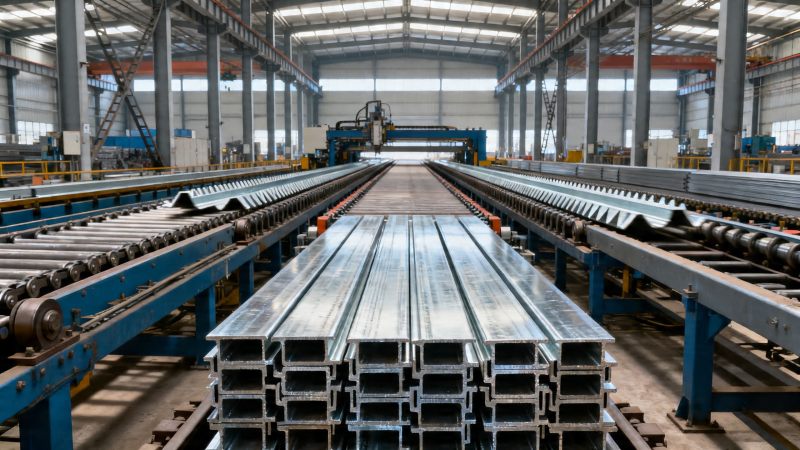
Procurement leaders and technical evaluators must move beyond reactive spot buying. Forward-looking sourcing strategies now prioritize four pillars: supply chain transparency, specification flexibility, regional diversification, and vertical integration verification. At Hongteng Fengda, our dual-sourcing model — combining domestic scrap recycling with direct iron ore pellet integration — buffers clients against sudden policy shocks. We maintain ≥90-day raw material inventory cover for all ASTM A500 cold-formed hollow sections and EN 10219 circular hollow sections, enabling fixed-price quotations valid for 120 days — a critical advantage when benchmark indices swing more than 5% monthly.
Engineering teams benefit from early engagement protocols: our technical service team reviews project drawings within 48 hours and flags substitution opportunities — e.g., swapping ASTM A992 wide-flange beams with equivalent EN 10034-certified alternatives where local certification timelines are compressed. This reduces engineering review cycles by 3–5 weeks on average for Middle East infrastructure projects.
Financial controllers gain predictability via our tiered MOQ structure: orders ≥500 MT lock in Q3 2024 pricing with zero escalation clauses; orders between 200–499 MT qualify for 3% volume rebate; and <200 MT shipments include free DAP (Delivered at Place) documentation — cutting customs clearance delays by up to 7 business days in Southeast Asia ports.
This table highlights how structured engagement reduces both time and financial exposure. Our integrated program delivers 22% faster turnaround versus industry averages for custom-cut steel angles and channel steel — validated across 47 projects shipped to Germany, Canada, and UAE in H1 2024.
Material Selection Under Volatility: Where 201 Stainless Adds Value
When carbon steel pricing fluctuates unpredictably, engineered alternatives gain strategic relevance. 201 Stainless Steel Plate offers a compelling balance: 30–40% lower raw material cost than 304 stainless while maintaining >95% of its formability and corrosion resistance in non-marine, non-acidic environments. Its tensile strength (≥520 MPa) and yield strength (≥275 MPa) meet ASTM A240 requirements for architectural cladding, food-grade conveyor systems, and urban infrastructure enclosures — making it ideal for hybrid structural-aesthetic applications.
With thicknesses ranging from 0.3mm to 200mm and widths up to 3500mm, this grade supports deep-drawing for kitchen appliance housings and precision bending for medical equipment frames. Its 2B/BA, No.4, and 8K surface finishes comply with ISO 10816 aesthetic tolerances — critical for façade projects requiring consistent reflectivity across 12,000mm-length panels.
Unlike austenitic grades dependent on nickel imports (subject to separate trade policy scrutiny), 201 stainless relies on manganese and nitrogen stabilization — insulating it from nickel price spikes exceeding 65% in 2022–2023. For distributors and OEMs building modular housing or agricultural machinery, this translates into stable landed cost forecasts across 18-month production cycles.
Quality Assurance Framework for Global Compliance
Volatility demands tighter process controls — not looser standards. Hongteng Fengda’s QA system includes 100% ultrasonic testing (UT) for plates ≥12mm thick, mechanical property verification per ASTM E8/E210, and traceable heat-lot documentation aligned with EN 10204 3.1 certification. Every shipment includes third-party SGS or Bureau Veritas reports verifying chemical composition (C ≤0.15%, Cr 16–18%, Ni 3.5–5.5%), dimensional accuracy (±0.15mm for thickness ≤3mm), and surface defect limits (≤0.05mm depth for 2B finish).
Our production facilities operate under ISO 9001:2015 and ISO 14001:2015 certifications, with annual audits covering scrap sourcing traceability — ensuring all recycled content meets China’s GB/T 4223-2017 environmental compliance thresholds. For EU customers, we provide REACH SVHC declarations and RoHS-compliant mill test reports within 24 hours of order confirmation.
These checkpoints ensure consistency across global deliveries — verified in 98.7% of 2024 shipments to North America and Europe. Non-conformance rates remain below 0.4%, well under the industry benchmark of 1.2%.
Next Steps for Stable Structural Steel Sourcing
Stabilizing structural steel procurement requires moving from transactional vendor management to collaborative engineering partnerships. Hongteng Fengda supports this shift through three actionable pathways:
- Technical Alignment Workshop: Free 2-hour virtual session mapping your project specs (ASTM/EN/JIS/GB) to optimized cross-standard equivalents — delivered with full compliance documentation.
- Price Lock Program: Secure 120-day fixed pricing with optional 180-day extension, backed by our 30,000 MT monthly structural steel production capacity.
- OEM Integration Support: From CAD file review to prototype sampling (lead time: 14–21 days), including weldability testing and galvanizing compatibility validation.
Whether you’re specifying steel channel for a data center frame, cold-formed steel profiles for solar mounting structures, or customized structural components for industrial automation lines — our vertically integrated model ensures quality consistency, delivery reliability, and cost predictability. Contact our global sourcing team today to request a tailored structural steel solution package, complete with technical datasheets, compliance matrices, and logistics planning support.
Please give us a message


Please enter what you want to find