Choosing the right Industrial Steel Beam specification is rarely a minor technical detail. It shapes structural safety, fabrication efficiency, procurement timing, and the total cost of correcting mistakes later. In steel-intensive projects, beam size, material grade, tolerances, and compliance standards work together, and weak control in any one area can raise project risk long before installation begins.
Why beam specifications matter beyond the drawing
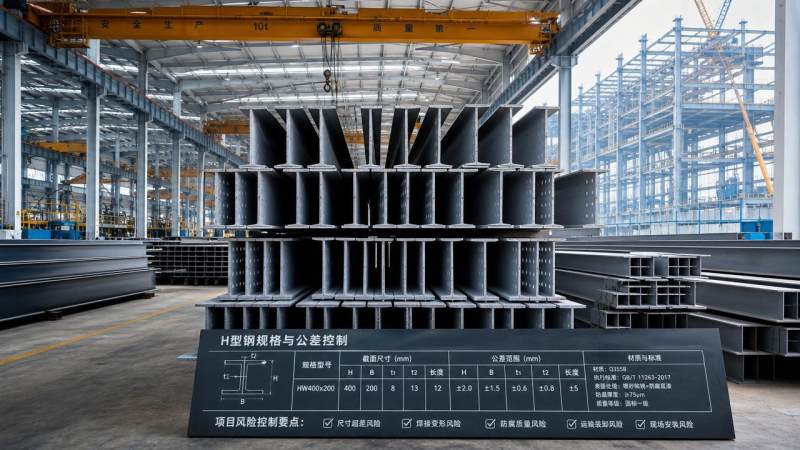
An Industrial Steel Beam is expected to carry load, keep alignment, and fit into a wider structural system. On paper, that sounds straightforward. In practice, the specification defines whether the beam can perform consistently across production, shipping, welding, and on-site assembly.
A beam that is technically available but poorly matched to the application can create avoidable costs. These costs often appear as rework, slower erection, rejected batches, design revision, or disputes over standard compliance.
That is why current sourcing decisions focus less on unit price alone and more on specification clarity. Reliable structural steel supply depends on how well the ordered beam matches real project loads, connection details, corrosion conditions, and regional code requirements.
The specifications that most often affect project risk
Not every data point carries the same risk weight. Some specifications directly influence whether the beam can be used without delay or redesign.
Section size and geometry
Depth, flange width, web thickness, and section shape determine load capacity and stiffness. If these values are not aligned with the structural calculation, the Industrial Steel Beam may meet a catalog description but fail project expectations.
Geometry also affects fabrication. Hole placement, coping, stiffener welding, and connection fit-up become harder when actual dimensions vary too much from the expected profile.
Steel grade and mechanical properties
Yield strength, tensile strength, and toughness influence both safety margin and weight efficiency. Higher grade material may reduce section size, but only if it remains suitable for welding, forming, and the governing design code.
Mechanical properties must be verified through material traceability and test documentation. A mismatch between ordered grade and delivered grade can disrupt approval and inspection.
Dimensional tolerances
Tolerance control is often underestimated. Camber, straightness, twist, length deviation, and flange squareness all influence installation speed. Even a strong beam becomes a project problem when it cannot align with plates, bolts, or adjacent members.
For export projects, tighter tolerance management often reduces hidden field costs more effectively than aggressive price negotiation.
Surface condition and corrosion protection
Storage environment, transport duration, and end-use exposure all matter. Bare beams may be acceptable for some indoor frames, while coastal, marine, or industrial environments need stronger corrosion planning.
This is also why related steel components deserve the same review. In projects using lifting, tensioning, or support systems, Galvanized Steel Wire Rope is often selected where corrosion class and coating thickness must match service conditions. Thin, medium, and thicker zinc coating groups support different exposure levels, which is a useful reminder that beam protection should also be specified by environment, not assumption.
Standards, certification, and the cost of ambiguity
A common source of risk is not poor material, but unclear standard alignment. ASTM, EN, JIS, and GB standards may describe similar products, yet their dimensional series, chemistry limits, and testing expectations can differ in ways that affect approval.
When an Industrial Steel Beam is specified only by general name, supply teams may receive quotations that are difficult to compare. Two offers can look similar, while using different standards, tolerances, or test scopes.
A clearer sourcing request usually includes the exact standard, grade, section designation, required inspection documents, and any project-specific fabrication or coating needs. This reduces the chance of commercial alignment hiding technical differences.
Where risk shows up in real projects
Industrial Steel Beam selection has different consequences depending on the project type. Warehouses, plants, equipment platforms, transport infrastructure, and manufacturing facilities do not all fail in the same way.
For long-span structures, stiffness and deflection control often become more important than simple strength. In heavy equipment support frames, connection detailing and fatigue resistance may deserve more attention. In export construction, packaging, length restrictions, and delivery sequence can affect project progress as much as the steel itself.
This is where supplier capability becomes part of the technical decision. A manufacturer with stable rolling or fabrication capacity, modern equipment, and documented quality control can reduce the gap between ordered and delivered condition.
Hongteng Fengda operates as a structural steel manufacturer and exporter from China, supplying steel beams, angle steel, channel steel, cold formed profiles, and customized structural components. For buyers working across ASTM, EN, JIS, and GB requirements, that combination matters because cross-standard familiarity helps avoid translation errors between design intent and production output.
How to evaluate a beam supplier with fewer blind spots
Price still matters, but risk usually sits in what the quotation does not explain. A more reliable evaluation looks at manufacturing discipline and communication quality together.
- Check whether the offered Industrial Steel Beam is tied to a named standard, exact grade, and measurable tolerance range.
- Review mill test certificates and ask whether traceability remains intact through processing, cutting, or fabrication.
- Confirm lead time against actual production capacity, not only trading availability.
- Ask how non-conforming material is handled and documented.
- Compare packaging, marking, and shipment planning for export movement and site unloading.
In projects that combine beams with other load-bearing steel systems, consistency across product categories also matters. For example, if a site uses wire rope in cranes, elevators, marine handling, drilling, or foundation work, alignment in quality culture becomes visible across the supply package. Products such as Galvanized Steel Wire Rope, available in steel or stainless steel, with normal tensile strength from 1470Mpa to 1960Mpa and standards including ISO 9001, DIN, EIPS, and ABS, show how specification discipline extends beyond a single item.
Practical checks before placing the order
A good purchasing decision usually starts with a short internal checklist. It keeps commercial and technical teams aligned before the order reaches production.
Define the service condition clearly
State whether the beam is used indoors, outdoors, in corrosive air, near seawater, or under dynamic loading. Service condition changes material and protection requirements.
Match the beam to fabrication reality
If the Industrial Steel Beam will be drilled, welded, cut, or assembled into prefabricated modules, include those needs at quotation stage. Late changes usually increase scrap and delay.
Separate essential from optional requirements
Not every project needs the highest grade or the tightest tolerance. It is more useful to identify which requirements are structurally critical and which are commercial preferences.
Document the approval path
Clarify who reviews drawings, material certificates, and inspection reports. Approval bottlenecks often delay shipment more than production itself.
A more reliable way to move forward
The safest Industrial Steel Beam decision is not simply the strongest section or the lowest quote. It is the option with the clearest fit between design load, standard, tolerance, fabrication method, and delivery plan.
When specification discipline is combined with dependable manufacturing and export support, project risk becomes easier to control. That is especially valuable in cross-border steel sourcing, where a small mismatch in standard interpretation can become a large construction problem.
A useful next step is to review current beam requirements line by line, compare them against supplier documents, and identify where assumptions still exist. The more precise that review becomes, the more predictable cost, schedule, and structural performance will be.
Please give us a message


Please enter what you want to find