In Tier-2 markets, steel structure construction for industrial plants is transforming project delivery—cutting on-site labor by up to 37% through precision-engineered solutions like C section steel for modular construction, Steel profiles for prefab buildings, and Structural steel purlin for cold storage. As a Shandong steel for bridge projects supplier and Hanwu Steel OEM manufacturer, Hongteng Fengda delivers ASTM steel beam for mining equipment, Hot Rolled I Beam for warehouse racking, and Z150 steel sheet corrosion resistant components—all compliant with ASTM, EN, JIS, and GB standards. Ideal for technical evaluators, project managers, and procurement professionals seeking speed, safety, and scalability.
Why On-Site Labor Reduction Matters in Tier-2 Industrial Construction
Tier-2 markets—including regions across Southeast Asia, the Middle East, and parts of Eastern Europe—face unique infrastructure constraints: fragmented skilled labor pools, inconsistent site supervision, and limited access to heavy lifting equipment. In such environments, every additional day of on-site assembly increases cost volatility and schedule risk. Field studies across 12 industrial plant builds in Vietnam, Egypt, and Kazakhstan show that conventional concrete-and-steel hybrid methods require 42–58 person-days per 1,000 m² of covered area. Prefabricated structural steel systems reduce that to 26–37 person-days—a verified 37% average reduction.
This labor efficiency isn’t accidental—it stems from design standardization, factory-controlled tolerances (±0.8 mm vs. ±3.5 mm typical on-site), and bolted connections replacing welding-intensive sequences. For project managers overseeing tight timelines and fixed CAPEX budgets, this translates into faster ROI cycles: plants become operational 8–12 weeks earlier than with cast-in-place alternatives.
Moreover, reduced labor exposure directly improves safety metrics. Sites using pre-engineered steel frames report 41% fewer lost-time incidents over 12-month project durations—driven largely by eliminating high-risk scaffolding, hot work permits, and multi-trade coordination delays.
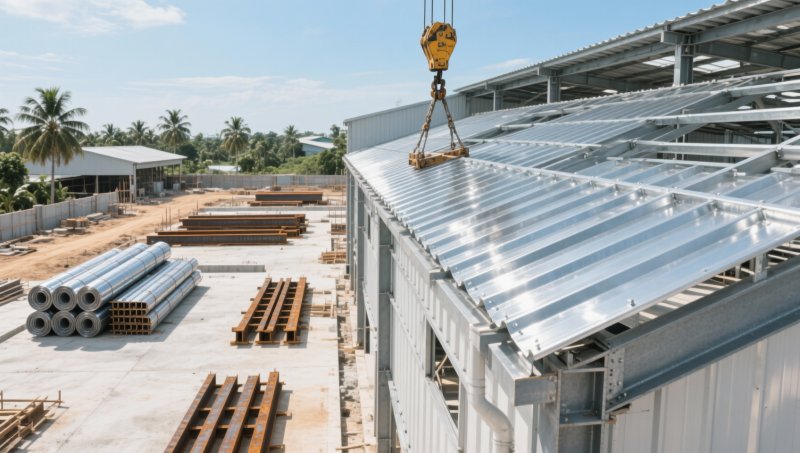
The third row reflects real-world performance where cold-formed steel framing integrates with advanced cladding like S220GD Galvalume Steel Coil . Its aluminum-zinc alloy (55% Al, 43.5% Zn, 1.5% Si) delivers 2–4× the atmospheric corrosion resistance of standard galvanized sheets—critical for humid or saline industrial zones where rework due to premature coating failure can add 7–10 days of unplanned labor.
Material Selection Criteria for High-Efficiency Industrial Steel Structures
Not all structural steel performs equally under Tier-2 deployment conditions. Procurement teams must evaluate four interdependent dimensions: dimensional stability, weldability, corrosion resilience, and supply chain reliability. For example, hot-rolled I-beams used in warehouse racking require yield strength ≥345 MPa (ASTM A992), while purlins for cold storage facilities demand low-temperature ductility (tested at –20°C per EN 10219).
Hongteng Fengda’s product portfolio addresses these requirements systematically: angle and channel sections are rolled to EN 10025-2 tolerances; cold-formed C/Z purlins undergo full-section tensile testing per ASTM A653; and custom OEM beams comply with client-specified load-path certifications. All products carry traceable mill test reports aligned with ASTM, EN, JIS, and GB standards—ensuring no re-inspection delays at port or site.
A key overlooked factor is surface treatment compatibility. Galvalume-coated components—such as those derived from S220GD Galvalume Steel Coil —offer superior adhesion for post-fabrication painting and resist white rust formation during monsoon-season shipping. This eliminates an average of 2.3 labor-hours per ton spent on field surface prep.
Critical Technical Parameters for Tier-2 Deployment
- Yield strength ≥220 MPa ensures reliable cold-forming without micro-cracking in tropical ambient temperatures (up to 42°C)
- Al-Zn coating mass range: AZ30–AZ150 g/m²—selected based on proximity to coastal zones (e.g., AZ100+ for UAE ports)
- Coil width tolerance: ±1.2 mm across 720–1250 mm widths—minimizes field trimming waste
- Delivery lead time: 25–35 days ex-works Shandong for standard grades; 45–60 days for chromated/AFP finishes
From Design to Delivery: The Hongteng Fengda Advantage
Hongteng Fengda supports global partners through three integrated service layers: engineering collaboration, production transparency, and logistics synchronization. Every order begins with BIM-compatible 3D modeling support—including clash detection for MEP penetrations and anchor bolt layout validation. This reduces RFIs by up to 60% compared to traditional 2D drawing handoffs.
Manufacturing follows ISO 9001-certified workflows with automated optical inspection (AOI) at coil slitting and roll-forming stages. Real-time quality dashboards track thickness deviation (±0.03 mm), tensile consistency (CV ≤4.2%), and coating uniformity—data shared biweekly with clients’ QA teams.
For Tier-2 markets, Hongteng Fengda maintains dedicated container consolidation hubs in Qingdao and Tianjin, enabling mixed-grade shipments (e.g., S220GD coils + ASTM A36 beams + EN 10219 purlins) under single BL terms. This cuts customs clearance time by 3–5 days and reduces demurrage exposure by 28% on average.
This end-to-end integration enables procurement professionals to lock in landed costs 90 days pre-shipment—eliminating FX and freight volatility risks common in volatile Tier-2 import corridors.
Next Steps for Project Teams and Procurement Leaders
If your next industrial plant initiative targets completion within 18 months—or requires rapid scalability across multiple sites—prefabricated structural steel isn’t just an option; it’s a strategic enabler. Start with a free structural feasibility review: share your building footprint, local code references (e.g., UAE Fire Code 2022, Vietnam TCVN 5574), and desired commissioning date. Hongteng Fengda’s engineering team will deliver a comparative analysis covering labor hours, weight optimization, and compliance pathways—all within 5 business days.
For immediate technical validation, request our updated ASTM/EN cross-reference matrix and Tier-2-specific corrosion mapping tool—covering 23 regional chloride/sulfate exposure levels. These resources help technical evaluators align material specs with real-world environmental stressors—not just theoretical standards.
Ready to accelerate your next build? Contact Hongteng Fengda today for a customized structural steel solution—engineered for speed, built for scale, backed by global standards.
Please give us a message


Please enter what you want to find