For quality control and safety managers, retaining wall performance is not just a design issue—it directly affects excavation stability, worker safety, schedule certainty, and compliance risk. Steel sheet piles for retaining walls offer a proven way to strengthen temporary and permanent earth retention systems while reducing site hazards caused by soil movement, water pressure, and inconsistent material quality. By choosing accurately manufactured, standards-compliant sheet piles from a reliable structural steel supplier, project teams can improve installation control, minimize rework, and build safer, more predictable construction environments.
On congested jobsites, a retaining wall failure can stop excavation within minutes, expose workers to collapse risk, and trigger costly corrective work. The right steel system helps convert uncertain ground behavior into a controlled construction sequence.
For buyers, inspectors, and safety teams, the question is not only whether a wall can stand. It is whether every delivered pile, interlock, length, grade, and coating supports predictable installation and verifiable compliance.
Why steel sheet piles reduce retaining wall risk on active sites
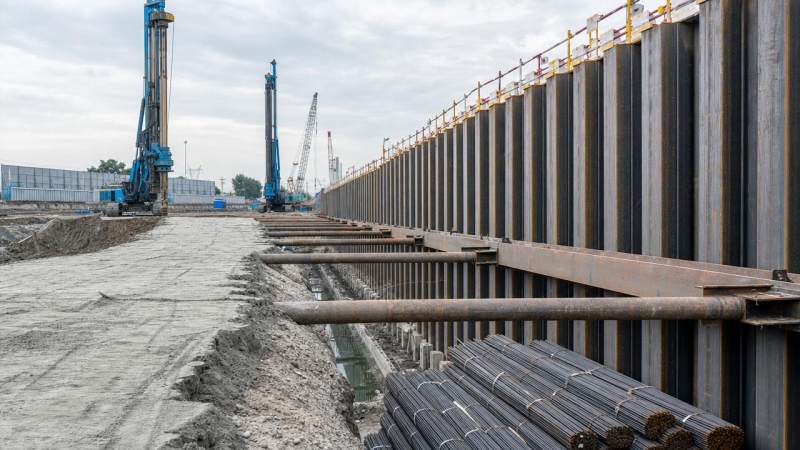
Steel sheet piles for retaining walls create a continuous barrier by connecting individual sections through interlocks. This gives the wall stiffness, alignment control, and resistance against soil and water pressure.
Compared with many cast-in-place solutions, sheet piles can be installed in a shorter sequence, often with fewer wet processes and less waiting time. That matters when excavation depth changes daily.
Key hazards controlled by a continuous steel barrier
Most excavation incidents are linked to a few predictable hazards: lateral soil movement, groundwater inflow, vibration exposure, over-excavation, and poor sequencing. Steel piles help teams manage these risks in measurable ways.
- Soil movement is restrained by interlocked sections that transfer lateral load along the wall line.
- Water seepage is reduced when interlocks are correctly engaged and sealing measures are specified.
- Excavation access improves because sheet piles require a narrow footprint along the boundary.
- Temporary works become easier to inspect through visible alignment, head level, and bracing points.
For safety managers, these controls are practical because they can be checked in 3 stages: before driving, during installation, and before each excavation lift.
Temporary and permanent retaining applications
Steel sheet piles for retaining walls are used in basement excavation, waterfront works, bridge abutments, cofferdams, utility trenches, flood protection, and industrial foundation projects.
For temporary works, extraction and reuse may reduce material waste across multiple projects. For permanent walls, coating, corrosion allowance, and design life become more important.
Typical site conditions where sheet piles add value
They are especially useful when excavation boundaries are close to roads, neighboring structures, pipelines, or existing foundations. In these cases, 10–30 mm of unexpected ground movement may be significant.
When groundwater is present, a properly installed retaining wall also helps reduce pumping demand and improves working conditions for welding, cutting, inspection, and reinforcement activities.
Quality control checkpoints that matter before installation
Quality control starts before materials arrive on site. Steel grade, section geometry, interlock condition, straightness, length tolerance, and mill documentation all influence retaining wall performance.
A practical inspection plan should identify 6 checkpoints: specification review, document verification, dimensional inspection, surface assessment, interlock trial fit, and installation feedback from the driving crew.
The following table summarizes common control points for steel sheet piles for retaining walls and how they support safer field execution.
The strongest conclusion from these checks is simple: dimensional accuracy and interlock integrity directly affect installation control. A low-price pile with inconsistent geometry can become expensive within one shift.
Documentation and traceability
Safety managers should request mill certificates, heat number traceability, packing lists, and standard references before unloading. These documents shorten approval cycles and help resolve claims quickly.
Hongteng Fengda supplies structural steel products and customized components under major standards including ASTM, EN, JIS, and GB. This supports buyers who need consistent paperwork across multiple regions.
Related steel components in braced retaining systems
Retaining walls often need walers, struts, tie rods, or tubular bracing. In these assemblies, compatible steel quality is as important as the sheet pile itself.
For projects requiring structural tubular members, Tube Carbon Steel can be specified in grades such as S355JRH, S355J0H, S355J2H, S275J0H, and S355K2H.
Available options include seamless sizes from 1/4 inch to 36 inches, welded tubes from 21.3 mm to 3620 mm, and lengths typically from 3 to 12 meters.
With good welding performance, toughness, plasticity, and corrosion resistance, these carbon steel tubes can support bracing, lifting machinery, pipeline engineering, and general mechanical structures around retaining works.
How correct specification improves safety and schedule certainty
A retaining wall specification should connect engineering intent with procurement reality. If section modulus, pile length, coating, and tolerances are unclear, the site team inherits avoidable risk.
Steel sheet piles for retaining walls are normally selected by soil profile, excavation depth, groundwater level, surcharge load, driving method, and expected service period.
Four decisions that shape wall reliability
- Confirm the design load case, including active earth pressure, water pressure, and nearby surcharge.
- Select pile length with sufficient embedment, often reviewed in 0.5 m or 1 m increments.
- Match section stiffness to allowable deflection, especially near existing utilities or foundations.
- Define corrosion protection for marine, chemical, or permanent exposure conditions.
These 4 decisions should be locked before purchase. Late changes after fabrication may require rework, special transport planning, or additional splice welding on site.
Installation method and equipment compatibility
The installation method should be reviewed with soil conditions. Vibratory hammers are common in granular soils, while pressing systems may be preferred near vibration-sensitive buildings.
In dense layers, pre-drilling, jetting, or impact assistance may be considered. The decision should account for noise limits, access width, crane capacity, and daily production targets.
Tolerance control during driving
A typical site control plan records pile number, driving depth, verticality, refusal conditions, interlock issues, and head level. Records should be updated at least once per shift.
Small deviations should not be ignored. A 1:100 verticality issue can accumulate across a long wall and reduce interlock engagement or create difficult corner closures.
Procurement criteria for safety-focused buyers
For quality control personnel, procurement is not only a commercial step. It is the first safety barrier before excavation, lifting, welding, and groundwater control begin.
A reliable structural steel supplier should provide stable production capacity, clear inspection procedures, export packaging, and practical communication before shipment.
The table below helps compare supplier capabilities when sourcing steel sheet piles for retaining walls for international projects.
The key purchasing lesson is that supplier evaluation should include technical risk, not only unit price. A delayed shipment or tolerance problem can affect cranes, crews, and permits.
Why manufacturer coordination matters
Hongteng Fengda is a structural steel manufacturer and exporter from China serving construction, industrial, and manufacturing projects across North America, Europe, the Middle East, and Southeast Asia.
The company supplies angle steel, channel steel, steel beams, cold formed steel profiles, and customized structural steel components for buyers needing standard specifications or OEM solutions.
For retaining wall projects, this broader structural steel capability is useful because sheet piles rarely work alone. Brackets, beams, frames, and temporary supports often require coordinated sourcing.
Commercial details that should be clarified early
Before ordering, teams should confirm 5 items: quantity, pile length, steel grade, coating requirement, and delivery sequence. These basics prevent many avoidable site interruptions.
For overseas projects, document preparation should start at least 1–2 weeks before shipment where possible, especially when third-party inspection or special customs paperwork is required.
Implementation practices for safer retaining wall execution
Even well-made steel sheet piles for retaining walls can underperform if unloading, storage, lifting, or installation is poorly managed. Site controls should be simple and repeatable.
A practical execution plan divides the work into 5 phases: delivery inspection, storage, setting-out, driving, and excavation monitoring. Each phase needs a responsible person.
Delivery and storage controls
Unload bundles on level ground, keep identification marks visible, and avoid dragging interlocks across abrasive surfaces. Damaged interlocks should be flagged before they reach the driving line.
If storage exceeds 30 days in wet conditions, inspect corrosion, coating damage, and blocking stability. Simple weekly checks can prevent handling accidents and material mix-ups.
Driving sequence and excavation monitoring
Install guide frames where alignment is critical, especially near corners, utilities, or long straight runs. A guide can reduce correction work during the first several piles.
Excavation should follow the approved sequence, usually in controlled lifts rather than deep one-time cuts. Bracing or tiebacks must be installed before unsupported height becomes excessive.
Inspection frequency during active excavation
Safety managers should inspect the wall at the start of each shift, after heavy rain, after equipment impact, and whenever unusual seepage or deflection is observed.
Monitoring points may include wall head movement, ground cracking, water inflow, brace connection condition, and access edge protection. Findings should be recorded with time and location.
Common mistakes that increase retaining wall exposure
Many failures are not caused by a single dramatic error. They develop from small omissions in specification, inspection, communication, or temporary works sequencing.
Steel sheet piles for retaining walls perform best when the design team, supplier, contractor, and safety manager share the same assumptions before work starts.
Mistake 1: buying without confirming ground and water conditions
A pile section suitable for dry shallow excavation may not be suitable for deep cuts with groundwater. Soil report review should precede final procurement.
Mistake 2: treating interlocks as a minor detail
Interlocks are central to wall continuity. Bent or contaminated joints can create leakage, driving resistance, and reduced system behavior under lateral load.
Mistake 3: separating price from installation cost
A small material saving can be lost quickly if the crew spends 2–3 extra shifts correcting alignment, cutting piles, or handling documentation issues.
Mistake 4: delaying supplier communication
Late clarification of length, coating, or packing requirements can affect production planning. Early technical communication helps keep lead time realistic and measurable.
Building a safer procurement and installation strategy
For quality control and safety teams, the best strategy is to connect material control with site execution. Steel sheet piles for retaining walls should be selected, inspected, and installed as one risk-control system.
Start with clear design requirements, verify standards compliance, inspect critical dimensions, protect interlocks during handling, and monitor the wall throughout excavation. These steps reduce uncertainty at every stage.
Hongteng Fengda supports global buyers with structural steel manufacturing, export experience, customized solutions, and dependable quality control. The goal is to help partners reduce sourcing risk, control cost, and complete projects efficiently.
If your project involves retaining walls, braced excavation, waterfront structures, or customized steel components, contact Hongteng Fengda to discuss specifications, documentation, delivery planning, and a practical solution for your site.
Please give us a message


Please enter what you want to find