For business decision-makers, line efficiency is more than a production metric—it directly affects cost control, delivery performance, and competitiveness. In steel-related supply chains, metal packaging equipment plays a direct role in throughput, product protection, labor use, and shipment consistency. When packaging systems match production rhythm, operations become more stable. When they do not, bottlenecks spread across cutting, stacking, bundling, storage, and dispatch.
Understanding the role of metal packaging equipment in steel operations
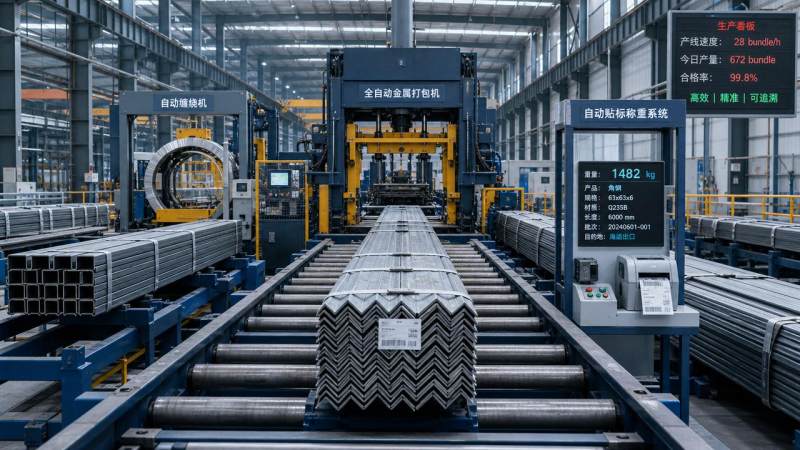
Metal packaging equipment includes strapping machines, wrapping systems, palletizing units, weighing devices, labeling stations, and automated conveying equipment. In steel processing, these systems secure finished products for storage, inland transport, and export movement.
For structural steel products, packaging is not a final cosmetic step. It is an operational control point. It influences handling speed, crane availability, forklift cycles, bundle integrity, and loading sequence accuracy.
A line may produce angle steel, channel steel, beams, or cold formed profiles efficiently. Yet poor packaging flow can still reduce total output. That is why metal packaging equipment should be evaluated as part of the full production line.
Why line efficiency depends on packaging performance
Line efficiency reflects how smoothly material moves from fabrication to shipment. In steel manufacturing, heavy products, long lengths, and mixed specifications increase handling complexity. Packaging equipment reduces that complexity when properly selected and integrated.
The impact of metal packaging equipment on efficiency usually appears in five areas:
- Faster bundle formation and unitizing
- Lower manual handling time
- Reduced product damage during movement
- Better traceability and shipment accuracy
- More predictable loading and dispatch scheduling
Without reliable metal packaging equipment, finished steel often waits in staging areas. This creates congestion, raises touch frequency, and weakens delivery performance. Over time, hidden packaging delays can become a major operational cost.
Industry signals shaping packaging decisions
Steel exporters and project suppliers face rising expectations for packaging consistency. Buyers increasingly value secure loads, clear identification, and fewer receiving issues. This is especially important for international shipments and mixed-item project orders.
These factors explain why metal packaging equipment is now viewed as a capacity enabler, not only a support function. In modern steel operations, packaging quality and packaging speed both influence commercial performance.
How metal packaging equipment improves throughput and handling flow
The first efficiency gain comes from cycle time reduction. Automated strapping and wrapping shorten the time between final inspection and warehouse entry. This allows production lines to release finished steel faster and maintain cleaner work areas.
The second gain comes from better material control. Long steel sections can shift, scratch, or deform when packed inconsistently. Standardized packaging reduces rework, improves stackability, and supports safer lifting.
The third gain is data visibility. Modern metal packaging equipment can connect weight checks, labels, bundle counts, and batch records. That supports faster loading confirmation and fewer shipment disputes.
In related industrial applications, durable metal-based materials are also selected for filtration, screening, and protective uses. For example, Stainless Steel Welded Mesh is used in filters, sieve systems, chemical processing, mining, architecture, and residences.
Available in SS 201, 304, 304L, 316, 316L, and 430, it offers resistance to rust, corrosion, acid, alkali, heat, and chemicals. With mesh ranges from 2 to 635 mesh and roll width up to 240 inches, it fits demanding industrial environments.
This matters because steel packaging lines often serve broader industrial supply chains. Materials that perform reliably in harsh handling and processing conditions reinforce the same operational goal: stable flow with fewer interruptions.
Business value for structural steel manufacturers and exporters
For a structural steel manufacturer and exporter, packaging efficiency affects more than internal productivity. It also shapes freight utilization, customer acceptance, and project delivery coordination across markets.
When metal packaging equipment performs well, several business benefits become measurable:
- Lower labor dependency in repetitive packaging tasks
- Fewer damaged bundles during container loading and unloading
- Better lead time control for export schedules
- Improved warehouse organization and stock identification
- Reduced sourcing risk through consistent shipment presentation
Companies supplying ASTM, EN, JIS, and GB compliant steel products need packaging systems that support the same level of consistency. A strong product standard can lose value if packaging creates confusion, loss, or delay at destination.
For export-oriented operations, metal packaging equipment also helps maintain dependable lead times. Stable packaging flow means fewer last-minute loading adjustments, fewer missing labels, and fewer mismatched bundles.
Typical steel packaging scenarios and efficiency priorities
Different product forms require different packaging priorities. The best metal packaging equipment setup depends on product geometry, shipment volume, transport mode, and storage duration.
This classification shows that metal packaging equipment should not be selected only by speed. It should also match loading logic, product risk, and downstream handling requirements.
Practical considerations when evaluating equipment
A useful evaluation begins with line balance. If packaging capacity is lower than fabrication output, inventory will accumulate. If packaging is much faster than upstream processes, equipment may sit idle without delivering real value.
Key points to review include:
- Bundle size range and product length compatibility
- Integration with conveyors, scales, and label systems
- Strap material suitability for heavy steel loads
- Maintenance access and spare part availability
- Operator safety and manual intervention frequency
- Export packaging requirements for destination markets
It is also important to track performance after installation. Useful indicators include packaging cycle time, unplanned stoppage, bundle rejection rate, loading delay, and packaging material consumption per ton.
These measurements help confirm whether metal packaging equipment is improving total line efficiency or simply moving bottlenecks to another area.
Implementation guidance for stronger operational results
A practical implementation plan usually starts with mapping the current end-of-line process. That means reviewing waiting points, labor movement, forklift travel, mislabel incidents, and packaging-related damage records.
Next, define the target state clearly. The goal may be higher throughput, lower damage, shorter dispatch time, or better packaging consistency for export steel products. Clear targets improve equipment selection and layout decisions.
Pilot testing is valuable when product mix is complex. Steel operations with multiple profile types benefit from confirming bundle stability, label readability, and handling safety before full-scale rollout.
Training should not be limited to operators. Warehouse, quality, and shipping teams should understand how the packaging sequence supports line efficiency. Cross-functional use reduces avoidable interruptions.
Moving from packaging cost to packaging advantage
Metal packaging equipment has a direct and measurable influence on line efficiency in the steel industry. It affects throughput, material handling, product protection, shipment accuracy, and delivery reliability across domestic and export operations.
For structural steel supply, efficient packaging supports stable production capacity, consistent quality, and dependable lead times. These factors are essential for reducing sourcing risk and helping projects move forward without unnecessary delay.
The next step is to assess packaging as part of the full production system. Review current bottlenecks, compare equipment fit against actual product flow, and prioritize solutions that improve both operational control and shipping performance.
Please give us a message


Please enter what you want to find